Jesus is the Good Shepherd

Homily for 4th Sunday of Easter
April 21-22, 2018
Sacred Heart, EGF: 5:00 PM
Holy Trinity, Tabor: 8:00 AM; St. Francis of Assisi, Fisher: 10:00 AM

Focus:              Jesus is the Good Shepherd.
Function:        Let him shepherd you.
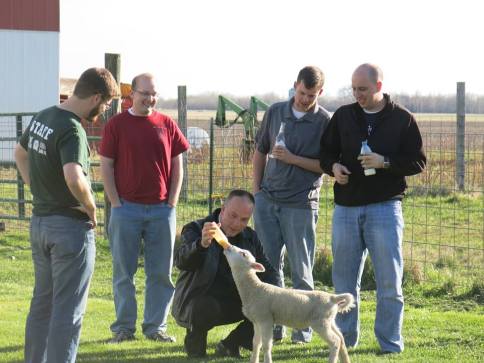

Fr. Peter the Good Shepherd

Some friends at Mom and Dad’s farm on the weekend of my diaconate ordination in 2016.  Fr. Peter is a veteran priest, 3 of us are rookie priests, and 1 will be ordained this summer.

Thank God that Jesus is a Good Shepherd, because I know how much I am prone to wander…


As the Good Shepherd, Jesus leads me to green pastures, he shows me where to drink from the waters of salvation, he feeds me with the Bread of Life and the Cup of Salvation…

And as the sheep, I walk away, focused more on myself than on him. I choose to wallow in the muck of my sins, I wander away, off on my own path, rather than walking in the way he has pointed out to me.

And when I do that, when I sin, he calls me back. He never abandons me.  He comes looking for me.  He beckons.  He calls out to me.  He invites me to “turn around” and to repent, to call out to him even as he calls out to me so that he can find me, pick me up, put me on his shoulders, and bring me back.  He reminds me that I can’t do it without him, that I am dependent on him, that I need him.  But he also reminds me that that’s OK, because he is there for me.  He is my Shepherd.

Jesus is the Good Shepherd. I am the sheep.  To be a good disciple is to be a good sheep – a sheep who gets distracted and wander from time to time, certainly; but also a sheep who knows the One to whom he belongs.  I am to be a sheep who knows the heart of His Shepherd.

The heart of my Shepherd is a heart of love, a heart that listens, a heart that calls me, that protects me, that leads me, that feeds me. The heart of my Shepherd knows the heart of his sheep.  The heart of my Shepherd lays down his life for his sheep.

And, brothers and sisters, he invites us to do the same.

The Good Shepherd first invites us to follow him as his sheep, then as we mature he invites us to become shepherds for others.

He calls us to do this as husbands and fathers, and wives and mothers, who introduce their children to the Good Shepherd.

He calls us to do this as priests who stand in the person of Christ, who make Christ present in a parish through the celebration of the sacraments and in the preaching of His Word…

He calls us to do this as monks and nuns, as brothers and sisters, who by the radical yet joyful laying down of their lives give us an example of faith and sacrifice to imitate as they devote their lives to leading others to the Good Shepherd.

Today is World Day of Prayer for Vocations.

Today, the Church asks us to pray particularly for an increase in vocations to the priesthood and the religious life. Pope Francis has asked every Christian in the world to spend some time today praying for vocations to the priesthood and the religious life.

The Good Shepherd speaks into the hearts of the children and young adults in our midst. Today is a day to remember that as they grow and mature, their vocation will be revealed to them, if they learn to listen for it, if we pray for them, and if we promote an environment where that vocation is encouraged to grow and flourish, an environment where it will not suffocate from fear or lack of encouragement.

Our diocese needs priests. When was the last time you told a young man that you think he’d be a good priest and why?  Our future shepherds are among us.  Christ does not leave his Church without shepherds.  They just need us to shepherd them as they grow and discover this call.

We can shepherd others only if we ourselves know and strive to follow the Good Shepherd. If we don’t know the voice of the Good Shepherd in our own lives, if we don’t try to listen and to follow the voice of the Good Shepherd in our own lives, then we become a hireling and not a shepherd.

St. Gregory the Great said this:
Whether a man be a shepherd or a hireling, cannot be told for certain, except in a time of trial. In tranquil times, the hireling generally stands watch like the shepherd.  But when the wolf comes, then everyone shows with what spirit he stood watch over the flock.

The shepherd is the one who has learned to lay down his life for the sheep…

The shepherd is the one who loves with a sacrificial type of love…

Jesus Christ is the Good Shepherd precisely because he is also the Lamb of God, the Lamb of God who offered himself upon the altar of the Cross in order to take away the sins of the world.

Blessed indeed are we who are called to the supper of the Lamb.
 

The Wounds of Christ are what God uses to Heal our Wounds

Homily for Divine Mercy Sunday (B)
April 8, 2018
Sacred Heart, EGF – 7:30, 9:00, 10:30

Focus:              The wounds of Christ are what God uses to heal our wounds.
Function:        Show him your wounds.


DivineMercyPostcardHe showed them his hands and his side.
He showed them his wounds.

His body, risen and glorified, still bore the scars, the gashes, and the holes from the nails that held him to the cross. It still bore the mark of the soldier’s spear that was thrust through his most Sacred Heart.

Thomas, put your finger here and see my hands, and bring your hand and put it into my side.

You need to see my wounds? I not only show them to you, I let you experience them.

He showed them his wounds.

The wounds of Christ are what God uses to heal our wounds.

The wounds of Christ remind us of the price he paid for our redemption.

The wounds of his hands, which bled…his hands, through which the blood of Christ pours over your baptized soul, when a priest, acting in the very person of Christ, raises the same wounded hand of Christ over your head and pronounces those sacred words: I absolve you…

The wounds of Christ, especially the wound in his side, the wound of his Sacred Heart, pierced for our offenses so that his Precious Blood could gush forth like a raging torrent, washing over our sins, forgiving and healing them, restoring the life we had lost. It was through the wound in his side that his Precious Blood poured forth, the blood that prefigures the Eucharist, the same Blood from his Sacred Heart that pours forth from his side and into the Chalice in this celebration of the Eucharist.

The wounds of his side, through which the water which prefigures baptism and the gift of the Holy Spirit surges forth, the true stream that flows out of the Temple of his Body onto a dry and weary land, giving new birth, new life, to those who drink from this living stream in the fountain of baptism…

He showed them his wounds…

The wounds of Christ are what God uses to heal the wounds of sin.

The wounds of Christ are what God uses to heal our wounds.

Today is Divine Mercy Sunday.

Today we celebrate the mercy of God. The mercy of God is manifested in the wounds of his Son, in the wounds He bore for us.

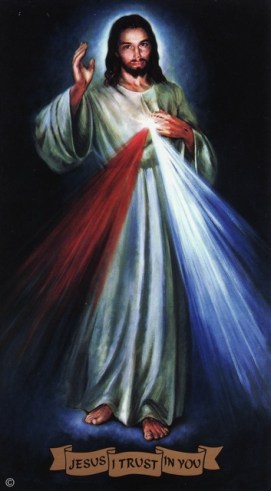
This is a special feast day for our parish in particular. We are the community of Sacred Heart, and today we are reminded that His Sacred Heart was pierced.  Blood and water flowed forth, as we see in the image that Sr. Faustina left us.

I am speaking, of course, of the image of Divine Mercy.

This image is in our church, it is in the most appropriate place in our church. It is in the confessional.

The image shows Jesus looking at you, one hand raised in blessing, the other pointing to the wound in his side…his wounded heart, through which 2 rays shine forth onto you…2 rays representing the water and the blood that flowed from his side. Jesus Christ came in water and in blood.

He came in water to give you new birth.

He came in blood to nourish you with his flesh for the life of the world.

He came to manifest the mercy of God. He came to give us an image of Divine Mercy.

Mercy. Misericordia.  The Latin word means “a suffering heart”.  A heart that is wounded by the suffering of another.

My brothers and sisters, if you ever doubt the words of Christ, you need only to look to and to experience his wounds. If you doubt his words, believe his wounds.  The caption under the image of divine mercy reads, “Jesus, I trust in you.”  Look at the crucifix and see what he endured for you, for love of you.  His heart suffered for your sins.  His heart was wounded by your sins in order to absolve you of your sins.  Look at the mark on his side, see that his heart was pierced for you, and believe in the Mercy of God.  Trust in the mercy of God.  Look at the wound of his side, and cry out in faith with Thomas: My Lord and My God! Jesus, I trust in you!

The wounds of Christ are what God uses to heal our wounds.

He shows us his wounds so that we will show him our wounds.

He shows us his wounds so that we will trust him with our wounds.

The place where we trust him with our wounds is in the confessional. Whose sins you forgive are forgiven them. Whose sins you retain are retained.

God takes away our sins, but he doesn’t take away our wounds. They still remain, just like Christ’s wounds remain.  But he heals them.  He glorifies them, just as Christ’s wounds were glorified.  He leaves the scars to remind us of what he has done for us.

The scars remind us of his Divine Mercy.

His glorified wounds remind us that his mercy continues to gush forth from them, even today. They remind us that his mercy endures forever.

It is Far Easier to Admire Jesus on the Cross than it is to Carry the Cross

Good Friday Homily
March 30, 2018
Sacred Heart, EGF – 3 PM

Focus:             It is far easier to admire Jesus on the Cross than it is to carry the Cross..
Function:       Carry the Cross.


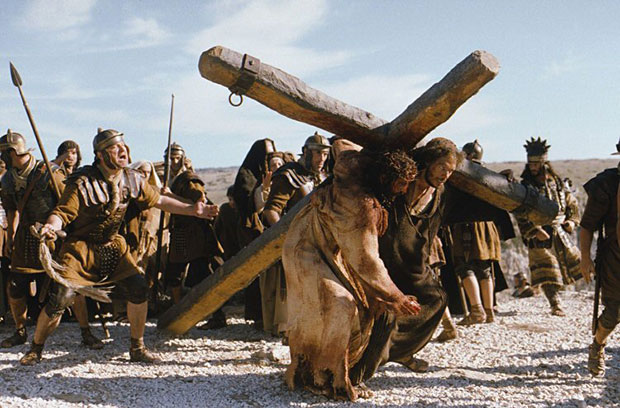
simon and jesus

It is far easier to admire Jesus on the Cross than it is to carry the Cross.

Yesterday afternoon, I sat down in my comfortable chair in my room with a hot cup of coffee to think and pray about this homily. It was finally quiet…and I was ready to admire Jesus on the Cross in the hope that I’d be given an insight to share with you today.

I was mid-sip into my first sip of coffee when the phone rang.

It was a family friend. Her father-in-law was in the Emergency Room.  They were working on him.  Could I come?

The chaplain met me in the ER and brought me to him. The room was full of doctors and nurses as they performed CPR on him.  This was Cal’s Good Friday.  He was experiencing the Cross.  I approached, absolved his sins, and anointed him.

I then joined the family as the doctor was updating them on his condition. There was nothing more they could do.  The doctor said we would be able to see him shortly, and left the room.  I began to pray with the family, that they would be given strength in this moment of grief.  I paused as the nurse came in to tell the family that they could see him.  My friend grasped my hand and said, “Please don’t leave us.”  It was indeed Cal’s Good Friday, but it was also his family’s Good Friday as, like Mary and the Beloved disciple, they stood at the foot of the Cross and watched their husband and father breathe his last.

It is one thing to admire Jesus on the Cross, it is something altogether different to experience the Cross.

It is far easier to admire Jesus on the Cross than it is carry the Cross.

I admire the Cross when I stand in awe of what he did.
I carry it when I allow his suffering to cause me to suffer.

I admire the Cross when, like Peter, I stand at a safe distance…when I stay outside of the courtyard of another’s pain and suffering.

I carry the Cross when, like the Beloved Disciple, I am willing to enter inside the courtyard of suffering, when I stand at the foot of the Cross and offer my presence to another in the midst of their suffering and despair, offering strength and hope by my simple presence, a presence that says “You are not alone. I care.  I love you.”

Brothers and sisters, today our Lord endures his agony. Good Friday is not only remembered, it is made present to us today.  We stand at the foot of Calvary.

As you approach the altar to venerate the Cross today, will you admire the Cross? Or will you carry it?

It’s the Most Wonderful Time of the Year

Homily for Ash Wednesday (Year B)
February 14, 2018
Holy Trinity, Tabor – 6:00 PM
St. Francis of Assisi, Fisher – 7:30 PM

Focus:                   It’s the most wonderful time of the year.
Function:             Live Lent intentionally.


Ash Wed

It’s the most wonderful time of the year!
There’ll be ashes and fasting
no chocolate nor candy
this Valentine’s Daaaaaaay!

Maybe I should stop before I’m thrown out…

After all, we’ve been fasting all day. No meat. We’re hungry. It’s cold and dark outside. It’s been a long day.

We’re all a little cranky.

This isn’t the time to be messing around. Let’s get on with it…Mass is going to take long enough since we all have to come forward twice…

Repent and believe in the Gospel.
Remember that you are dust, and unto dust you shall return.

Real cheerful.

It is certainly not the most wonderful time of the year. It’s a time of drudgery, a time of penance, a time where we wallow in our guilt, or at least pretend to wallow in our guilt. We take up arbitrary penances for the sake of punishing ourselves for no apparent reason other than it’s what we do. A little bit of Catholic guilt is supposed to be good for the soul.

We watch as our co-workers eat their juicy cheeseburgers and then listen as they taunt us for our outdated traditions.

Penance services abound and the priests are cranky because we’ll drive 20 minutes in the cold, dark night to offer our 8th penance service of the week and two people will show up.

The readings are woeful as they urge us to be reconciled to God, to turn away from our sins, to rend our hearts with repentance to such a degree that they are torn open and new spiritual muscle grows.

It’s Lent. The most wonderful time of the year…

Uh-huh. I don’t know about that.

It’s a time, alright, but what type of time is it? Our second reading gives us a clue:

Behold, now is a very acceptable time. Behold, now is the day of salvation.

The day of salvation…the day of salvation will be a wonderful time.

The day of salvation when there will be no more suffering, no more pain, where we will experience new life and live it to the full. And, of course, the Good News of the Gospel is that we can begin to live this new life here and now. Jesus promises us this new life here and now. The Kingdom is among us.

Behold, now is a very acceptable time! Behold, now is the day of salvation!

Behold, now is the time to begin anew. Now is the time of conversion, the time for new life, for new life in this life, for a life lived to the full, a resurrection experience in midst of the winter of life.

Now is the time of opportunity, the time of struggle, yes, but also a time of great growth that comes in the midst of the struggle. As they say, no pain, no gain…

Behold, now is a very acceptable time. Now is the day of salvation!

Now is the time to become who you were meant to be. Now is the time for breaking out of the humdrum and ho-hum of everyday life.

Now is the time to end the endless cycle of cynicism and mediocrity and lukewarm Christianity and to begin to live our faith, our life, our love of God and neighbor with boldness and with zeal. Now is the time to become fully alive in Christ. Now is the time for cold hearts to be rent open and set ablaze with Divine love.

Behold, now is a very acceptable time! Now is the day of salvation!

It’s the most wonderful time of the year if we seize it. It’s the most wonderful time of the year if we make the most of it.

It can indeed be the most wonderful time of the year if we make this Lent different from the Lents of the past…if we take up our Crosses daily and follow after him…if we direct all of our prayer, fasting, and almsgiving toward rending our hearts of the vices that plague them and replacing those vices with the opposing virtues.

What if?

What if we directed our Lenten sacrifices, our prayer, our fasting, and our almsgiving…what if we directed them toward tearing open our hardened hearts so that they could be emptied of pride or greed or anger or lust or sloth or gluttony or envy or…?

What if we emptied our hearts of these vices and sins and then filled them, filled them with the virtues of humility or generosity or patience or chastity or diligence or temperance or gratitude or…? What if we did that?

What if our penances were directed toward a purpose?

What if we actually expected to grow this Lent…to change this Lent?

What if we actually tried to seize this acceptable time, this day of salvation, this wonderful time of the year?

How would your life be different? Would it be better? Would it be more…wonderful?

Where is Jesus inviting you to grow? Where is Jesus calling you from death to life?

Pray for the grace to grow in that area. Pray for it on your knees, daily on your knees imploring the God of all grace for the grace that you need to seize this acceptable time. Pray for the grace to return to confession if it’s been years. Pray for the grace to rend your heart – to experience true contrition for your sins. Pray for God to do within you what you cannot do for yourself.

St. Augustine offers this piece of wisdom: Do you want your prayer to fly to God? Then give it the wings of fasting and almsgiving.

Prayer gives God permission to do his part. Fasting and almsgiving is your part.

Pray and then fast.

Fasting builds spiritual muscle. We have one will. If you strengthen your will in one area, it will strengthen it in other areas where you struggle. Giving up desserts strengthens your will in the area of food, and that carries over into the areas of anger, drink, and sex among others. But you have direct it toward that virtue you are trying to grow in.

Pray, fast, and give alms. Almsgiving atones for sins. It returns to God from a grateful heart, and in turn it makes the heart more grateful. It focuses your heart on others – it stretches your heart so that it can be filled with the love of God.

Pray, fast, and give alms – direct all of those practices toward the pursuit of a virtue that will bring about the day of salvation, a virtue that will give you the freedom to live more fully and to love more deeply.

Don’t put off to next year what you can do this year. Don’t waste your time – your acceptable time.

Behold, now is the acceptable time. Behold, now is the day of salvation.

It is, indeed, the most wonderful time of the year.

If You Wish, He Can Make You Clean

Homily for 6th Sunday in Ordinary Time (Year B)
February 11, 2018
St. Henry – 7:30 AM Eastern Time (St. Henry, Indiana)

Focus:              If you wish, he can make you clean.
Function:        Will it – be made clean!


Pope Francis

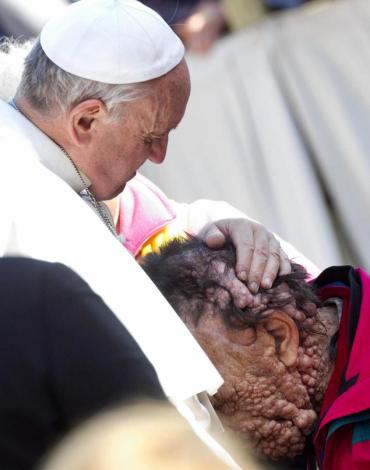
It was the most dreaded of all diseases.  Leprosy.  The word means “to peel off”.  For someone who lived during Old Testament times, leprosy was a living death.  One was separated from family and community.  They were kept outside, away, apart, at a safe distance, where they would not be able to infect others.

Today we meet one of them.  We meet a leper.  He comes to Jesus, kneels down, and begs him:
If you wish, you can make me clean.

Last week, I found myself in the chapel at Saint Meinrad for a time of Eucharistic adoration.  As I sat there, I was aware of my own need to go to confession.  It had only been two weeks and yet I knew that I needed to go.  There was something bothering me, sin weighing me down and getting in the way of my relationship with the Lord, something for which I knew that I needed to ask forgiveness…a leprosy of the heart that needed to be cured.

And I sat there.

I sat there knowing that I needed to go but not wanting to go.

Perhaps you can relate.

So often, we think of confession as our once/year obligation that needs to be met.  We hate to go.  We think we don’t need to go.  We’d rather pretend we’re fine.  I haven’t been that bad, after all.  I’m a good person. 

I’m sure the leper was a good person too.  He still needed to be healed of his leprosy.

All of us experience this leprosy of the heart in its different forms.  There’s the leprosy of a heart puffed up by pride, a heart embittered by anger, a heart soiled by lust or soured by envy.  There’s the leprosy of a heart weakened by gluttony, paralyzed by sloth, or poisoned by greed.

The leprosy of the heart plagues us.  Sometimes we are all too well aware of it and at other times we try to pretend it’s not there, but we can’t escape it.  We know it’s there.

And like the leper, we can’t cure it on our own.  Like the leper, we need to come to Jesus with a simple request:

If you wish, you can make me clean.

Sin makes us want to hide.  We try to hide it like Adam and Eve tried to hide themselves in the Garden.  But, like leprosy, sin doesn’t get better by hiding it.  We must bring it into the light.

The leper had to show himself to Jesus Christ, the true priest.  And, brothers and sisters, so must we.  We must show our leprosy to the priest.

Just as leprosy disfigured the body, so sin defaces the soul.

Just as leprosy caused pain, fear, and depression, so sin destroys interior peace, creates remorse and instills fear of judgement.

But the good news of the Gospel is that we are not to be left in our sins.  Our leprosy is not incurable.  It can be healed!  God sent his Son to die for us so that it could be healed!  God wants to dwell in our hearts – he wants to make his abode in our hearts, but he can do so only if we allow him to first heal our hearts so that they can become a fit dwelling place for him!

Jesus said, “Blessed are the pure of heart, for they shall see God.”  If we are to be pure of heart, we must allow him to clean the leprosy from our hearts.

We must approach him with the words of the leper on our lips:
If you wish, you can make me clean.

I finally got up.  I walked into the confessional and showed my leprosy to the Lord.  If you wish, you can make me clean. I allowed him, in the person of the priest, to stretch out his hand and to speak the words that he spoke to the leper in today’s Gospel: I do will it, be made clean

The invitation works both ways.  The leper said to Jesus, “If you wish, you can make me clean.”

Jesus extends the invitation to you: “If you wish, I can make you clean”

Do you will it?

Do you want to be made clean?

Lent begins this week.  Confession is a great way to start Lent.  Then, we can direct our prayer, fasting, and almsgiving toward overcoming a particular leprosy of the heart.  We can direct our prayer, fasting, and almsgiving to the Lord, asking him to heal us of the particular leprosy that we struggle with, be it pride, anger, greed, lust, envy, sloth, or gluttony.  We can focus our Lenten disciplines toward asking the Lord to overcome these vices in us and to help us to cultivate the opposite virtues.  He will do it.  He wishes to make you clean.

When the leper was healed, he couldn’t contain his joy.  His living death was over.  He experienced resurrection.  He experienced new life.  He experienced redemption.

If you wish, you can make me clean.

Jesus wills it.

Do you?


Your Hands are a Manger When They Receive the Body of Christ

Homily for Christmas (Year B)
December 24-25, 2017
4:30 PM – Holy Trinity, Tabor
10:00 PM – Sacred Heart, East Grand Forks
10:00 AM – St. Francis of Assisi, Fisher

Focus: Your hands are a manger when they receive the Body of Christ.
Function: Stand in awe of this mystery.


Original Sin and the Fall
• At the dawn of humanity…in the Garden of Eden: 2 trees – Tree of Knowledge of Good and Evil; Tree of Life
• Adam and Eve, in disobedience, reach out and take from the Tree of Knowledge. Sin and death enter the world. They have to leave the Garden lest they reach out and take from the Tree of Life as well.
• The Original Sin: Pride, Disobedience, Taking

2000 Years ago…on this night
• In the silence…in the stillness…without much fanfare…the Lord comes.
• God becomes man – one of us
• Divinity takes up humanity
• Adam and Eve took the fruit from the Tree of Knowledge
• God gives his son and places him in the womb of the Virgin Mary
o The Son – the fruit of not the Tree of Knowledge, but the Tree of Life
o “Blessed is the fruit of thy womb, Jesus”
o “I came that they might have life and have it to the full…” John 10:10
• Mary then places the God-man in the wood of the manger
o Wood comes from trees…

What is a manger, if not a feeding trough? A place where animals eat…
• Foreshadows the Eucharist.
• Jesus is the Bread of Life from the Tree of Life

At the Cross
• Christ, in obedience, allows men to place him back on the tree.
• Un-does the sin of Adam: Humility, Obedience, Giving
• Christ dies, rises, and ascends to the Father…

Now at this Mass
• Adam and Eve reached out and took the fruit from the Tree of Knowledge
• God gives his Son in the womb of the virgin Mary. She places him in the manger.
• He allows himself to be placed back on the Tree of the Cross…The Cross that stands revealed as the Tree of Life.
• And now at this Mass, he comes to us again and is placed back onto the wood of this altar. The Fruit from the Tree of Life, the Bread of Life, the Body of Christ, comes and is laid on the manger of this altar.
• The Body of Christ once again is placed on the manger of this altar…and then you come forward and receive him into the manger of your outstretched hands. And you take him into yourself, and he is born, tonight, not in Bethlehem like he was 2000 years ago, but he is born into your heart this Christmas night.
o May we never fail to stand in wonder and awe of so great a mystery!
o May we never spurn by indifference a love so fervent, a love so marvelous…but may we always stir up within our hearts a great love and fervor for the One who gave everything for us.

Our God has become so small that our very hands can hold him, like that manger in Bethlehem.
May we never fail to place ourselves within his hands, as he places himself within ours.

(Excerpts from Pope Benedict XVI, “The Blessing of Christmas”, Chapter 3: The Tree of Life)

God Preserved Mary from Original Sin for Our Sake

Homily for Solemnity of the Immaculate Conception (Year B)
Friday, December 8, 2017
6:00 PM – Saint Francis of Assisi, Fisher; 7:30 PM – Holy Trinity, Tabor

Focus:             God preserved Mary from original sin for our sake.
Function:        Let us remain free from sin for His sake.


Sing to the Lord a new song, for he has done marvelous deeds!

Brothers and sisters, on this holy night we celebrate one of the most marvelous deeds of our God. We celebrate the Solemnity of the Immaculate Conception…Mary conceived in her mother, Anne’s, womb…Mary conceived without original sin.

At the dawn of humanity, when Adam and Eve walked in the garden, they enjoyed friendship with God. Adam and Eve were created without original sin.  They were also created with free will.  They could choose.  They could choose because they were called to love.  One cannot love if one cannot choose because love is essentially a choice, a choice to will the good of the other.

We know how they chose.

The serpent approached Eve. “Did God really say that if you eat of the fruit of any tree in the garden, you would die?”

“No, we may eat of any of the trees in the garden, it is only the fruit from the tree in the middle of the garden that God said, ‘You shall not eat of it, lest you die.’

But the serpent said, “You surely will not die! No, you will become like God himself.”

Eve looked at the tree. She had a choice to make.  Would she choose to trust God, to obey God, to love God?  Or would she distrust, disobey, and choose for herself?

She chose.
She chose to commit the original sin.

Sin entered the world, and with sin, the effects of sin. Our freedom to choose God was now wounded.  We experienced the effects of sin in ourselves.  We do what we hate and we do not do what we want.

Sin entered the world, and with sin, death.

Eve became the mother of all of the living. But all of the living would eventually die.

But already, at that moment, before the apple core had hit the bushes, God had a plan. “I will put enmity between you and the woman, between your offspring and hers.”

In the fullness of time, God himself would become one of us. God would become man so that man might become God and live forever.  But to become one of us, he needed one of us.

He needed a mother.

He who could make all things from nothing would not remake his ruined creation without Mary.[i]

And so, in the fullness of time, he chose and prepared a worthy mother.

He chose Mary, a humble girl. He chose her, before the foundation of the world, to be holy and without blemish before him.

He chose her, and he preserved her. He preserved her from original sin.

He preserved her before he was born, suffered, died and rose.  He preserved her by the merits of his Passion before he underwent his Passion.

He preserved her, not for her own sake, but for ours.

We needed a redeemer who was both God and man:
Man, because man was the one who needed to pay the debt…
God, because only God was capable of paying the debt…

The Son already had a Father who was God.
What he needed was a mother who was human.

So much was riding on Mary’s cooperation with God’s plan to bring Jesus Christ our Redeemer into the world that he wanted to make sure she was fully free to choose.

God preserved Mary from original sin for our sake.
And Mary became the new Eve.
And, like Eve, she was presented with a choice.

But where Eve failed, Mary succeeded.
Where Eve distrusted, Mary trusted. “Behold, I am the handmaid of the Lord.”
Where Eve disobeyed, Mary obeyed. “Let it be done unto me according to your word.”

Mary undid what Eve had done.
God used the means of our Fall to redeem us.

Sing to the Lord a new song, for he has done marvelous deeds!

Jesus Christ is son of God and son of Mary. He is son of God in his divinity and son of Mary in his humanity.

And how great a redeemer we have! Christ died in his humanity to pay the debt for our sins, and in dying, he broke the prison bars of death and restored us to life.  He lives to restore us, even now, to the glory and freedom we experienced before the Fall!

God preserved Mary from original sin for our sake.
Let us who have been redeemed keep ourselves from sin for his sake.

Because of the Father’s love for us…
Because of Mary’s yes for us…
Because of the Son’s sacrifice for us…
We are able to be restored to our original freedom, to our original call.

Listen again to the words of Saint Paul:
Blessed be the God and Father of our Lord Jesus Christ, who has blessed us in Christ with every spiritual blessing in the heavens, as he chose us in him, before the foundation of the world, to be holy and without blemish before him.

Mary was preserved from original sin so that she might be worthy to bear the Lord in her body.
May we who have been redeemed by him keep ourselves from sin so that we might be worthy to bear the Lord in our bodies.

He dwelt in her. Now he comes to dwell in us.

Brothers and sisters, may we never take it for granted.

Like Mary, we have a high calling.
Like Mary, we have a choice.

May we, like Mary, choose Him.  May we choose to love.

May we who have been redeemed by him be quick to turn to him, to confess our sins, and to seek his mercy, so that like Mary, we might be made a worthy dwelling place for Christ.

Sing to the Lord a new song, for he has done marvelous deeds!

O Mary, conceived without sin, pray for us who have recourse to thee!


[i] St. Anselm.  Liturgy of the Hours, Office of Readings for the Solemnity of the Immaculate Conception.

Jesus Christ is King of the Universe

Homily for Christ the King (Year A)
November 25-26, 2017
St. Francis of Assisi, Fisher – 5:00 PM
Sacred Heart, EGF – 7:30 AM; Holy Trinity, Tabor: 10:00 AM

Focus:              Jesus Christ is King of the Universe.
Function:        Crown him the King of your universe.


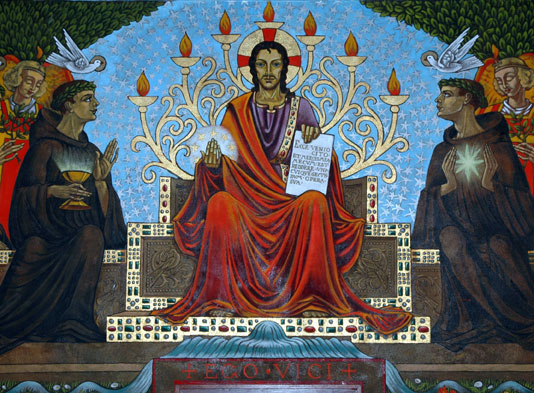
Christ on throne - Meinrad Chapter Room 1

Christ seated on his throne, ready to reward each who followed him faithfully.
Saint Meinrad Archabbey – Chapter Room
Ecce veni cito et merces mea mecum est reddere unicuique secundum opera sua. (Rev 22:12)
Behold I am coming soon. I bring with me the recompense I will give to each according to his deeds.

Inside every human heart, there is a kingdom.

This kingdom has great potential. It possesses unfathomable wealth.

This kingdom has an incredible intellect that can be used to accomplish marvelous things.

This kingdom has the power to dramatically influence the lives of others.

This kingdom can be at the service of others or it can be at the service of itself. It can be a wellspring of great good or a never-ending pit of evil.

It can be a kingdom of excellence or a kingdom of mediocrity.

Inside every human heart, there is a kingdom.
Inside every heart, a battle rages for this kingdom.

A battle rages for the kingship.

Every kingdom has a king.

Who will be the king of your kingdom?
Who sits upon the throne of your heart?

We’ve been hearing a lot about the Kingdom of God in these final days of Ordinary time.

The Kingdom of Heaven is like ten virgins who took their lamps and went out to meet the bridegroom… (MT 25:1-13, Nov 12).

The Kingdom of Heaven will be as when a man going on a journey called his servants and entrusted his possessions to them…to one he gave five talents, to another, two, and to a third, one. (MT 25:14-20, Nov 19).

The Kingdom of God cannot be observed, and no one will announce “Look, here it is” or “Look, there it is.” For behold, the Kingdom of God is among you. (LK 17:20-25, Nov 16).

Brothers and sisters, the Kingdom of God is here and now.
The kingdom of God is among us.
It is here.

It is here because Jesus is here.
He is here in the Eucharist.
He is here in the Body of Christ which is the community of the Church.

The Kingdom of God is here even though it may be difficult to see it at times.

We have to learn to look for it.

A few summers ago, I participated in a hospital chaplaincy program in the cities. I went to the hospital every morning and visited patients, and I was on-call several nights and weekends during the summer.  For someone who likes to be in control and to know what’s coming, it was an anxiety-provoking experience.

I found my refuge each day in a nearby parish which offered adoration and daily Mass at a time that allowed me to attend before going to the hospital each day.

At the start of the summer, I was very aware of receiving the Lord in the Eucharist and then bringing him with me, in the pyx of my heart, into the hospital each day. I trusted that, through me, he was present to the patients I encountered throughout the day.

That was true.

But it wasn’t until mid-summer that I realized something else.

I realized that I was beginning to see differently.

It was as if time slowed down. As I walked by someone in the hallway, I began to see them as Jesus would see them.  I saw them as a son or daughter of the Father.  I became less focused on myself and how I could minister to them and became more focused on them.  I began to see Jesus in them.  Jesus was not only in my heart from receiving the Eucharist that day, he was also within the sick people I met each day.

That changed everything. It changed how I interacted with them.

The Kingdom of God is among us.
We have to learn to see it.

It is ready for us, but we must be ready for it.

We must decide.
Each of us must decide.
You must decide.

Inside every human heart, there is a kingdom.
Every kingdom has a king.
You must decide who will be the king of the kingdom within your heart.

Jesus Christ is the rightful king. He is the one who created you, who redeemed you, and who loves you.  He went to the Cross for you.  You are made to live with him eternally.  You are his.

Is he yours?
Is he your king?

Jesus Christ is the King of the Universe. That is certain.  That is what we celebrate today.  One day he will return again.  He will return and he will sit upon his glorious throne, and all the nations will be assembled before him. And he will separate them one from another…

He will separate them.

He will separate those who have enthroned him as the King of their Hearts from those who have enthroned someone else.

Those who have him seated on the throne of their hearts will inherit the kingdom that has been prepared for them from the foundation of the world.

Those who have themselves seated on the throne of their hearts, those who find themselves sitting on his throne when he returns, will go off into the eternal fire.

Who sits on the throne of your heart?
Who is the king of your heart?

Is it Jesus? Or is it you?
Are you wearing his crown? Are you sitting in his chair?
Or are you serving the needs of His Kingdom?

How do you know?

Brothers and sisters, we know.

We know where we compromise.
We know where we cut corners.
We know where we are stingy, where we are selfish, where we choose ourselves over others.

We know.

Matthew 25 confronts us face-to-face today.

If you want to know whether Jesus Christ is the King of your Heart, here’s the test.

For I was hungry and you gave me food.
I was thirsty and you gave me drink.
A stranger and you welcomed me.
Naked and you clothed me.
Ill and you cared for me.
In prison and you visited me. 

If Jesus Christ is the King of your heart, you see differently.

You see as he sees.
You see others as he sees them.
You see with tenderness.
You recognize others who have him as their king, and you serve him by serving them.
You recognize within others the battle raging for the kingdom…even if they don’t recognize it themselves.

The Kingdom of God is about changing how we see. It is about conversion of heart.  It is about changing from being “me-focused” to being God-focused, and since God cares for all, that leads us to care for all.

Jesus Christ is the King of the Universe.
Is he the King of your universe?

The Saints are Among Us

Homily for All Saints Day (Year A)
November 1, 2017
Good Samaritan, EGF – 10:00 AM
Holy Trinity, Tabor – 6:00 PM; St. Francis of Assisi, Fisher – 7:30 PM

Focus:              The saints are among us.
Function:         Today we celebrate them.


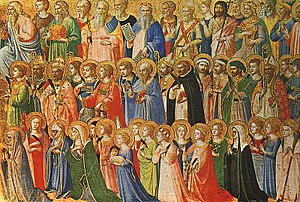
all saints

They are here. They are among us.
The saints.
They are living among us.
They are here.

St. Irenaeus once said that “the glory of God is man fully alive.” The saints were fully alive when they lived on earth and they are fully alive in Heaven.  If the glory of God is man fully alive, and the saints are fully alive, then the Glory of God is in his saints.

And, brothers and sisters, the Glory of God is blinding today. It is a blinding light.

They are here.
They are all around us.

We are surrounded by so great a cloud of witnesses…
A cloud of intercessors.

We are surrounded by men and women who sought to love God with the totality of their being – with all they’ve got – with all they have and are.

We are surrounded by men and women who allowed their lives to be transformed, who allowed their hearts to be converted, by the grace of God and the light of the Gospel.

We are surrounded by them.
We are.
They are here.
They are among us.

We are surrounded by men and women whose example of life inspires us and spurs us on to pursue a more abundant life. A life lived not for ourselves but for others.  A life poured out in service.  A life lived for God.

Today we celebrate them. We celebrate all saints.

Saints both known and unknown.
Saints from every time and place.

kolbe

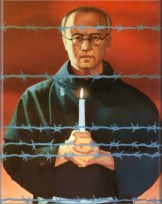
Saints like Maximilian Kolbe, a man who stepped forward and offered his life in exchange for the life of Franciszek Gajowniczek, who had been sentenced to death in a starvation bunker in Auschwitz during World War II, a man whose last dying act was to raise his hand in blessing over the man who gave him his lethal injection.

Today we celebrate them. We celebrate all saints.

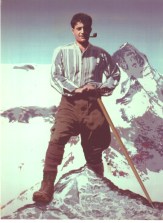
frassatiSaints like Pier Giorgio Frassati, still a blessed and not yet recognized as a saint, an Italian man who loved the Eucharist even more than he loved mountain climbing and smoking cigars, a man who died much too young at the age of 24 by contracting polio from a sick person he ministered to, a man whose last act on his deathbed was to scribble out a note to a friend telling him that the medicine in his coat pocket was to be delivered to a poor man who was unable to afford the medicine he needed.
Today we celebrate them. We celebrate all saints.

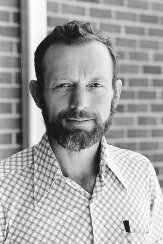
Stanley_RotherSaints like Stanley Rother, a farm boy from Oklahoma who became a priest of the Archdiocese of Oklahoma City who worked in the Missions in Guatemala, a man who refused to leave during the civil war when it became dangerous, stating “The shepherd cannot run at the first sign of danger.” Fr. Rother was true to his word and it cost him his life. He was beatified 2 months ago and became the first American-born martyr.

Today we celebrate them. We celebrate all saints.

Saints known and unknown.
Saints famous and obscure.
Saints recognized and unrecognized.

Saints like our parents and grandparents who, in simple and humble ways, went about the tasks of their daily lives with a charity, a joy, and a zeal for others that lifted others’ spirits, that let others know they were cared for, that they were loved, that they mattered.

Today we celebrate them. We celebrate all saints.

Saints like our friend who suffered greatly from this or that cancer, but never complained and seized the moment of each day, saints who turned their suffering into a sacrifice for the sake of the ones they loved, saints who lived each day to the fullest, saints who could see God’s grace present to them in the midst of the Cross they carried.

Today we celebrate them. We celebrate all saints.

Saints like firemen who rush into burning buildings to save others’ lives at the cost of their own.

Today we celebrate them. We celebrate all saints.

Saints known and unknown.
Saints canonized and not canonized.
Saints famous and obscure.

And, brothers and sisters, saints in heaven but also those saints who still walk among us.

Saints like our children and grandchildren who struggle to balance work and family life, who strive to teach their children about the Love of God in a culture that so often has forgotten about God.

Saints like the neighbor who has suffered so much loss in her life and yet still she presses on with courage and joy because she hopes in the promises of her loving God and longs to see his face.

Saints who volunteer their time to come and sit with us, to listen to our stories, saints who visit those in the nursing homes and hospitals, saints who visit those who are confined to their homes, saints who comfort us in our sadness and bathe the wounds that come from living with the compassion from their hearts.

Today we celebrate them.
Today we celebrate the heroic men and women of every time and place.
Today we celebrate all saints.

Today we honor them.
Today we thank them.
Today we ask them to continue to pray for us, so that where they have gone, we may one day follow.

They are here.
They are all around us.

They are the Glory of God.
And, brothers and sisters, the Glory of God is indeed blinding today!

Love God and Light a Fire for the Sake of His People

Homily for 30th Sunday in Ordinary Time (Year A)
October 29, 2017
Holy Trinity, Tabor – 8:00 AM; St. Francis of Assisi, Fisher – 10:00 AM

Focus:              God loves his people.
Function:         Love God and Light a Fire for the sake of his people.


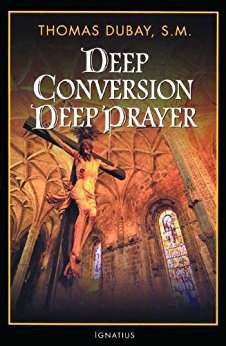
Recently, I have been reading a very good book by Fr. Thomas Dubay. The book is called Deep Conversion Deep Prayer.  The book is about how a deeper prayer life leads to deeper conversion, and how deeper conversion leads to a deeper prayer life.

At the beginning of the book, Fr. Dubay introduces us to Saint Bernard of Clairvaux, a man who lived in the 1100s. St. Bernard is a saintly hero of mine – I greatly admire him for his preaching ability.  When he was 20 years old, he entered a monastery, which is remarkable in itself.  What is extraordinary is that he brought 20 other young men with him.

Eventually Bernard was elected as the abbot of his monastery. In one of his conferences to his monks, he said this:

There are more people converted from mortal sin to grace, than there are religious people converted from good to better.

Fr. Dubay echoes this point, but he goes on further to state that this is true of people in all states of life. It is true of priests, married people, religious people, and single people.  It is true of all of us.

There are more people converted from mortal sin to grace, than there are religious people converted from good to better.

In other words, there are more people who give up serious alienation from God then there are people who give up small wrongs or willed venial sins. And there are even fewer who grow in heroic virtue and live as saints live.[i]

There are more people who go from bad to good than there are people who go from good to better and better to best.

There are more people who repent and believe in the Gospel than there are people who seek to love God with their whole mind, heart, soul, and strength and their neighbor as themselves.

People will give up serious sin but they will stop at pursuing holiness. They will work to overcome vice but they will stop a pursuing virtue.

There are more people converted from mortal sin to grace, than there are religious people converted from good to better.

Of course, we are called to more than simply giving up sin. We are called to love.  Sin stands in the way of our ability to love so we must give up sin.  But to merely give up sin without progressing in love is to give up on the journey after we’ve packed the car and pulled out of the driveway.

Brothers and sisters, we are called to more. We are called to so much more.

We are called to love.

We are called to love with a heroic love.

We are called to love the One who first loved us with a love so strong that it called us into our very existence. We are called to love Him with all that we have and are because He first loved us.

Can we do it?

We can, with God’s help. And what’s more, it’s what we’re called to.  It’s who we’re called to be.

You shall love the Lord, your God, with all your heart, with all your soul, and with all your mind. This is the greatest and first commandment.  The second is like it: You shall love your neighbor as yourself.  The whole law and the prophets depend on these two commandments.

Brothers and sisters, outside of the context of freeing us to love, the other commandments make no sense. We can fulfill the letter of the law when it comes to the other commandments but if our motivation is something other than to grow in our ability to love, then we are missing the mark.

In another place, Jesus said:

You have heard it said that You Shall Not Commit Adultery. But I say to you, whoever looks at another with lust has already committed adultery with her in his heart.

If we merely fulfill the letter of the law but miss the spirit of the law, we are missing the point. If we look at another lustfully but stop short of committing the act of adultery, we are missing the point.

We are called to more. We are called to so much more.  We are called to love.

The whole law and the prophets depend on these two commandments. To love God with everything we have, and to love our neighbor as ourselves.

How are you doing?

Do you love God with all you’ve got?

Where do you compromise?

Where do you make excuses to sin?

There are more people converted from mortal sin to grace, than there are religious people converted from good to better.

Where do you stop short of conversion?

John Henry Newman was an Anglican priest who lived in the 1800s. He converted to Catholicism and later became a cardinal.  Fr. Dubay noted that Newman made this observation:

[L]arge groups of people, even large groups of religiously-minded people, do not light fires. Throughout the Church’s twenty centuries of history, it is individuals who ignite the blazes…Government bodies, town hall meetings, boards of directors on occasion promote worthy projects and programs…but these groups seldom, if ever, do anything that looks like [a huge fire].  If the group is blessed to have a saint in its midst, something great may happen–unless the group manages to thwart even a saint with majority mediocrity.  It is men and women like Augustine, Chrysostom, Benedict, Bernard, Francis, Dominic, Catherine, Thomas, Ignatius, Teresa of Avila, John of the Cross, John Vianney and Therese of Lisieux who light fires.  The evidence is convincing.

The glories of Church history are chiefly the works of individuals who, themselves bursting with love and intimacy with the Trinity, spark others to imitate their burning love, their [greatness of soul] and their heroicity in all the virtues. At the same time it is their deep love intimacy with the Lord that is the taproot of their ability to heal human hurts.[ii]

Brothers and sisters, the Lord came to cast a fire on the earth. He came to ignite a fire – the fire of charity.  The fire has been lit.  Will you catch fire and illumine the darkness so that others will catch fire from you?  Will you help spread it?

Become who you were meant to be and you will set the world on fire.
Put the law of love into practice and you will set the world on fire.

The two great commandments go together. They cannot be separated.  Love of God with all you’ve got will lead to love of neighbor, because you cannot love God with all you’ve got without loving what God loves with all you’ve got.  And God infinitely loves you and the person sitting next to you.

October is Respect Life Month.
Today is Life and Dignity Sunday.

Today provides you with a small opportunity to take a step toward conversion. To take a step toward loving God and loving your neighbor.  Today provides you with an opportunity to be converted from good to better.


MCC
In your pews are cards to sign up for the Catholic Advocacy Network. This network is run by the Minnesota Catholic Conference of Bishops.  It provides a way for you to stay informed of current legislation of interest to Catholics in Minnesota – legislation that has the potential to help or harm your brothers and sisters right here at home.


You may be tempted to say, “I don’t care. I don’t need another email.  I don’t want to be involved.”

I would remind you of this. God cares.  And for that reason, so should you.  God loves you infinitely.  He loves your children infinitely.  He loves your neighbor infinitely.  And he calls you to love them as you love yourself.  Love doesn’t stand idly by.

You shall love the Lord, your God with all your heart, with all your soul, and with all your mind. This is the greatest and first commandment.  The second is like it: You shall love your neighbor as yourself.  The whole law and the prophets depend on these two commandments.

Take a step toward deeper conversion today.
Take a step toward becoming a saint.
Take a step toward loving more deeply.
Take a step toward setting the world on fire.


[i] Fr. Thomas Dubay, Deep Conversion Deep Prayer, p. 12.
[ii] Ibid., p. 74.