You Belong to God

Homily for 29th Sunday in Ordinary Time (Year A)
October 21-22, 2017
Sacred Heart, EGF – 5:00 PM
Holy Trinity, Tabor – 8:00 AM; St. Francis of Assisi, Fisher – 10:00 AM

Focus:               You Belong to God.
Function:         Give Yourself to God.


Repay to Caesar what belongs to Caesar, and repay to God what belongs to God.

What belonged to Caesar?

Matters of state.
Care for the population.
The taxes to be paid by the coin that bore his image.

What belongs to God?

Everything. All of creation.
Glory and Honor, according to the Psalm response for this Mass (Ps 96: “Give the Lord Glory and Honor”).
Most especially, the coin that bears his image.

What is this coin that bears the image of God?

You are.

In the beginning He created them, in the divine image he created them, male and female he created them.

You are made in the image and likeness of God.  Through your baptism, the likeness of God that had been lost through the original sin was restored to you.

You are made in the image and likeness of God.  You bear his image in the world.

Repay to God what belongs to God.

In other words, give yourself to him.

St. Irenaeus, an early Church Father, said this: The Glory of God is Man Fully Alive.
The responsorial psalm for this Mass exhorts us to Give the Lord Glory and Honor.
Jesus says to Repay to God what belongs to God.

So, if we are to repay to God what belongs to God, then we must become fully alive in Christ.  The disciple who is fully alive in Christ gives glory and honor to God.

The person who goes above and beyond,
who pursues excellence and virtue,
who pushes the limits of a charity which knows no limits,
who strives for greatness…
This person gives glory and honor to God.

The person who strives to love rather than to merely fulfill the requirements of the law,
to shoot for the stars rather than figure out the bare minimum to be done,
to sacrifice for the good of others instead of flying under the radar…
This person gives glory and honor to God.

The person who asks not “How hard do I have to work” but rather “What am I capable of?” This person gives glory and honor to God.

The person who seeks to love like Jesus loves,
setting their heart ablaze with the fire of a charity that cannot be contained more than they try to merely avoid sinning…
This person gives glory and honor to God.

We’ve all known people like this in our lives. We’ve experienced the Glory of God
in people who have inspired us, in disciples whose example, whose witness, whose often silent witness, calls and challenges us to be the best that we can be. They call the best out of us.  They inspire it out of us.

They don’t take the easy way out.
They challenge themselves.
They surround themselves with others whose witness challenges them.
They are willing to challenge others to be the best that they can be.
They live the truth of the Gospel without compromise.
They don’t complain.
They are joyful.
They don’t look to their own interests but look to the interests of others.
They love.

And the image of God can be seen clearly in them.

The image of God in them isn’t obscured by selfishness, covered over by negativity, or buried in the mire of vices and sins. Not that they don’t have sins and vices, but they constantly work to overcome them, picking themselves out of the gutter when they find themselves there and returning to the Lord in prayer and the sacraments so that he can polish them, making them shine as they bear his image ever more clearly to a world in need.

In a word, they give glory to God because they pursue one thing: holiness. They strive to be holy.  They abandon themselves to the God whose love is a living flame, and they allow his love to burn away the sins and vices that cover his image in them.  They look to Christ whose image they are to bear and they strive to conform their wills to His, to become an icon, an image, of Jesus Christ in the world.  They die to themselves and allow themselves to be transformed by Christ, to be transformed into another Christ.

CS Lewis described these people in his book Mere Christianity:

Already the new men are dotted here and there all over the earth. Some, as I have admitted, are still hardly recognizable: but others can be recognized. Every now and then one meets them. Their very voices and faces are different from ours: stronger, quieter, happier, more radiant. They begin where most of us leave off. They are, I say, recognizable; but you must know what to look for. They will not be very like the idea of ‘religious people’ which you have formed from your general reading. They do not draw attention to themselves. You tend to think that you are being kind to them when they are really being kind to you. They love you more than other men do, but they need you less. They will usually seem to have a lot of time: you will wonder where it comes from. When you have recognized one of them, you will recognize the next one much more easily. And I strongly suspect that they recognize one another immediately and infallibly, across every barrier of color, sex, class, age, and even of creeds. In that way, to become holy is rather like joining a secret society. To put it at the very lowest, it must be great fun.

Brothers and sisters, you are made in the image and likeness of God.
You bear his image.
You belong to him.

The Glory of God is man fully alive.

Become what you were meant to be.
Become fully alive in the Spirit and give yourself to Him.
Become fully alive in the Spirit by giving yourself to Him.

Give Him glory and honor.

Repay to God what belongs to God.

And at the end, on that day when Jesus looks at you and says “Show me the coin”, all will know to whom you belong because they will clearly see Whose Image you bear.
The Feast is Ready

Homily for 28th Sunday in Ordinary Time (Year A)
October 15, 2017
Sacred Heart, EGF – 7:30 AM; 9:00 AM; 10:30 AM

Focus:               The Feast is Ready.
Function:          Come Hungry.


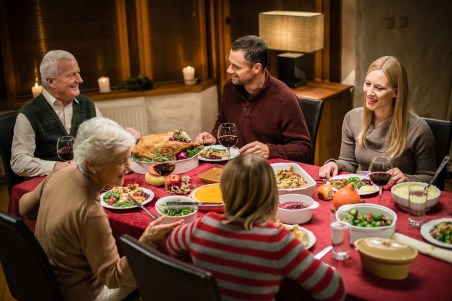
Thanksgiving dinner.jpgWhen I was in high school, I worked for a Kmart store. All of us were expected to work on Thanksgiving Day since it was such a big shopping day, but they would always try to schedule the shifts in such a way as to allow as many of us as possible to enjoy Thanksgiving Dinner with our families.

Still, no one cares for working on Thanksgiving. To make it more enjoyable and to create some excitement, the store always catered in an early Thanksgiving lunch.  Turkey, mashed potatoes and gravy, corn, cranberry…

When it was my turn for a break, I went back to the lounge and got a plate. I had been up early and was hungry.  It smelled so good!  I enjoyed lunch with some of my friends and then went back to work for another hour to finish my shift.

When I got home, the yard was filled with cars. I walked in the house and was greeted by my mom and dad, aunts, uncles and cousins.  They had been waiting for me.  We prayed and everyone started going through the line.  I hung toward the back.

“Matt, grab a plate!” my mom said.

This wasn’t going to go over well…

I had so filled myself with the catered meal at work that I had no appetite for the home-cooked feast that my mom had prepared…I’ll never forget how her face fell as she exclaimed: “I can’t believe you did that!”

Brothers and sisters, today’s readings remind us that the Lord has prepared a feast for us…an abundant feast of rich foods and choice wines. We are called to the supper of the Lamb.  Yet, so often, we fill ourselves with other foods and kill our appetite for the feast that the Lord has prepared.

We fill ourselves with the fast food of pleasure and instant gratification so that we no longer hunger for the banquet of Christ’s love.

But Christ calls us to something more.

Christ calls us to the Banquet.

And he calls us to go into the main roads and invite to the feast whomever we find. Bring them in so that they may feed on banquet that will satisfy every hunger of the human heart.

Some declined the invitation to the Wedding Feast. They declined it because weren’t hungry for it.  They had filled themselves with other things, things that seemed to satisfy but in the end would only leave them hungry again.

Others jumped at the invitation to the Feast and gladly accepted, but they took it for granted. They came to the Feast but they spurned the King by coming in unprepared.

They came to the feast but did not robe themselves with repentance.

They came to the feast but failed to clothe themselves with the garment of gratitude, the clothes of conversion, preferring instead the soiled clothes of an unmoved heart. They treated the special wedding feast as if it were a quick lunch break at a fast food restaurant, and they offended the king.

Brothers and sisters, the feast is ready.

The fatted calf has been killed.
Everything is ready.

Come to the feast.

Come to the feast and receive the food that satisfies the hungers of the heart.

Come to the feast and receive the Living Bread come down from Heaven – the bread that is the flesh for the life of the world.

Come to the feast and taste a wine that is rich and full-bodied, a foretaste and sample of the good wine we all hope to experience one day at the Wedding Feast of Heaven, a sober intoxication of the Spirit of God himself.

Come to the feast.

Come hungry.

This is why the Church requires us to fast an hour before receiving the Eucharist. We fast from the food that doesn’t satisfy in order to increase our desire for the food that ultimately satisfies…

The Bread of Life and the Chalice of Salvation…
A Body broken and Blood outpoured…

Come to the feast.

Come with your wedding garment, come clothed in the white garment that was given to you by the King at your baptism, the white garment that is the outward sign of your Christian dignity, the garment that you were urged to bring unstained into the wedding feast, a garment that so often gets soiled by the sin of our daily living but thanks be to God the garment that is also able to be washed white again by the Blood of the Lamb in the confessional.

This is why we are to confess any serious sins, any mortal sins, before we receive Holy Communion, so that we may enter the feast clothed in our wedding garment, so that we may partake of the banquet with hearts contrite and spirits humble.

God provides all that we need.

God is the one who provides the banquet.
God is the one who prepares the feast.
God is the one who provides the garment.

God is the one who has invited us, called us, chosen us.

Blessed are those who are called to the supper of the Lamb.

Brothers and sisters, everything is ready.
The invitation has been extended:
“Come to the feast.”
“Come hungry.”

Bear Fruit That Will Remain

Homily for 27th Sunday in Ordinary Time (Year A)
October 7-8, 2017
Sacred Heart, EGF – 5:00 PM
Holy Trinity, Tabor – 8:00 AM; St. Francis of Assisi, Fisher – 10:00 AM

Focus:             He has chosen you to bear fruit.
Function:       Bear fruit that will remain.


vineyard

We’ve been hearing a lot about vineyards over the past couple of weeks.

Two weeks ago, we heard the story of the landowner who went out at various hours of the day to hire laborers to work in his vineyard. He went out at 6:00, 9:00, noon, 3:00, and 5:00 and hired laborers to work in his vineyard. “Go into my vineyard”, he told them. He gave them what, in his eyes, was just, although the laborers who were hired early in the day did not feel it was fair, even though most of them received more than they could have hoped for.

Last week, we heard the story of the Father who told his two sons: “Go and work in my vineyard today.” One said “I will not” but changed his mind and went. The other said “Yes, sir” but did not go.

This week, we hear about more vineyards.

The first reading speaks of how the Lord worked hard to cultivate a vineyard that would bear abundant fruit, but despite all of his efforts, despite all of the grace that he poured upon it, it would not bear fruit. The only thing to be done was to tear it down. This vineyard was compared to the Israelite people – the people whom God had chosen, called out of slavery in Egypt, brought into the Promised Land, and worked countless signs and wonders in their presence so that they would trust Him. They didn’t. They constantly rebelled, they sinned, and they bore bad fruit.

The Gospel, like the first reading, speaks of how the Lord worked hard to cultivate a vineyard that would bear abundant fruit. This time, it does bear fruit, but the tenants in charge of it are greedy and won’t give the landowner the fruit. They work against the landowner. They rebel against him and even kill his son. They wouldn’t share the fruit that the vineyard bore. So the landowner took it away from them.

Brothers and sisters, throughout the pages of history, this story of the vineyard has repeated itself time and time again. The book is now opened to our page. We are given everything we need to bear abundant fruit. Christ calls us to bear abundant fruit.

I have chosen you from the world, says the Lord, to go and bear fruit that will remain.

He has chosen us to bear fruit, and he has equipped us to do so. He equips us with his grace. He gives us the gift of His Spirit, which we receive in Baptism and Confirmation. He calls us to use the gifts of the Holy Spirit to bear fruit.

Saint Paul’s letter to the Galatians tells us that the fruits of the Holy Spirit are love, joy, peace, patience, kindness, generosity, faithfulness, gentleness, and self-control.

If we are responding to the grace that God is pouring upon us at every moment, we will see these fruits abound in our lives. If we aren’t seeing these fruits, perhaps something in our spiritual lives needs to change.

Jesus said, By your fruits you will know them…Every sound tree bears good fruit, but the bad tree bears evil fruit… (MT 7:15-20).

Are you bearing good fruit?

Are you bearing the fruit of love,
love that is more than a feeling,
love that pours itself out in service to others?
If you aren’t experiencing this fruit, consider finding a way to serve others, to make a gift of yourself to others. Don’t just think about it, do it.  You say you don’t have time.  I say that if you make time you will find time, and you will find more than time, you will find love, joy, peace, and happiness…

Are you bearing the fruit of joy,
a joy that abides even amid the stresses that are part of daily living,
a joy that comes from knowing that you are a beloved son or daughter of the Father,
a joy that comes from knowing that your eternal inheritance is in Heaven?
If you aren’t experiencing this fruit, I encourage you to take up the practice of counting your blessings each day. See the gifts that God has given you and your heart will be filled with joy.

Are you bearing the fruit of peace,
a deep peace that is unshakeable even amid the waters of the most turbulent storm,
a peace that comes from spending time in the presence of the Lord?
If you lack peace in your life, consider spending one hour per week in Adoration of the Blessed Sacrament. Come any day during the week and sit before the Tabernacle, or come on Tuesday and gaze upon the Lord while he is enthroned upon this altar – the Lord who said to his apostles “Peace I leave you, my peace I give you.” I promise you it will bear the fruit of peace.

Are you bearing the fruit of patience, a willingness to bear the burdens of another, to put up with another’s foolishness because they are willing to put up with yours?

Is your life marked by the fruits of kindness and gentleness, fruits that grow in lives secure in the strength of their identity as one created, redeemed, and loved by God?

Is your life bearing the fruit of generosity? Would others say you are a generous person? If you want to grow in generosity, take a leap of faith a give heroically of your time, talent, or treasures. Commit to something even if you don’t feel you have the time or money to do so. Ask the Lord to provide for you. He will teach you dependence on him and your generosity will bear abundant fruit.

Is your life marked by the fruit of faithfulness? Do you keep your commitments to God and to the people in your life? If you want to grow in faithfulness, pick a target – an area where you want to be faithful – and ask someone to hold you accountable, to check-in from time to time and ask how you’re doing.

Is your life a life of self-control? Are you a man or woman of temperance, of moderation? If you want to grow in self-control in an area of your life, whether it be anger, food, drink, or sexuality, consider the practice of fasting from something. We have one will – when we deny ourselves in one area of our lives, that strengthens our will to be temperate in other areas of our life. Practice fasting in some area and you will find yourself bearing the fruit of self-control.

I have chosen you from the world, says the Lord, to go and bear fruit that will remain.

He has chosen you to bear fruit that will remain.
By your fruits, you will be known.

Are you bearing good fruit? Or do you need to make a change in your spiritual life?

He gives you all you need.
You are not alone in this.

He gives you the fruit of his very Body and Blood from this altar to strengthen you so that your life can bear abundant fruit.

Blessed are those who are called to the supper of the Lamb.

Today is the Day. Seize the Day.

Homily for 26th Sunday in Ordinary Time (Year A)
September 30 and October 1, 2017
Sacred Heart, EGF – 5:00 PM
Holy Trinity, Tabor – 8:00 AM; St. Francis of Assisi, Fisher: 10:00 AM

Focus:               Today is the day.
Function:         Seize the day!


cats in the cradle

Two sons.
One call.

Two answers.
Two responses.

Son, go out and work in my vineyard today.

“I don’t want to.”
“I do enough already.”
“I’m scared.”
“I have other things to do.”
“I’m too busy.”
“I don’t want to work that hard.”
“Someone else can do it, it’s not my job.”
“Other people can take care of it.”

Son, go out and work in my vineyard today.
I will not.

Two sons.
One call.

Two answers.
Two responses.

Son, go out and work in my vineyard today.

“Sure, Dad, right after this TV show is done.”
“I will Mom, just give me a minute.”
“I will as soon as things slow down at work.”

Son, go out and work in my vineyard today.
Yes, sir.

Brothers and sisters, like the two sons in today’s Gospel, we given the invitation every day to work in the vineyard. What is our response?

Is it the response of the first son, who said “No” but then changed his mind and went?
Or is it the response of the second son, who said “Yes” but never went?

The Lord gives us the invitation to follow him every day. The Lord cares about what we do with today’s invitation.  He’s not interested in what we did with yesterday’s invitation.  He’s interested in what we will do with today’s invitation.

When someone turns away from virtue to commit iniquity, and dies, it is because of the iniquity he committed that he must die.

It is because he gave up his opportunity today. He had the freedom that virtue gives – he had the good habits that he needed and he freely chose to turn away from them to sin.  He failed to seize the day.

But if he turns from the wickedness he has committed, he does what is right and just, he shall preserve his life; since he has turned away from all the sins he has committed.

It is because he worked to overcome his enslavement to sin. His freedom was lacking because of the vice that had him enslaved, and he freely chose to turn away from that sin.  He seized the day.

The Lord extends his invitation every day. He’s not interested in how we’ve responded to the invitation in the past.  He cares about today.

Today is the day.

Today is the day to pray.
Today is the day to serve.
Today is the day to turn off the TV and spend time with your family.
Today is the day to examine your conscience and make a decision to confess your sins if you’ve been putting it off.
Today is the day to make a decision to combat the vice you struggle with by cultivating the opposite virtue.
Today is the day to make a gift of yourself to others.
Today is the day to repent, to turn around, to make a radical change in your life.
Today is the day to not give in, to not give up. Today is the day to continue to seek His grace in times of temptation, to persevere in your pursuit of virtue.

Today is the day you’ve been given.

Today is the day.

Seize the day.

Do not put off until tomorrow what you can do today.
Delay not your conversion to the Lord, put it not off from day to day.

Yesterday is gone. Tomorrow is not yet here.
The only time we have is today. Make the most of it.

I’m reminded of the famous song by Harry Chapin:

My child arrived just the other day
He came to the world in the usual way
But there were planes to catch, and bills to pay
He learned to walk while I was away
And he was talking ‘fore I knew it, and as he grew
He’d say, I’m gonna be like you, dad
You know I’m gonna be like you

And the cat’s in the cradle and the silver spoon
Little boy blue and the man in the moon
When you coming home, dad?
I don’t know when
But we’ll get together then
You know we’ll have a good time then

My son turned ten just the other day
He said, thanks for the ball, dad, come on let’s play
Can you teach me to throw, I said, not today
I got a lot to do, he said, that’s okay
And he walked away, but his smile never dimmed
Said, I’m gonna be like him, yeah
You know I’m gonna be like him

Well, he came from college just the other day
So much like a man I just had to say
Son, I’m proud of you
Can you sit for a while?
He shook his head, and he said with a smile
What I’d really like, dad, is to borrow the car keys
See you later
Can I have them please?

I’ve long since retired and my son’s moved away
I called him up just the other day
I said, I’d like to see you if you don’t mind
He said, I’d love to, dad, if I could find the time
You see, my new job’s a hassle, and the kid’s got the flu
But it’s sure nice talking to you, dad
It’s been sure nice talking to you

And the cat’s in the cradle and the silver spoon
Little boy blue and the man in the moon
When you coming home, son?
I don’t know when
But we’ll get together then
You know we’ll have a good time then

The Lord continually calls us, he invites us, he urges us.

Go and work in my vineyard today.

TODAY, brothers and sisters, today.

Can you hear his call?

Today is the day.

Seize the day.

You Have to Know His Mercy to Show His Mercy

Homily for 24th Sunday in Ordinary Time (Year A)
September 17, 2017
St. Francis of Assisi, Fisher – 8:00 AM; Holy Trinity, Tabor – 10:00 AM

Focus:              You have to know His mercy to show His mercy.
Function:        Know His mercy.


pope francis confession

To the servant, mercy was shown.
But by him, it was not known.
And because it was not known
To another, it could not be shown.
And because it could not be shown
In the end, the only thing to be known
Was pain and torture, which was shown

The debt he owed was massive.

In the time of Jesus, the main currency was the denarii. A denarii was a day’s wage. If one worked six days a week and rested on the Sabbath, there would be 312 working days in a year, so a person could earn 312 denarii per year.

A talent was six thousand denarii. If one worked 312 days per year, every year, it would take him 19 years to bring in one talent. A working man of that time would bring in his first talent after working for half of his lifetime.

This servant owed a “myriad of talents.”

A myriad was ten thousand.

Sixty million days’ wages.

It would take him 5,000 lifetimes to earn the amount needed to cover his debt. And that was before he provided for the needs of his family.

He owed a massive debt that he had absolutely no hope of paying.

And payment day came.

Payment day came, and he pleaded with the Master, “Please, give me some time! Be patient with me and I will pay you back in full!”

Be patient with me?!

Five thousand lifetimes! The servant owed ten thousand talents. The most he could hope to pay back was two!

Yet, the master did something incredible. He forgave the entire debt.

To the servant, mercy was shown.
But by him, it was not known.

It was not known because he did not accept the forgiveness of the debt. The Master looked upon him with pity, but like so many of us, he didn’t want pity. He wanted to pay back what he owed even though it was impossible. He wanted to pull himself up by his bootstraps. He accepted not mercy but an extension on an unpayable loan.

Rather than looking with amazement and profound gratitude on the incredible gift he has just been given, he runs to the couch and digs through the cushions, looking for enough change to make the next payment on his mansion.

He spurns the gift of the Master.

He chokes the servant who owes him 100 denarii – a debt that can be repaid within the year – and demands that it be paid back in full immediately.

To the servant, mercy was shown.
But by him, it was not known
And because it was not known
To another, it could not be shown.
And because it could not be shown
In the end, the only thing to be known
Was pain and torture, which was shown

Brothers and sisters, like that servant, you and I owe a massive debt. It is a debt that we have no hope of repaying.

God has given us everything we have. He has given us life. He has given us our family and friends. He has given us our health. He has given us our skills, talents, food, water, and freedom. We can never repay him for what we have been given. All we have is gift.

In the words of Psalm 49:
For no man can buy his own ransom,
Or pay a price to God for his life.
The ransom of his soul is beyond him.
He cannot buy life without end,
Nor avoid coming to the grave.

In spite of the gift we have been given, we added to the debt we already owed God. We sinned against him. We spurned the gifts we’ve been given. With the first sin, death entered the world.

Paul tells us in the Letter to the Romans that:
The wages of sin is death (Romans 6:23a).

Death entered the world, and we owed a debt that could not be paid. But God himself paid it for us. He sent his Son in to the world to pay the debt that we ourselves could not pay. That’s the Good News of the Gospel!  Yes, the wages of sin is death, but that’s only the first half of the sentence.  The verse from Romans continues:

The wages of sin is death, but the free gift of God is eternal life in Christ Jesus our Lord (Romans 6:23).

Christ has set us free. Christ has paid the debt. It is a double gift. First, the gift of life and everything we have and are. Second, redemption of the gift which we spurned with our sins.

Do we accept the gift we’ve been given?

Do we accept the mercy offered by God every day?

Or, like the servant in today’s Gospel, do we spurn the gift, foolishly trying to pay back a debt that we are unable to repay, frantically trying to take care of it ourselves rather than accepting the gift we’ve been given?

All that God asks of us is to be merciful with each other as he has been merciful to us. But until we know the mercy that he has shown us, we will not be able to show it to others.

You have to know His mercy to show His mercy.

Do you know His mercy?

How long has it been since you’ve been to Confession?

You have to know His mercy to show His mercy.

Realize the magnitude of the gift that is offered to you, and accept it. Accept it, and you will be amazed how easy it becomes to forgive others their faults, when you realize how much you yourself have been forgiven.

To you, his servant, mercy is shown.
If by you, it could only be known…
To another, how easily it could be shown!
And if it could be shown
In the end, the only thing to be known
Is the gift of eternal life, which will be shown.


You Need a Watchman

Homily for 23rd Sunday in Ordinary Time (Year A)
September 9-10, 2017
Sacred Heart, EGF – 5:30 PM
St. Francis of Assisi, Fisher – 8:00 AM; Holy Trinity, Tabor – 10:00 AM

Focus:              You need a watchman.
Function:        Who’s your watchman?


spiritual-watchman

I have appointed you watchman for the house of Israel; when you hear me say anything, you shall warn them for me.

The watchman had a heavy responsibility. He was stationed on the highest part of a city to warn the citizens of an approaching enemy.  From his perspective, the watchman had a clearer view than others.  He could see what they could not see, and so it was his job to warn them of the danger that they could not see coming.

The capital sin is pride. Pride was the original sin that led Adam and Eve to eat the forbidden fruit.  They thought they could be like God himself.  They were wrong.  Pride is a blinding sin.  It causes us to fail to see the faults in ourselves – faults that others can clearly see.  And so, like the house of Israel, we need a watchman.

You need a watchman.

You need a watchman who will sound the alarm when he sees you walking into danger.

You need a watchman who will warn you when you veer off of the narrow path that leads to eternal life and begin to walk down the wide road that leads to destruction.

You need a watchman with the courage and the clarity of Paul Revere, a watchman who will not remain enclosed in the fortress of his own self-preservation, a watchman who will ride through the darkened streets of your conscience, shining the lantern of truth to enlighten your mind and heart to the approaching of the enemy that you cannot see.

Brothers and sisters, you need a watchman.

You need a watchman who will hold you accountable to living the Christian life.

You need a watchman with the courage to challenge you when you need to be challenged.

You need a watchman…in other words, you need a good friend. St. Basil the Great said it well: For in this way especially does a friend differ from a flatterer: the flatterer speaks to give pleasure, but the friend refrains from nothing, even that which causes pain.

You need a watchman.

Who is your watchman?

Do you have one?

Do you listen to him? Do you heed his warning?  Or do you deafen the ears of your heart to the cry of his voice?

In the Gospel, Jesus gives us the way in which we are to sound the alarm. He gives us the teaching on fraternal correction, on how to correct a brother or sister.  He shows us how to be a good watchman.

If your brother sins against you, go and tell him his fault between you and him alone. If he listens to you, you have won over your brother.

Being a watchman takes courage. If you really want to grow in the Christian life, choose someone you trust and share your heart with them.  Let them in on your struggles.  Ask them to hold you accountable.  Appoint him as your watchman, and watch your friendship deepen as you grown in holiness together.

Be a watchman for others. But know your motivation.  Your only motivation must be love. Love does no evil to the neighbor, hence, love is the fulfillment of the law. There is an easy way to check your motivation.  If you enjoy being a watchman for others and pointing out their faults, then your motivation is not love – it is pride – and you are not the right person to be their watchman.  If it pains you to think about telling another person about the danger you see them in, but it weighs heavily on your heart, then you are probably the right person to tell them.  Perhaps the Lord is appointing you as their watchman.  Tell them with love.  We always tell the truth with love.  Love wills the good of the other and requires sacrifice of us.  Tell them with love and leave the decision to them.  The watchman sounded the alarm but it was up to the citizens to act.

Brothers and sisters, you need a watchman. We are called to be watchmen for each other.

Who is your watchman?

Who are you watching out for?


God Gave You Everything You Have

Homily for 22nd Sunday in Ordinary Time (Year A)
September 3, 2017

Sacred Heart, EGF – 8:00 AM; 10:00 AM

Focus:        God gave you everything you have.
Function:  Give out of gratitude for what you’ve been given.


stewardshipEvery so often, it’s good for us to stop and take an inventory of what God has given us, as well as how we’re using what he’s given us.
And what has God given us?

He has given us everything.
He has given us life.
He has given us our families and friends.
He has given us gifts and talents.
He has given us time to develop and use those gifts and talents.
He has given us treasure.

Everything that we have is a gift from God. And the gifts we have been given are not for ourselves alone, but to be used in service to God and to others. They have been given to us so that we may give them away. They have been given to us to be used for building up the Kingdom.

Every so often, it’s good for a disciple to stop and take stock of his stewardship. Stewardship is a matter of the heart. A good steward realizes what he owns is not his own but has been put into his care by another. Everything we have is a gift. A good steward realizes this and gives back to God out of gratitude for what he has been given.

Stewardship is a matter of the heart. Test your heart. What’s your attitude toward your time, your talents, and your treasure? Do you find yourself saying “This is mine” or “this is owed to me”? Do you find yourself asking “What’s in it for me?”

Or do you find yourself asking “What can I give? What can I do?”

During my first year of seminary, a wise priest gave us some advice that has made this come alive for me. Seminarians don’t receive a pay check. They receive a small stipend but it doesn’t cover very much. However, at Christmas time, people are very generous. This priest warned us that it can be very easy to begin to “count on” what others would give us at Christmas time – to begin to feel entitled to it or as if it were owed to me. And that sense of entitlement is dangerous to our spiritual lives because it erodes the sense of the gift.

He suggested a simple practice to keep this in check. He suggested that each year, as Christmas approached, but before we received our first gift, to decide on a percentage that we would give away to charity. Since these were gifts, the percentage might be higher than normal – say 20 or 30 percent.

I took him up on this challenge during my first year in seminary. It revealed a lot about my heart.

The first thing that it revealed was how easy it is to feel entitled. The more that I received, the harder it was to give away a higher amount. I found myself wanting to reduce the percentage that I had committed to giving. After all, people had given this money to me. It was mine, and I should be able to do with it what I want…but of course therein lies the trap of entitlement…

The second thing that it revealed was how much I wanted to depend on myself rather than on God. The amount that I was giving away was significantly higher than my monthly stipend. Shouldn’t I be able to count on this money to provide for my needs throughout the year? Except, of course, that everything I had received was a gift in the truest sense of the word, over and above what I could have expected to receive. God was the one providing for my needs by of the generosity of his people. I wanted to depend on myself while in reality I was completely dependent on him.

The third thing it revealed was the magnitude of the gift, of what I’d been given. At first, I found myself focusing on the large sum that I was giving away. Over time, I found that what I was giving away made me more grateful for what I got to keep. The amount I was giving away made me more aware of how much people had given, of how generous they had been toward me. It increased my gratitude for what I’d been given. What was even more powerful was that often after I had made the donations to charity, more checks would come and they would cover a large amount of what I’d just given away. God would not be outdone in generosity.

Every so often, it’s good for us to stop and take stock of our stewardship. God has given you everything you have. What is the attitude of your heart regarding what God has given you?

God gives you 168 hours every week. How do you use the time you’ve been given?

How many hours do you use to visit others, to encourage others, to serve others, to edify others? How many hours do you give back to God in prayer and in service to the Church and your community? How many hours do you use developing the gifts, skills, and talents that you’ve been given?

How much time do you give the Lord each week?

God has given you unique gifts and talents. What talents has He given you? Have you discovered all of them yet? I bet that some of them are still hidden…

He has given the gift of music and art to inspire and to lift the soul to God.

He has given the gift of writing – the ability to twist a phrase and tell a story to teach important life lessons and to convert hearts.

He has given the gift of listening, of empathy, of being a good conversationalist or a great encourager and there are people who long for a word of hope, who long for another to hear them.  There are people who are homebound or in nursing homes who long for your company.

He has given the gift of athletic abilities that make us stand in wonder at what human beings are capable of.

He has given the gifts of carpentry, of woodworking, of being the handy-man who can fix anything.

Do you give your talents back to God by using them to glorify him? Do you use your God-given talents to build up the Church and the community around you? How much time to you give each week using your talents for the building up of the Kingdom?

Saint John Paul II once said that man…cannot fully find himself except through a sincere gift of himself (Gaudium et Spes, #24). God is love. The inner life of the Trinity is a continual outpouring of love – a complete and total gift of self. We are made in the image and likeness of this God. Our lives are meant to flourish in an outpouring of love. Love wills the good of another. Love builds up. One who loves makes a sincere gift of himself to another.

Brothers and sisters, every so often it’s good for us to stop and take stock of our stewardship. Here at Sacred Heart, we are celebrating September as stewardship month. We have been given this time to evaluate the state of our hearts when it comes to everything God has given us.

God gave you everything you have.
Give to him out of gratitude for everything He’s given to you.

Give to him out of gratitude even when it hurts and your life will become a living sacrifice acceptable to God. You will find that you have more than enough. Your gratitude for what you have will increase.

Peter tried to stop Jesus from giving everything he had for us because he was thinking like human beings do and not as God does. Let us learn from Peter’s mistake.

Jesus gave everything to redeem us.
He continues to give everything he has to us in this Eucharist.

Let us give to him out of gratitude for everything he’s given for us.

Peter Finds His Identity When He Acknowledges Christ’s Identity

Homily for 21st Sunday in Ordinary Time (Year A)
August 26-27, 2017
Sacred Heart, EGF – 5:30 PM
St. Francis of Assisi, Fisher – 8:00 AM; Holy Trinity, Tabor – 10:00 AM

Focus:              Peter finds his identity when he acknowledges Christ’s identity.
Function:         Acknowledge Christ as Lord.


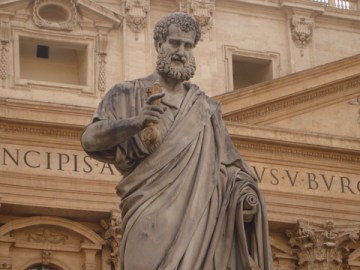
st peterThere is an existential question at the heart of today’s Gospel.

Who do you say that I am?

It is a very personal question, a risky question, a question that cuts to the heart of the matter. It is a question that gets down to the level of identity.

Who do you say that I am?

Simon tells Jesus who he is, and then Jesus, in turn, tells Simon who he is.
And who is he?
He is a fisherman.
He is the one who walked on the water.
He is one who saw Jesus in his glory on the mountain.
He is a sinner.

Who is he?
Blessed is he.
He is Simon, son of Jonah.
He is Peter, the rock, “Rocky”, the keeper of the keys, the Master of the House, the one on whom the Church will be built. 

Who do you say that I am?

You are Peter, and upon this rock I will build my Church, and the gates of the netherworld shall not prevail against it. I will give you the keys to the kingdom of heaven.

Simon acknowledges who Jesus is, and then Jesus tells Simon who he is. Simon discovers who he is when he discovers who Jesus is.

Peter finds his identity when he acknowledges Christ’s identity.

Brothers and sisters, the same is true for us. We find our identity when we find Christ’s identity. We discover who we are when we discover who He is. We find our very selves when we find him, the one through whom all things, including us, were made.

There is so much uncertainty in the world today. People are lost. They are like sheep without a shepherd, with no one to look to, with no one to lead them. So many people do not know who they are, or they have forgotten who they are. They do not know who they are because they do not know who Christ is. And they are searching, desperately searching, for someone to show them who they are. And in their searching, they look to people who seem confident in who they are, who seem to know who they are. Often they look to the wrong people, and what do we see? Panic. Unrest. Anxiety. Anarchy.

But, what if?
What if they were able to look to people who have been able to answer the question posed by Jesus in the Gospel today?
What if they were able to look to people who know who Jesus Christ is?
What if they were able to look to people who know what they are looking for because they have found it for themselves?

What if?
What if they were able to look to you or to me, and to hear us say:
You were made for more.
You were made for greatness.
You were made to be a saint.
You are a beloved son or daughter of the Father.
You are loved beyond measure.
You are the one for whom Christ gave everything to redeem.

What if?
What if they heard us say:
You are looking for love but you are bound by sin. The Church has the key to set you free. I know because I was there too. Here’s how I found freedom…

All of us look to someone else to find out who we are.  We see this especially with children.  Children look to their parents to find out who they are, and if they don’t find a strong example in their parents, they look to their peers.

All of us look to someone else to find out who we are.  Brothers and sisters, if you aren’t following Christ, I guarantee you that you are following someone or something.  And so my question for you this morning is this:

Who are you following?
Who do you look to?

Who do people say that you are?

There is nothing so compelling as when a disciple of Jesus speaks out of that place where Christ has been revealed to him, when he naturally shares his experience of a time when he encountered Christ in his life and how it changed him. Like Peter, we discover who we are when we discover who Christ is. And it changes everything. It changed Simon’s name to Peter and made him a firm foundation upon which the Church could be built. It changes us and gives us a firm conviction of who we are, a solid foundation on which we can build our lives.

Back to Saint Peter…

At the end of his life, Saint Peter’s gaze was so tightly fixed on the One he acclaimed as Lord that his identity was unshakeable – it was so unshakeable that he was able to bear being crucified upside down on a cross in the middle of a square in Rome.

He was crucified like his Lord. The great Rock of the Church seemed to crumble and fall. He was buried, and years passed. 2000 years passed.

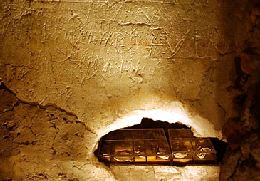
This past January, my classmates and I went on pilgrimage to Rome. While in Rome, we had the privilege of going on the Scavi tour – a tour of the excavations under St. Peter’s Basilica in Rome.

The Emperor Constantine built the original Saint Peter’s Basilica in the 4th century. Tradition holds that he built it over the grave of Saint Peter. It was a massive undertaking. Much of Vatican Hill was leveled in order to build the basilica exactly where Constantine wanted it built.

He could have built it in another spot nearby where the ground was already level, but he wanted it directly over the grave of Saint Peter. A chapel in the basilica was built over Peter’s grave, and the main altar in the basilica was erected one story above the chapel, directly over Peter’s grave.

In the 1500’s, Constantine’s basilica was taken down and the current Saint Peter’s Basilica was built. The main altar was kept in the same place because of the tradition that it was directly over the location of Saint Peter’s grave.

In the mid 1900’s, excavations under Saint Peter’s basilica began. Many tombs and graves were discovered, dating back to the 2nd and 3rd centuries. As our guide led us deeper and deeper underground, we eventually reached the spot where the bones of a man in his sixties were discovered – several stories directly under the main altar.

grafitti-wall-detail-wall-G-saint-peter-tomb-glass

We stared in wonder at a small piece of jawbone.

The jawbone that had partaken of the First Eucharist at the Last Supper…
The jawbone that had denied Christ, and then repented when the cock crowed…
The jawbone that confessed Christ as the Son of the living God…
The jaw of the one whom Christ declared as the Rock on whom He would build his Church…

Saint Peter’s Basilica – the Mother of all the Churches – is built on the Rock, and not only on the Rock of Saint Peter, but on his confession of faith and the jaw that proclaimed the answer to Christ’s question.

That same question comes down to you and to me today.

Who do you say that He is?

God Surpasses Every Human Desire

Homily for 20th Sunday in Ordinary Time (Year A)
August 19-20, 2017
Sacred Heart, EGF – 5:30 PM
St. Francis of Assisi, Fisher – 8:00 AM; Holy Trinity, Tabor – 10:00 AM

Focus:             God surpasses every human desire.
Function:        Increase your desire for God.


Steak on GrillIt had been a long day at work, and he was starving. But he was about to be filled. My uncle had bought a choice cut of meat, and the steak had been marinating for 24 hours. The charcoal was lit and the temperature was finally right. He threw the steak on the grill. As the steak sizzled and the aroma of the cooking meat filled the air, his mouth watered. He watched it closely. Not yet…not yet…ok, now.  He flipped it over at the perfect time. It sizzled some more. Finally, it was time to take the steak off of the grill. He ran inside to get a plate and some silverware. This was going to taste so good!
He came back outside, picked up the spatula, and…

The steak was gone.

GONE.

He looked around in disbelief, and then it hit him.

There sat Winzer, his year-old rambunctious Doberman Pincher, and he was licking his chops.

And the words of the Lord never seemed clearer:
It is not right to take the food of the children and throw it to the dogs. 

Our desires are meant to be fulfilled, and our desires move us, they push us forward, to pursue the end that we desire. For every natural desire that we possess, there exists something to fulfill that desire.

We experience hunger – the desire for food, and it is satisfied by eating a meal.
We experience thirst – the desire for a drink, and it is satisfied by water.
We experience loneliness – the desire for communion with another – and it is satisfied by a meaningful relationship.

Most importantly, we experience a desire for the infinite. We recoil at the idea of death. We experience a desire for eternity. We experience a desire to live forever.

And there is something to fulfill that desire.

CS Lewis put it this way:
If I find in myself a desire which no experience in this world can satisfy, the most probably explanation is that I was made for another world (Mere Christianity).

And yet, we know that not all of our desires are good. Some of desires are disordered. They propel us toward something that ultimately will not satisfy. These desires need to be reordered. They need to be redirected. They need to be purified.

This is what the pursuit of holiness is all about. Holiness is about the purification of our desires. It is about becoming pure of heart. Our hearts are where our desires lie, and our hearts have been wounded by original sin as well as our personal sins. Our hearts need to be purified so that they can receive what God desires to give us. Jesus said, “Blessed are the pure of heart, for they shall see God.”

Yet too often, rather than purifying our hearts, we spend our time giving into misdirected desires thinking that they will satisfy us, and they do satisfy us for a short time, but then, at some point, we experience the ache of our hearts again. We experience a desire for something more. What temporarily fulfilled that desire no longer works, so we move onto something else. We try to fill the infinite hole in our heart with finite things, and we’re always left feeling empty. We’re always left wanting more.

Saint Augustine knew this experience well. He spent years pursing empty relationships, giving into lust, and taking pride in his intellectual achievements. It left him empty. When he experienced his conversion and finally began to pursue holiness – to purify his heart – he put his realization this way:
You have made us for yourself, O Lord, and our hearts are restless until they rest in you.

God is the one who promises to fulfill our deepest desires, and God is the only one who can fulfill our deepest desires. Our opening prayer for Mass stated it so beautifully:

O God, who have prepared for those who love you
good things which no eye can see,
fill our hearts, we pray, with the warmth of your love,
so that, loving you in all things and above all things,
we may attain your promises,
which surpass every human desire.
 

During my deacon summer, I had the privilege to work with many couples who were seeking to come into the Church or to come back to the Church after some time away. They had a longing, a real desire, to receive Holy Communion. But they were living in an irregular marriage situation, and it took some time to go through the annulment process and then to go through their marriage preparation in the Church.

Yet, in all of this, they went about it in the right way. They knew they couldn’t receive communion until they were in right relationship with God and each other, and so they waited. And while they waited, they prayed.

And their desire grew stronger.

This is what prayer does. It stretches our hearts. Prayer enlarges the desires of our hearts so that they are able to contain what God desires to give us.

When the annulments came through and we celebrated their marriage in the Church, and the time came for them to receive Holy Communion, they were in a daze. You could see the ultimate fulfillment that they were experiencing on their faces. It was so good! It made all of the waiting worth it, because the time of waiting increased their hunger for the Eucharist and now they have a greater appreciation for it than many of us probably do.

Our desires are meant to lead us to God.

Brothers and sisters, where are your desires leading you?

Are you seeking to purify your desires? Are you pursuing what will ultimately satisfy? Or are you pursuing things that only leave you empty and hungering for more?

Do you desire the Eucharist? Do truly desire the Eucharist? Or have you become complacent and lukewarm?

Do you examine yourself before you receive the Eucharist and go to confession when your examination pricks your conscience?

Or do you numb your desire by making excuses, by filling up your mind with other thoughts so that you do not have to face your conscience?

Careless and ignorant reception of Communion without examining ourselves will blind us to the greatness of the gift and make us lukewarm. It will decrease our desires and shrink our hearts.

But careful and reverent reception of Communion after examining ourselves will help us recognize our unworthiness and thus will magnify the greatness of the gift. It will increase our desires and stretch our hearts.

Let us not be like Winzer the Doberman Pincher who felt that he was entitled to the steak and took it for himself. No, let us instead be like the Canaanite woman who knew she was unworthy of such a great gift.

She knew she was unworthy, but she asked for it with faith, with perseverance, and with humility. Her prayer showed both her great faith and her great desire, and the Lord fulfilled her desire because of her great faith.

She didn’t take it for herself, she received it as a gift, and how great is the gift that she received.

God surpasses every human desire. And God has a desire too.

God desires your heart.

Purify your heart so as to awaken your desire for Him, the only One who can truly satisfy every longing of your heart.

Live a Transfigured Life

Homily for the Feast of the Transfiguration (Year A)
August 6, 2017
Sacred Heart, East Grand Forks – 8:00 AM; 10:00 AM

Focus:             A converted life is a transfigured life.
Function:       Live a transfigured life.


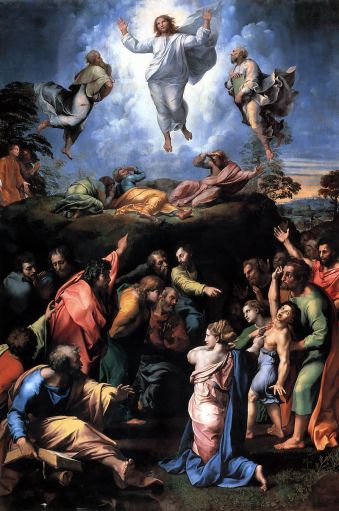
Transfiguration - Raphael

The Transfiguration – Raphael

Today we celebrate the Feast of the Transfiguration. There are many things that I could say about this feast.

I could talk about how this feast was celebrated as early as the 5th century by East Syrians.

I could speak of how it began to be celebrated by the entire Church when it was inserted into the general calendar in 1457 by Pope Callistus III.

I could reflect on how this this feast occurs 40 days before the Feast of the Exultation of the Holy Cross. I could point out that the gospel we hear proclaimed today is also proclaimed during the second Sunday of Lent, perhaps hearkening back to an ancient tradition which held that the Transfiguration took place 40 days before Good Friday.

I could preach about how Moses represents the law and Elijah represents the prophets, and so today’s conversation on the mountaintop shows us how Jesus fulfills both the law and the prophets and ushers in the new Covenant.

I could…
I could talk about any of those things.

But I think that today’s feast invites us to consider something deeper.

Today’s feast invites us to remember who Jesus is.
It invites us to remember the destiny to which we are called.
It reminds us to remember who we are, even now.

Peter, James, and John have been with Jesus for quite awhile by the time they go up the mountain with him today. They have been with him for 16 chapters in Matthew’s Gospel.

They have heard his famous sermon on the Mount.  They have heard him teach the crowds about the Beatitudes, about anger, retaliation and love for one’s enemies.  They have heard his teachings on prayer, fasting, and almsgiving; on storing up treasures in Heaven, and on God’s knowledge of how many hairs are on our heads.  They have heard his invitation to ask, to seek, and to knock.  They have heard his warnings on striving to enter through the narrow gate.

They’ve heard a lot.

They’ve also seen a lot.

They’ve seen him cleanse a leper.
They’ve seen him heal a centurion’s servant and even Peter’s own mother-in-law.
They watched him calm a storm at sea.
They’ve seen him cast out demons with the command of his word.
They’ve seen him heal a paralytic, two blind men, and a man with a withered hand.
They’ve even seen him raise a girl from the dead.

Peter, James, and John have every reason to believe that Jesus is the Son of God. But today, Jesus goes even further to strengthen their faith that he is who he says he is.

Today, he reveals his glory in a new way.
Today, he is transfigured before them.

His face shone like the sun and his clothes became white as light…and while he was still speaking, behold, a bright cloud cast a shadow over them, then from the cloud came a voice that said, “This is my beloved Son, with whom I am well pleased; listen to him.”

In all of his teachings and in all of his healings, Jesus looked like an ordinary man. Today, we see him for who he is. We see him in his divinity. We see him as God. And, with the three apostles, we stand in wonder and awe of what we see.

And we stand in wonder and awe of the destiny to which we are called, because he invites us to share in his glory. He invites us to share in his divinity.

The Church Fathers had a saying: God became man so that man might become God.

This is our great calling, and today’s feast draws this out.

Christianity is not primarily about becoming good and kind people. It is not primarily about a moral way of living, although all of that flows from Christianity. Christianity is primarily about God becoming man so that man might become God.

Through Jesus Christ, God invites us into a deep and personal relationship with him, so that we might share in his divinity.

This is the great mystery we contemplate today.
This is what today’s feast is about.

Jesus Christ is transfigured before us to remind us that we ourselves are destined to be transfigured.

When Christ comes again, our bodies will be raised with his and glorified with his if we remain united with him.

Brothers and sisters, stand in awe of the Transfiguration today and see the great destiny to which you are called.  You are sons and daughters of God, invited to share in his divinity.  You are children of light in the midst of a crooked and perverse generation, who shine like the stars of the sky.

Like those first disciples, experience for yourselves the transfiguration of Christ and let your minds and hearts be converted. See the Lord transfigured in his glory, and your life will be transfigured too. How could it not be?  A converted life is a transfigured life – your life will be transfigured because you have seen his glory for yourself.

What does a transfigured life look like?

It looks like the college student at the party who doesn’t play the drinking games, not because she is a prude or because it’s against the rules, but because she sees beyond the glory of the night into the glory of eternity. She lives a transfigured life and that life shines as a bright light to all of those around her.

It looks like husbands and wives, mothers and fathers, families who pray together, who sacrifice time in their busy schedules to be together because they know they are made not for the fleeting glory of sports, wealth, or a career but for the glory of eternity.

It looks like the person who prays, who seeks God’s mercy in the confessional on a regular basis, who worships and receives the Transfigured Lord in the Eucharist each Sunday, and all of this with joy because they know that God is giving them the grace to live more and more like his son or daughter.

It looks like parents who bring their children to the waters of baptism, not because it is a rite of passage or a nice ceremony but because they desire their children to be transfigured into sons and daughters of light who will share in the joy of eternity.

Brothers and sisters, behold the glory to which you are called. See the glory of Christ and live a transfigured life even now. You are made for eternity.  You are made for greatness.  You are made to be saints.  You are called to live not an ordinary life but an extraordinary life, a transfigured life.

Contemplate the glory of the Transfiguration and see the glory to which you are called, even now.