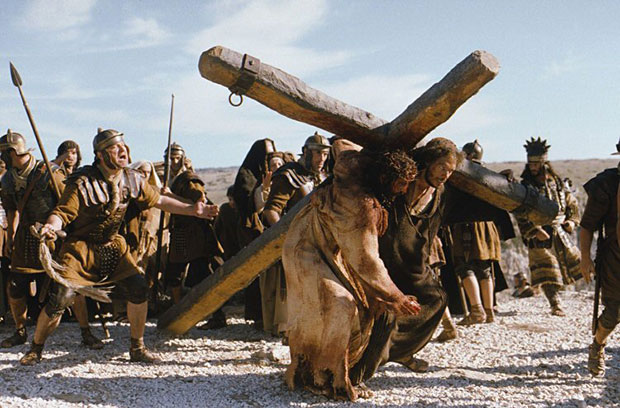
The Holy Family is the Model for Our Families

Feast of the Holy Family (Year A)
December 28, 2025
Sacred Heart, EGF
Saturday – 5 PM; Sunday – 8 AM, 10 AM, 5 PM

We celebrate today the Feast of the Holy Family:
the family of Jesus, Mary, and Joseph.
the family that God chose for his Son when he would take on our human nature.

To be human is to be born into a family:
a connection of persons
a web of relationships

a Lineage.

We call them the Holy Family because they are Jesus’ family.

Jesus: the son of God, adopted as the son of Joseph who claimed him when he named him.

Mary: the mother of Jesus, given the grace of the Immaculate Conception so she could be the Mother of Christ

Joseph: no superhuman, prevenient grace, but nonetheless a virtuous man.  There are two characteristics of St. Joseph worth mentioning today:

  1. He listened for God’s voice and was open to it.
  2. He obeyed it promptly when he heard it.

Scripture recounts 4 dreams of St. Joseph.  The last three of them are all in today’s gospel passage:

  1. “Do not be afraid to take Mary into your home…”
  2. “Flee to Egypt…”
  3. “Return to Israel…”
  4. “Settle in Galilee…”

In all of them, Joseph listened for God’s voice and was open to it, and he promptly obeyed it when he heard it.

We call them the Holy Family because they are Jesus’ family,
but what really makes them “holy” (set apart),
is that they have Jesus at the center.

In that way, the Holy Family is the model for our families.

Our families, too, are called to be holy families, set apart.
God put the family at the center of his plan for humanity.

God blesses family life.
Adam and Eve: “God blessed them and said, ‘be fertile and multiply’…”

Children are the crowning joy of marriage.

Last summer we had a lot of weddings.
Lately, many of them having been coming up to me and saying, “We have big news…”
Their faces are radiant with joy.
Their families are radiant with joy.
We rejoice with them as a family forms!

We, too, are born into families:
people with whom we will journey closely and for a long time – our lifetimes.

God entrusts us to a family.
God entrusts us with a family.

Family is where we get our start in life.
The people charged with caring for us when we cannot yet care for ourselves.
The people who will be charged with caring for us when we can one day no longer care for ourselves.

Some we choose, like our spouses or adopted children.
Some we do not, like our parents or our biological children.
They are a gift to us.

Family is where we learn fundamental human values:
Obedience.
Working together.
Fighting and Forgiving.
To contribute to the common good, learned through doing my part in household chores.
The Virtues: honesty, sharing.
I learn that I am not the center of the universe!
How to pray.
How to face suffering together.

Family life is the path to holiness.
It teaches love of God and love of neighbor.
It is the training ground to become a saint.

Many of us come from holy families.  A holy family has Jesus at the center.
Some of us come from families that often didn’t treat us or others as sacred.

Perhaps members of our families failed in their responsibility to care for us.
Perhaps we failed in our responsibility to them.

Perhaps a fresh start is possible.
Perhaps it is too late for that.

If that resonates with you, a good question to take to prayer is this one:
”Jesus, where were you in the pain and in the darkness?”

Ask that question with faith and I believe that Jesus will show you right where he was.
It is where he always is:
At the center, with you.
He was present with you.
He suffered with you.
He redeemed you.

By taking your humanity to himself, he offers you his divinity – divine grace –
to forgive what seems impossible to forgive so that it does not consume you…
to find healing where healing does not seem possible…

to experience, as the priestly blessing states:
“the peace of Christ, which surpasses all understanding (Phil 4:7).

It surpasses all understanding because Christ is present with me in the darkness.

Brothers and Sisters,
On this great feast,
we thank God for the gift of the Holy Family of Jesus, Mary, and Joseph.

We also give thanks that, because of our baptism,
God’s family has become our family.

We seek their intercession for our families,
that our families may also be holy,
with Jesus at the center.

We also thank God for our families:
those entrusted to us as companions for the journey.

We recommit ourselves to being devoted to the members of our family,
whom we can easily take for granted because they are always so near to us.

In closing, I share with you “A Family Prayer”:

God made us a family.

We need one another.
We love one another.
We forgive one another.

We work together.
We play together.
We worship together.

Together we grow in Christ.
Together we love all people.
Together we serve our God.
Together we hope for Heaven.

These are our hopes and ideals.
Help us to attain them, O God, through Jesus Christ our Lord.
Amen.
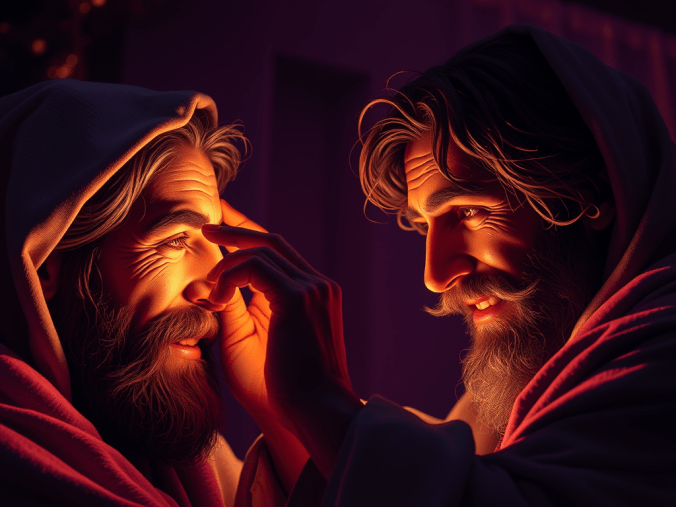
The Advent of the Two Blind Men

Homily for Friday of the First Week of Advent, Year II
Friday, December 5, 2025
Sacred Heart, EGF

7:15 AM

Matthew 9:27-31 – Two Blind Men

How long did those blind men follow after him?

They didn’t just cry out once. We hear:
As Jesus passed by, two blind men followed him, crying out…

Then, we hear:
When he entered the house, the blind men approached him…

It implies that some time passed.

So, how long did the blind men follow after him?

30 minutes?
An hour?
A day?
Longer?

We don’t know.

But we know that they waited. They experienced a mini-Advent in the darkness of their blindness.

How long had they been waiting in that darkness?

Years.

But in those years,
in that Advent,
they waited.

They watched interiorly, looking with their ears and hearts for the Savior.

They lived in the darkness of that deep violet shade for years. Dark violet like that one candle lit on our Advent wreath.
The light began to pierce it when they heard he was passing by. The violet turned to rose with their joy and hope that it could change.
It turned back to violet when it seemed he might not answer, but they kept pleading.

And then, in an instant, their waiting was over.
Their Advent ended.

Light pierced the darkness,
the white light of Christmas broke in.

Jesus, the Light of the world,
lit up their world
with light, with color, the dawn of day,
and they experienced a new kind of blindness.
They were blinded by the glory of God.

As their sight was restored,
the light of faith gave way to the glory of God.

Brothers and Sisters,
Your Advent waiting and watching is worth it.

What do you want him to do for you?

He asks you the same question he asked those two blind men:
Do you believe that I can do this?

Let it be done for you according to your faith.

Praying for All Souls – the Last Things

Homily for All Souls Day
Sunday, November 2, 2025
Sacred Heart, EGF
Saturday – 5 PM.  Sunday – 8 AM, 10 AM.

Saint Meinrad Cemetery
Vigil for All Souls Day

As we enter into the month of November, the Church invites us to remember that we are passing through this life on our way to our final home.

November invites us to remember our death.  It also invites us to remember eternal life.

November 1 – All Saints Day.  We remember the holy men and women of every time and place.  Saint known and unknown.  Those who rejoice in the Kingdom of Heaven.  Those whose example inspires us on to pursue a lives of holiness ourselves – to pursue a life of self-gift – a life given for God and given for others.

Today – All Souls Day.  Or the Commemoration of All the Faithful Departed.  Different from All Saints Day.  It implies that not everyone who has gone before us is yet a saint.

At the end of our life, there are 4 last things.

Death.  Judgement.  Heaven.  Hell.

Death.  The separation of the soul from the body.  “Indeed, for your faithful Lord, life is changed, not ended.” 

Death puts and end to human life, as the time open to either accepting or rejecting the divine grace manifested in Christ.1

Life gives us the opportunity to accept or to reject the grace given to us by Christ.

We accept or reject is by using our free will.
We have to choose. 
We choose every day.
We choose multiple times per day.

Sometimes we accept it.  We choose to love.
Other times we reject it.  We choose to sin.

After death, there are two judgements.  My particular judgement, which happens immediately. 

There are two options. The right or the left.  With the sheep or with the goats. 

Heaven or Hell.

If I rejected the divine grace given by Christ,
If I refuse to repent and to turn toward him,
I choose eternal separation from God.

Oftentimes I will visit someone who is dying.  They desire the last rites.  By that, they are thinking in particular of the anointing of the sick.

I always ask: “would you like me to hear your confession?”
Sometimes I will hear: “no thank you, I’m good. Just the anointing.” 
That is chilling.
I offer extra prayers for that person, hoping that they are just in need of purification so that they can see the Heavenly Vision.

But if I accepted the divine grace given by Christ, I enter into the vision of God in Heaven.
Sometimes that happens immediately.
Oftentimes that happens after a time of purification.

Sins can be forgiven. 
But sins have an effect on our soul. 

As an example:
If regularly choose to gossip or to judge others, I become a gossip or a judgmental person. 
There is a lack of charity in my soul.  I can confess the sin, but the effect on my soul remains.
That needs to be purified before I am ready to enter the vision of God.
It needs to be purified so that I can see the vision of God.

That is purgatory.

All who die in God’s grace and friendship, but still imperfectly purified,
are indeed assured of their eternal salvation;
but after death they undergo purification,
so as to achieve the holiness necessary to enter the joy of heaven.2

And the beauty of how God does this:
He does not do it through the action or merit of the one who needs to be purified.
The time for that person to do anything to help his situation has passed.
He does it through the prayers and charity of others.

The person who is gossipy is purified when they realize they are helpless to do anything about their own situation but they can see Heaven and greatly desire it.  They experience an intense longing and also a sadness because they cannot achieve it.

Perhaps then they see someone praying for them, interceding and asking God to have mercy on this.
The person praying for them is someone that they didn’t like.  It’s someone whom they gossiped about. 
The person receives that act of love, and the charity of the other purifies their soul.

My soul is purified when it is touched by the charity of another.

That transforms my way of seeing.  It transforms my heart.

Pope Benedict XVI:
I would go so far as to say that if there was no purgatory,
then we would have to invent it,
for who would dare say of himself that he was able to stand directly before God? 

And yet we don’t want to be, to use an image from Scripture, ‘a pot that turned out wrong,’
that has to be thrown away;
we want to be able to be put right.

Purgatory basically means that God can put the pieces back together again.
That he can cleanse us in such a way that we are able to be with him and can stand there in the fullness of life.

Purgatory strips off from one person what is unbearable
and from another the inability to bear certain things,
so that in each of them a pure heart is revealed,
and we can see that we all belong together in one enormous symphony of being.

When someone dies, there is a natural tendency to remember them with fondness,
to speak well of everything they did. 

If we loved them, we speak as if we are assured that they are in Heaven, and we will tell everyone that.
There is a great temptation for us to canonize them by our words.
But we must not forget to pray for them.

A eulogy speaks of what the person did.
A homily speaks of what God did…for the person, in the person, through the person.

When I die, please don’t assume that I am in Heaven.
(You say, “Don’t worry Father Matt, we won’t.”)

When I die, please don’t assume that I am in Heaven.
Rather, assist me with your prayers.

More than kind words, I will need prayers.

So do your loved ones.
So do those from our parish who have died and those whose names are inscribed in the book of remembrance.

They need our prayers.

An encouragement throughout the month of November:
Anytime you come into the church,
look at the list of names of those who have died in the last year,
or pick a name from the book of remembrance. 
Pray for that person.

Your prayers have power because you are a member of the Body of Christ by your baptism.
When the Church prays, Christ prays.
When you pray, Christ prays.

And the prayer of Christ can be applied to that person, through you,
in order to complete their purification,
so that they can enter into the vision of God,
where they will surely intercede for you in the Communion of Saints.

And so, with that in mind, let us pray for them now and also during the sacrifice we are about to offer:

Eternal rest grant unto them O Lord,
R:\ and let perpetual light shine upon them.

May they rest in peace.
R:\ Amen

May the souls of all the faithful departed, through the mercy of God,
R:\ rest in peace. Amen.


  1. Catechism of the Catholic Church, #1021 ↩︎
  2. Catechism of the Catholic Church, #1030 ↩︎

It is Time for the Vocations Drought to End

Holy Thursday
Mass of the Lord’s Supper
April 17, 2025
Sacred Heart, EGF – 7:00 PM

Tonight is one of the rare days where Holy Mother Church tells the priest what he is say in his homily.

After the proclamation of the Gospel, the Priest gives a homily in which light is shed on the principal mysteries that are commemorated in this Mass, namely, the institution of the Holy Eucharist and of the priestly Order, and the commandment of the Lord concerning fraternal charity.

I have to say, I’m glad to be told what to say.

I love being a priest.  It’s a beautiful vocation. I love to talk about it at vocation camps, in discernment groups, in conversations.

But I struggle to preach about it at parish Masses.

I am a priest, after-all, and so it somehow seems self-referential or self-serving,
as if I am looking for a pat on the back,
and that’s not the case at all.

Tonight, on the night before he will offer his life for us,
Jesus gives us the gift of the Priesthood and the Eucharist,
along with the command and example of fraternal charity.

These are beautiful gifts. And they are all connected.

You cannot have one without the other.

Without the priesthood, there is no Eucharist.
But without the Eucharist, there is no Priesthood.

The two are ordered to each other.

And charity – love – is the reason for both of them.

Did you know that a priestly ordination must take place within the context of a Mass for it to be a valid ordination?  That is the only sacrament where that is the case.  I can confirm someone who is dying in a nursing home, and I can do it outside of a Mass.

But a priest must be ordained within a celebration of the Eucharist.

The priest is ordained, and then he immediately concelebrates the Eucharist with his Bishop and the other priests who are present.

This is because the priest is ordained precisely to celebrate the Eucharist.  It’s the most important thing that he does.

A few years back, one of our seminarians asked me this question:
“Fr. Matt, what is your vision of the priesthood.”

I thought for a second, and then said:
“The priesthood exists to extend the Incarnation.”

The Incarnation: the Son of God took on human flesh in the person of Jesus. 
He walked among us.  Divine power flowed through him. 

And tonight, as his time on earth among us ends as his disciples have known it,
he leaves but he also has a way to stay with us until the end of time.

He gives us his Body in the Eucharist.

And he gives us the way for the Eucharist to be with us throughout all ages,
present in our own day here and in our own lives.

He gives us his apostles as the first priests to continue to make him present.
But they also make him present in their person.

They act in the person of Christ when they celebrate the sacraments.  Christ acts in and through them. The Holy Spirit directs the course of a priest’s ministry. Just this past week:

  1. Leaving the hospital, almost to my vehicle.  Meeting a person whose friend was dying.  Going back into the hospital.  Praying with her friend, who had been unresponsive, but who opened her eyes, showing that she could hear us.  It brought comfort and peace for the family.
  2. At an outing, greeting some people, medical emergency happens within one minute of my arrival.  I prayed for the person with my hand on her should as she is stabilized.  She later sent me a message: “Thank you for being there, your presence brought me comfort and let me know it was going to be ok.”
  3. On Monday, after the Chrism Mass, I waited to take a phone with a group of our youth from Sacred Heart. After the picture, I went to the gathering space. One of the Pastoral Center staff came up to me and handed me the Holy Oils for St. Francis of Assisi (one of my parishes). I moved into the social hall and was visiting. Within 5 minutes a parishioner approached and said, “I need to come see you sometime this week to be anointed.”  I held up the box of oils and said, “How about now?” She sent me a message: how much peace it brought her and her anxiety was removed.

Jesus’s heart burns with love for us.  Jesus shows his love for us through the priesthood and the Eucharist. 

“He loved his own who were in the world, and he loved them to the end.”

Love goes outside of itself and seeks to lay itself down.  He will lay his life down on the cross tomorrow.  But tonight, he desires to show his love for his apostles.  So, he washes their feet.

He serves them.

He serves them because his heart beats with love for them.
His heart beats with love for us.

The priesthood is the love of the heart of Jesus.
The Eucharist is the heart of Jesus, beating with love for us.

And so he gives his very self: “This is my Body which will be given up for you.”

He asks calls some men to follow him as priests. 
In calling them, he asks us to make these words of institution our own:
“This is my Body, which will be given up for you.”

And in giving up our bodies, in giving up our lives, we find ourselves.

That is true for all of us, but it especially true for the man who is called to the priesthood.

I cannot help but think of the Apostles tonight.  Peter.  Andrew.  John.  Thomas.  Simon.  Thaddeus.

Real men with real lives.  They had families.
James was Zebedee’s son.
Andrew was Peter’s brother.
Thomas was probably someone’s uncle.
Thaddeaus was someone’s friend.

Philip had a life.
Nathaniel had dreams.

Jesus called them. He called them.

They all, in their own say, had to say, “This is My Body, given up for you.”

I feel compelled to say something tonight.

The time has come for the vocations drought in this parish to end. 

The Eucharist and the Priesthood are deeply connected.  They cannot be separated.

A parish community centered on the Eucharist produces priests.

The Eucharist is important to all of us here, or we wouldn’t be here tonight.

But are we willing to sacrifice to spend time before the Eucharist?  To partake of the Eucharist?  To go above and beyond, to give that time to God, and to do so while asking him to call men from this parish to serve him as priests?

A former vocation director in our diocese once said:
“How can we expect a man to sacrifice his whole life for us if we are not willing to sacrifice an hour a week praying before the Eucharist for his vocation?”

We just finished a National Eucharistic Revival.
It has affected many of you sitting in this church tonight.

I believe, I really do, that we are on the cusp of a revival of the Priesthood – in the Diocese of Crookston, yes, but here at Sacred Heart in particular. 

God has always been calling.
The seeds of those vocations have been nourished here in recent years.
They need the watering of your prayers and support.

All that’s needed is for you to step out and to offer a word of encouragement, and to offer your time in prayer praying for someone in whom you sense the Lord’s call. 

You actually need to think about someone that you think would be a good priest, you need to pray for him, and then you need to look for the opportunity to personally tell him what you see in him.

They need to hear it.

God wants to call them through you.
God wants to call him through you.

You are going to want someone to baptize your great grandchildren.
I want someone to absolve my sins.
I want someone to sanctify my suffering with the Anointing of the Sick when the Cross comes.
And I want someone to commend my soul to God when the time comes for me, like Jesus, to journey from this world to the Father.

Our future priests are among us.

Some of them are behind me (altar servers). 
Some of them are in front of me (in the congregation). 
Some of them are not here.

To the young men of our parish, I say:
If the Lord is calling you, do not be afraid!
We would be incredibly proud to have God call you from our parish family to serve us as a priest.
Our community would stand with you.
Our community would support you.
Wouldn’t we?

In the next 5 years, I’d like to see 5 men from our parish enter the seminary. 

That is a very real possibility, if we center ourselves around the Eucharist in Charity on their behalf.

This is my Body, given up for you.
Do this in remembrance of me.

Repent and Believe in the Gospel

Ash Wednesday
March 5, 2025
Sacred Heart, EGF – 8:00 AM
St. Francis of Assisi, Fisher – 6:00 PM
Holy Trinity, Tabor – 7:30 PM


In the beginning, God formed man from the dust of the earth and breathed into his nostrils the breath of life, and so man became a living being.

From dust: nothingness, lifelessness. Death.
To a living being: spirit, vitality. Life. Destined to live forever.

Along came the enemy.

Once a being of great glory – Lucifer – “Light Bearer”…
Fallen because of his rebellion…
Now in the form of a serpent,
a snake,
one crawling on his belly in the dust.

Jealous of the life in man, he desires death for all.

He tempted them, our first parents.
They plucked the apple from the tree, from its life-source.
As soon as they plucked it, that apple began to die.
So did they.

With the first sin, death entered the world. Death entered the heart of man.

“Remember that you are dust, and unto dust you shall return.”

And return to dust, they did.
Like the palm branches received here and waved in the air last year,
once green with life,
then dry and brown,
and finally, yesterday, burned into these ashes here before us.

Adam and Eve had two sons, Cain and Abel.
Cain: a grower of crops
Abel: a shepherd

Cain brought an offering of his crops to God.
Abel brought his best lamb to God.

God was pleased with Abel’s sacrifice.
Cain was jealous of Abel. He harbored the dust of hatred in his heart.
So, he murdered his brother.
Abel’s blood returned to the dust of the earth, from which it cried out to God.

Cain was sentenced to roam the earth.
Blown away from the presence of God, the Source of Life,
like dust in the wind.

Joseph, the great-grandson of Abraham, our father in Faith.
His brothers, jealous of him, sold him into slavery in Egypt.
They sent him away,
like dust in the wind.

Famine struck. There was no food.
The winds of hunger drove the brothers to Egypt in search of grain. They traveled through the desert sands to get there.
Joseph was in charge of rationing the grain. He recognized them. His heart was pierced with grief when he saw them and he remembered what they had done to him.

Rather than take revenge, he forgave them.
They were reconciled.
The family moved to Egypt. They brought their father Jacob – Israel – with them.

Four hundred years passed.

The family of Israel grew into the nation of Israel, living in Egypt.
A new Pharaoh came to power, one who did not know Joseph.
Fearing the growing nation living within his own, he enslaved them,
not unlike how the Tempter enslaved our first parents,
not unlike how he enslaved us.

From life to a living death. Slavery. Misery.

We know the story. God will lead them home to their own land,
by way of the desert.

Brothers and Sisters,
he does the same for us.

Lent is a time to journey through the desert, to the freedom of the Promised Land.

It is a hard journey.
We must face our sins:
like Adam and Eve,
like Cain
like the brothers of Joseph,
like David who repented by lying in the ashes and weeping after his sin cost him his son.

If we are honest, we would rather skip the desert and jump right to the Promised Land.
If I am honest, I would rather skip this doom and gloom homily about repentance and jump right to the good news of Jesus saving us.

But there is no bypassing the desert.

Today, our faces are rubbed in it.

We are commanded: Repent and Believe in the Gospel!

That statement highlights the two parts of Lent.

For the first three weeks of Lent, we are confronted with our sin by the commend to “Repent!”.
We must acknowledge our sins.
We must feel sorrow for them.
We must repent,
and we must feel our powerlessness to set ourselves free.

Only then will we experience the truth and beauty of the Gospel.

We cannot free ourselves, but the good news is that we do not need to free ourselves.
We have a Savior,
and that brings us to the last two weeks of Lent.
“Believe in the Gospel!”

Jesus enters into the desert.
He fights our ancient foe.
Where we failed, He will be victorious.

Like Moses leading the people out of Egypt by way of the desert,
so Jesus will lead us out of the Egypt of our sins by way of the desert of Lent.

And so we are urged to repent, to let our sins trouble us. To rend our hearts.

When is the last time that you wept for your sins?
When was the last time that you felt sorrowful enough, guilty enough, to sacrifice, to pray, to atone.
We want to skip this.
We cannot.
It is essential.
Repentance is essential.

Replying not on our own efforts,
although we indeed must put forth our best effort.
Even though it is insufficient in itself,
our efforts are sufficient with God’s grace.

God’s grace will meet you there.

God is ready to meet you in the desert.

Repent! And Believe in the Gospel!

Someone recently asked me: “How do I know what I should do for Lent?”

Ask yourself this question:

Where am I slipping in my life these days?

Where is my struggle with sin right now. Am I even struggling? Or have I given in?

What is draining the life from my soul, turning it into a dry heap of ashes?

How are my sins harming
my relationship with God,
my relationship with others?

How are my sins harming ME?

Take a piece of paper, and write three headings:
Prayer
Fasting
Almsgiving

Commit to doing one thing in each area,
in a spirit of repentance,
asking God’s grace to meet you there,
and to lead you into freedom and new life.

He will,
because He already has:

He enters into our death,
and restores life.

Destined to Share in the Exchange

The Most Holy Trinity (Year A)
June 3, 2023
Sacred Heart, EGF.  Saturday – 5 PM.  Sunday – 8 AM, 10 AM


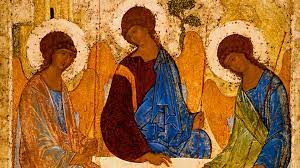
Andrei Rublev – The Trinity

Today is the Solemnity of the Most Holy Trinity: the central mystery of Christian life and faith, because it is the mystery of God in himself.

In the Catechism, the Church has a beautiful saying about the mystery of the Holy Trinity:

By sending his Only Son and the Spirit of Love in the fullness of time,
God has revealed his innermost secret:
God himself is an eternal exchange of love, Father, Son, and Holy Spirit,
and he has destined us to share in that exchange (CCC 221). 

Moses asks God today: “Do come along in our company…forgive our wickedness and sins, and receive us as your own.” And God does. He destines us to share in the exchange of love of the Trinity. He receives us as his own.

Of everything that our faith teaches us, this is the central mystery: the mystery of the Most Holy Trinity.  If we get this wrong, we get God wrong.  We get God wrong, we get ourselves wrong, because we are made in his image. 

This is why we pray the Creed every Sunday.  The Creed reminds us of what we believe of God.

What is the mystery of the Most Holy Trinity?

I believe in One God.

One God.

The Trinity is One.[1]  Of one substance.  One essence.  One God.  Not three gods.

We pray In the Name of the Father and of the Son and of the Holy Spirit.
We do not pray “In the Names of”…

Three persons in one God.  Father, Son, and Holy Spirit.

The three persons are really distinct from each other.[2]  They are distinct in their relationships.

  • The Father is not the Son.
  • The Son is not the Holy Spirit.
  • The Holy Spirit is not the Father.

Yet they are of one essence.  They are one God:

  • The Father is God.
  • The Son is God.
  • The Holy Spirit is God.

I believe in one God, the Father almighty, maker of Heaven and earth, of all things visible and invisible.

I believe in one Lord Jesus Christ,
the Only Begotten Son of God,
born of the Father before all ages,
God from God, Light from Light,
True God from True God,
Begotten, not made, consubstantial with the Father;
Through him all things were made.

In the early church, there were some who were trying to say that the Father existed before the Son, that the Son was created, that he had a beginning. 

A Father once looked at his son and said, “Son, I existed before you.  You would not have come into being without me.”

The son replied, “That’s true.  But you did not become a father until I became a son.”

In that human relationship, one man (a father) did exist before another man (his son), but he became a father at the same time his son became a son.

It is similar in God, except that the Father and the Son both always have been, are, and will always be. We proclaim this when we pray:

Glory be to the Father and to the Son and to the Holy Spirit,
as it was in the beginning, is now, and ever shall be.  (Past, Present, Future – Eternally)

The only begotten Son of God.  The Father generates the Son.  Eternally.  Always.  He did not have a beginning.  That is why he is born of the Father before all ages.

Like the Father, the Son is also God (the Son) from God (the Father), Light from Light, True God (the Son) from True God (the Father).

The Church is reigning in those who claim otherwise.

Begotten, not made, consubstantial (of the same substance/essence) with the Father.

The Son is begotten of the Father, but he is not created.  He did not have a beginning. 

And he is of the same essence as the Father.  The Son has the essence of God.

I believe in the Holy Spirit, the Lord, the giver of life
who proceeds from the Father and the Son,
who with the Father and the Son is adored and glorified,
who has spoken through the prophets.

The Holy Spirit proceeds from the Father and the Son.

The Son ascends to Heaven.  He is seated at the right hand of the Father, and the Spirit is sent forth for us.

The Father sent the Son to give us the Holy Spirit.

We pray TO the Father, THROUGH the Son, IN THE POWER OF the Holy Spirit.

God has now fully revealed himself: Father, Son, and Holy Spirit.

God has also equipped us.  He has given us the Holy Spirit.

The Spirit is sent forth for mission.

The mystery of the Most Holy Trinity is the Central Mystery of Christian faith and life.  It is the mystery of God in Himself.

The Father sent the Son.  The Son revealed the Father to us.

The Father and the Son sent the Holy Spirit.  The Holy Spirit is now with us to teach us and to guide us into all truth. He teaches us how to pray when we do not know how to pray as we ought. The Spirit prays within us with groanings that cannot be expressed in speech.

God not only reveals himself to us.

He also reconciles and unites with himself those who turn away from sin.

He wants us to share in his inner life.  To share in the life of the Trinity.  To share in the inner life of God.

It happens in baptism. 

We are baptized in the Name of the Father and of the Son and of the Holy Spirit.

We become brothers and sisters in Christ,
sharing of the same Spirit,
grafted into the Body of Christ, which is the Church.

What Jesus is by nature (the Son of the Father),
you and I become by grace (sons and daughters of the Father).

This is the Central Mystery of our Christian Faith.
You are not made for this world alone.
You are made for Communion, for “union with”, for union with God.

You are made to be caught up in the life of the Blessed Trinity.
He will join you to himself.  You will be divinized by the life of God in you.

Christian, remember your dignity.[3]

We renew it today by our communion with the Body and Blood of the Son,
who is one with the Father and the Holy Spirit,
and who, again, today, becomes one with you in the Eucharist.


[1] CCC 253

[2] CCC 254

[3] Leo the Great.

Zacchaeus Wasn’t the Only One Who Climbed a Tree

Homily for 31st Sunday in Ordinary Time (Year C)
October 30, 2022
Holy Trinity, Tabor: Sunday, 8:00 AM
St. Francis, Fisher: Sunday, 10:00 AM

Focus:             The gaze of Jesus changes people
Function:         Consider how the Lord looks upon you.


He went to a lot of trouble to see Jesus.
Zacchaeus.

Zacchaeus was short.  He could not see Jesus over the crowd.
But, by grace, that sycamore tree caught his eye.

Have you ever tried to climb a tree?
It’s not a pretty picture.

Jesus intended to pass through Jericho, but Jesus notices the small details.
He noticed one small man in a tree among the vast crowd.
He saw Zacchaeus trying to see him.

Jesus saw Zacchaeus.
He called him by name.

St. Ignatius of Loyola, in teaching us how to pray, gives us two steps to begin.
First, make the Sign of the Cross.
Then, in the amount of time that it takes to pray the Our Father, “consider how the Lord looks upon you.”

See his gaze.
See the Lord looking upon you.

Sometimes we feel we need to hide.
We can’t stand out.

Zacchaeus was aware of his sin.
He could have stayed hidden.
He chose to see.
He was willing to be seen if only he could see.

He allowed Jesus to look upon him.

Jesus saw him.
Jesus saw him trying to see Jesus.
His gaze fell upon Zacchaeus.

Zacchaeus saw Jesus looking at him.

He called him. 

And that changed everything for Zacchaeus.

Jesus sees you.
His gaze falls upon you.

See him.

See him looking upon you.
Consider how the Lord looks upon you.

Prayer is all about relationship.  Every relationship begins with a look.
The gaze of another affects us:[1]
An athlete is affected when he knows that his coach, or grandma and grandpa, are watching.
A child is affected when he knows that a parent is watching.
Parents are affected when they know their child is watching.
We are affected if a stranger is creepily watching us.

The gaze of Jesus received by Zacchaeus brought conversion and salvation.

Brothers and sisters,
Climb the tree.
Climb the tree and get above the vast crowd of your anxiety, your sin.  Rise above the noise that surrounds you. 
Climb the tree and get above the crowd of your distractions, cares and concerns.

Climb the sycamore tree of silence to see above all of that,
to see Jesus,
to let Jesus see you.

Zacchaeus wasn’t the only one who climbed a tree.

Jesus also climbed a tree.

Jesus climbed a tree so that we would see him and would invite him to come and stay at our house.

Behold the Lamb of God.  Behold him who takes away the sins of the world.

Lord, I am not worthy that you should enter under my roof, but only say the word and my soul shall be healed.


[1] Fr. Paul Hoesing, Have I Been With You? Personal Prayer for Young Disciples, page 20.

See the Scraps

Homily for 26th Sunday in Ordinary Time (Year C)
September 25, 2022
Sacred Heart, EGF: Saturday, 5:00 PM
St. Francis, Fisher: Sunday, 8:00 AM
Holy Trinity, Tabor: Sunday, 10:00 AM

Focus:             Christ is in the scraps.
Function:         See the scraps.

Scraps.

Small pieces of something, especially things that are left over after the greater part has been used.

A scrap of paper.

A bit of bread.

Fragments.  Leftovers.

Lazarus would have gladly eaten his fill of the scraps that fell from the rich man’s table.

The rich man would not have lost anything by throwing Lazarus some scraps.
But he didn’t see him.

He didn’t notice Lazarus any more than he noticed the scraps that fell from his table.

Scrap.

An old, discarded, or rejected item.

Lazarus.

Lazarus was scrap to the rich man.  Worth no more than the bits of food that fell from his table.

He wasn’t worth his time.  He wasn’t worth noticing.

So he scrapped him.  He left him lying at his door just like he left the food lying under his table.
Someone else will clean it up.  Someone else will take care if it. 

He scrapped Lazarus.

The lesson of the gospel:
If you don’t want to be scrapped, then notice the scraps.

Scrap has value.

Scrap metal.  Left over parts from a big project can be recycled and used for another project.  One man’s trash is another man’s treasure.

Lazarus was trash to the rich man, but he was treasured by Christ.
Lazarus is the only person in a parable of Christ to be named. 
Lazarus is not expendable to Christ.  He is not nameless.  He is not unnoticed.
No, he is a friend.  He has a name. 

Jesus wept over Lazarus when he had died.
Jesus wept over the one who was scrapped.

The rich man was indifferent to him, but Jesus loved him.

The scraps who fall from the table of life may seem like scraps to me but they are sons to someone else.

Brothers and sisters,
Who is the Lazarus lying at your door? 

Perhaps it is the lonely Lazarus who wants a scrap of your time. 

Perhaps Lazarus is in your own home, longing for a scrap of attention or concern.

Perhaps Lazarus is in your own heart, silently pleading for the scrap of a whispered prayer of repentance so that Jesus can call him by name, call him once again to life, saying “Lazarus, come out!”

Who is that unsightly person in your life that you can’t help but notice, even though perhaps you would rather not notice him?

That person is Lazarus.

The rich man didn’t see Lazarus lying at his door.
But when he needed him, his eyesight suddenly improved, he saw him from across the chasm.

It was too late for the rich man.  But it was not too late for his brothers.
It is not too late for us.

Send Lazarus…send him to my father’s house, for I have five brothers, so that he may warn them…if someone from the dead goes to them, they will repent.

Lazarus has been sent.
Christ, died, buried, and risen from the dead, has been sent.

He has been sent to warn us:

Whatever you do for the least among you, you do for me.
Whatever you do not do for the least among you, you do not do for me.

Jesus sees the scraps.

He sees Lazarus.

Brothers and sisters, there is still time for us.  We can see him too.  Put on the mind and heart of Christ and look around you.  The scraps are everywhere.

We come now to this altar.  The richest and most scrumptious banquet that satisfies every longing of the heart.  God himself spreads the table before us.

Scraps fall from the table of heaven.

A bit of bread
A sip of wine

He sees you, Lazarus.
He sees you, lying at his table.

Christ is in the scraps that fall from this altar.
He is in the scraps out there, too.

He sees you.
Now, go and see him in the world.

Use your Ingenuity for the Kingdom

Homily for 25th Sunday in Ordinary Time (Year C)
September 18, 2022
Sacred Heart, EGF – Sunday 8:00 AM, 10:00 AM, 5:00 PM

Focus:             There’s always a way.
Function:         Use your ingenuity for the Kingdom

Charlotte, North Carolina:

A lawyer purchased a box of very rare and expensive cigars,
then insured them,
among many other things,
against fire.

Within a month,
he had smoked all 24 of these great cigars,
and without yet having made even his first premium payment on the policy,
the lawyer filed a claim against the insurance company.

In his claim,
the lawyer stated the cigars were lost…
in a series of small fires.

The insurance company refused to pay,
citing the obvious reason
that the man had consumed the cigars in the normal fashion.

The lawyer sued… and won.

Delivering the ruling,
the judge agreed with the insurance company that the claim was frivolous.
The judge stated,
nevertheless,
that the lawyer had a policy from the company
in which it had warranted that the cigars were insurable
and also guaranteed that it would insure them against fire –
without defining what was considered to be acceptable fire –
and was obligated to pay the claim.

Rather than endure a lengthy and costly appeal process,
the insurance company accepted the ruling
and paid $15,000 to the lawyer for the loss of his 24 cigars lost in the fires.[1]

It’s disgusting, but you’ve got to admit, it’s pretty good.

He’s a rascal, but he’s a clever rascal…  (The lawyer and also the steward.)

The master praises the steward not for his dishonesty, but for his prudence. If a dishonest person could have that much foresight and planning when it comes to worldly business, how much more foresight should the disciple have when it comes to heavenly business?

What if the lawyer used his ingenuity for the Kingdom?

Brothers and sisters,
what about us?

What if we put that much effort into getting into Heaven?

What if we used our ingenuity for the Kingdom?

What if we used our money, our time, our skills
to lead others to Christ
to serve Christ in those in need?

What if acted shrewdly by appearing foolish in the eyes of the world
because we do not ultimately care about what this world will think of us –
because in the end the only thing that matters is what God thinks of us?

The gospel flips the values of the world upside down.  We know this.  What is given away here is stored up as treasure in Heaven. 

Be prudent!  Be creative!  Be generous!

If a dishonest steward can find a way to use his dishonesty to get what he wants,
certainly you and I can apply the Gospel to our lives
and use what we’ve been entrusted with in such a way
so as to receive what we will ultimately want
when we are asked to give an account of the stewardship of our lives.

That dishonest lawyer used his abilities to find a way.

Brothers and sisters,
So should we.

There’s much more at stake for us than a $15,000 payout.
We should not be outdone so easily…

Back to the story…

As I stated,
rather than endure a lengthy and costly appeal process,
the insurance company accepted the ruling
and paid $15,000 to the lawyer for the loss of his 24 cigars lost in the fires.

Now, for the best part…

After the lawyer cashed the check,
the insurance company had him arrested

on 24 counts of arson.


[1] https://youtu.be/6mP-bd2_Ysg?list=TLPQMTgwOTIwMjL_4TObtddhug

Holy Thursday – the Priesthood, the Eucharist, and Fraternal Charity

Homily for Holy Thursday
April 14, 2022
Sacred Heart, EGF – 7:00 PM


This day shall be a memorial feast for you.

The Lord speaks these words to Moses and Aaron before they celebrate that first Passover.  He is going to lead them out of Egypt.  The 10th plague, the death of the firstborn, will be the final plague that sets them free.

God will protect the Israelites from death by means of the Passover Feast.  They slaughter the lamb and sprinkle the blood on the doorposts.  The angel of death will “pass over” them. 

This is the feast of Passover. 

This day shall be a memorial feast for you.

For the Israelites, Passover wasn’t something that happened many years ago.  It was made present to them every year by their participation in it. 

They relived the events every year on the memorial feast
They didn’t merely remember; they re-lived. 
The past was made present to them.

This day shall be a memorial feast for you.

The Lord gathers tonight to celebrate the Passover, that memorial feast, with his disciples.
He says, Do this in memory of me.

In other words:

This shall be a memorial feast for you.

And, as for the Israelites, so for us.  We do not simply remember what the Lord did.  What the Lord did is made present for us.  Here.  Tonight. 

Tonight, the Church commands the priest to shed light on the 3 mysteries highlighted in this memorial feast.  The priest is to speak about the priesthood, the Eucharist, and fraternal charity.

First, Priesthood.

What is the priest?  The priest is one who offers sacrifice. 
The priest stands in the person of Christ
and acts in the person of Christ, the head of the body, that is the Church.

The Lord said to them, “Do this in memory of me.”

Not just “remember this.”  But “make it present.”  Make me present.  Make me present for my people so that the grace I won for them can be applied to their lives.

The Son of God took on flesh in the womb of the Virgin Mary.
We call that the incarnation – when God became man. 

The priesthood exists to extend the incarnation,
to continue to allow God to become man.

A man called to the priesthood
offers his human nature to Christ.

He offers his flesh to Christ
so that the divine power that flowed through Christ
can flow through the priest who acts in his person
to bring the life of God into the lives of God’s people
through the sacraments.

Just as our Great High Priest offered himself,
so the priest who is configured to Christ
is to offer himself in sacrifice
for the sake of the People of God.

The priest is an “alter Christus”, “another Christ.”

The priesthood continues the Real Presence of Jesus in the world.

Tonight was the night that the Lord instituted the priesthood. 

Do this in memory of me.

The priesthood exists for the sake of the Eucharist. 

The Eucharist, as we know, is the flesh and blood of the Lord.
The whole Christ is present in the Eucharist.
His humanity and his divinity are present in the Eucharist.
Body, Blood, Soul, Divinity.

I said that the priesthood continues the Real Presence of Jesus in the world.
The Eucharist continues the Real Presence of Jesus in the world.

The blood of the sacrificial lamb
was smeared on the doorposts of the Israelites
and the angel of death passed over them. 
The blood, the sign of life, preserved their lives.

The blood of the Lamb of God now anoints the lips of believers
so that they might live,
so that they might “pass over” from death to life
even as the Israelites “passed over”
from the death of slavery in Egypt to the freedom of life of the Promised Land.

The Eucharist is the gift of the Son
who continues to be made present on our altars
so that his one sacrifice which he will complete tomorrow
can be continually offered to the Father,
presented to the Father
for our salvation and the salvation of the world.

He then gives his Body and Blood to us
to be our food for this journey of life,
to feed us until he leads us home.

Do this in memory of me.

Jesus offered his Body and Blood,
His whole self,
including his blood, sweat, and tears,
which he will soon shed in the Garden of Gethsemane.

He offered himself for us because he loves us.
He did it out of love for us.

Which bring us to the third mystery we celebrate today:

Charity. 
Love. 
Love from the heart. 

Love was what led Jesus to give himself for us.
Love is what led him to wash the feet of the disciples.

I have given you a model to follow, so that as I have done for you, so you should also do.

Do this in memory of me.

The priesthood gives us the Eucharist.
The Eucharist gives us God, who is love.

Jesus taught us the two greatest commandments:
Love the Lord your God with all your heart, mind, soul, and strength.
Love your neighbor as yourself. 

Tonight, he raises the bar.

It is no longer enough to love your neighbor as yourself.

He gives us a new commandment:
Love one another as I have loved you.

Tomorrow, his love will lead him to offer his life for us.

Greater love has no man than this, than to lay down his life for a friend.
You are my friends, if you keep my commands.

Jesus gives us the command of love at the same time he gives us the Eucharist and the Priesthood.

The Priesthood, the Eucharist, and Fraternal Charity all continue the Real Presence of Jesus.

Charity toward others means that I see the presence of Jesus in them.  Charity is showing reverence to Christ in the other like we show reverence to Christ in the Eucharist. 

Following the Lord,
we lay down our lives in order to enrich the lives of others. 

Love moves us to use our baptismal priesthood
to offer the sacrifice of ourselves
for the sake of God and one another. 

Love says, “you are worth the sacrifice.  You are worth dying for.” 

Do this in memory of me.

Our Lord tonight institutes the priesthood, the Eucharist, and the commandment of fraternal charity.

All three go together.  All three are necessary. 

All three have the same goal:
Communion.
Union with.
Union with God.  Union with one another.

The priesthood, the Eucharist, and the command of charity all exist for the sake of communion.
If one of them is missing, something of Christ is missing. 

Brothers and sisters, these mysteries are made present for us tonight.
Let us receive them and allow them to be made present in our lives.

Do this in memory of me.