Chaplain’s Conference – At the Beginning

the Beginning

Sacred Heart Catholic School
Chaplain’s Conference – High School
Thursday, September 7, 2017

Here we are at the beginning of a new school year. Day 3. The nerves are starting to wear off as we settle in. We are figuring out the routine. We are learning the schedule. Students are learning their teachers and teachers are learning their students.

We stand just inside the doorway of this new school year. We stand at the beginning. I would like to reflect a bit this morning on the importance of beginnings. I think that beginnings offer us a unique opportunity, an opportunity that can be easily lost in the hustle and bustle of the school day if we don’t pay attention. Beginnings, especially this beginning of a new school year, offer us an opportunity to pause, to look at where we are now, and to look at where we are going.

What is in store for you this year? How will you have changed by the end of this school year? How will you have grown, or not grown? How will you be different?

Who do you desire to be at the end of this school year? Perhaps more importantly, who does God desire you to be?

I know who God desires you to be.

He desires you to be a saint.
He desires you to be young men and young women of integrity, men and women of character, men and women of virtue.
He wants to set you free from the sins that enslave you.
He wants you to flourish.
He wants you to be joyful.
He wants you to be bold and confident. He wants you to be a leader. He wants you to know what your life is about.
He wants you to learn to love more deeply.
He wants you to live your life to the full.

He loves you infinitely, and he wants you to know of his love for you.
He loves the person sitting next to you infinitely, and he wants you to love them with His heart.
He even loves the person you can’t stand – your enemy – infinitely. And he calls you to love even them, especially them, with His heart.

He desires for you to learn to love, to truly love, because love is of God, and it is love to which we are called. Love is not a feeling. Love is a choice, just like sin is a choice. To love is to will the good of another. To love is to choose the good of another. You can love someone even if you don’t like someone because you can choose the good of the other person even if you don’t like them.

You are called to love. You are called to love with the Heart of God. You are called to love with the Sacred Heart of Jesus Christ under whose Lordship we place this school!

Brothers and sisters, that starts here. That starts now. That starts today. At the beginning.

If we do not choose to practice love of God and love of neighbor here, now, today and every day this year, how can we expect to learn it? How can we expect to get where we are going?

The road to Heaven, the road to sainthood, is paved with your choices, your daily choices, your hourly choices, the choices of each moment, to live the great commandments: “You shall love the Lord your God with all your heart, with all your soul, with all your mind, and with all your strength. You shall love your neighbor as yourself” (Mark 12:30-31).

Here at Sacred Heart, you are given the means to do this. You are given everything you need. You are presented with opportunities every day to practice loving God and loving each other.

Here at the beginning of this school year, I would offer a couple of suggestions if you would take up the challenge to become men and women who love deeply and live fully.

First: pray.

You are given ample opportunities here to pray. You have Mass on Friday. You have a prayer period every day. You are given opportunities to lead prayer in your classrooms. Learn to pray.

Prayer is a relationship. If you are going to learn to love God and to love others with the heart of God, you must learn to pray. You must encounter the living God. This requires something of you. You have to give yourself to prayer. You must give yourself fully to prayer and seek to praise God, to thank God, to ask God for what you and for what others need with all your heart, mind, soul, and strength. You cannot learn to pray if you simply stand on the sidelines with everyone else. You have to get in the game. So often we end up just going through the motions. Going through the motions, or just “being here” while prayer is going on, is not prayer. It is a waste of your time.

In the Mass, the priest says “Lift up your hearts.” We respond, “We lift them up to the Lord.” When I was in the seminary, our rector would command us to do this: “Lift up your hearts!” We would exclaim “We lift them up to the Lord!” That command would always snap me out of my lukewarmness and cause my heart to surge. Prayer requires that of us. It requires energy, it requires strength, it requires you to choose to give yourself over to it. It requires you to choose to say the words, to speak up with enthusiasm, and to mean what you say.

Brothers and sisters, in our celebrations together this year, as we pray together, I challenge you to “lift up your hearts!” I dare you to turn your prayer into true worship. Say the words with vigor and with enthusiasm, and mean what you say. Think about what you say. Be bold! Lift up your hearts and voices and sing the songs of praise to God. Think about the words you sing and mean what you sing. Give yourself over to prayer and your heart will learn to love more deeply. Give yourself over to prayer with all of the strength at your command and it will stretch your heart so that it can contain the love of God Himself, a love that you can then pour out to others.

Pray.

Pray together in the Church. Pray together in your classrooms. Pray alone in the Chapel.

Ask your friends and classmates to pray for you. Ask them to pray with you. Pray in your own words – in a heart-to-heart conversation with God. This is risky. It will be awkward at first. But if you practice it regularly you will see friendships deepen – your friendship with God and your friendships with each other. Take the risk. Your love will deepen.

As we strive to love, we will fail at times. We will fall. We will sin. When that happens, acknowledge it and repent – turn away from it – and turn toward the Lord’s mercy in the confessional. Regular confession is something that will greatly help you grow in your ability to pray and to love God and each other more deeply. There is more joy over one sinner who repents than over 99 people who have no need of repentance. How often do you go to confession? I challenge you to be bold and go regularly. Once a year is the bare minimum. Once a month is a good rule of thumb. When your conscience pricks you, when you have sin weighing you down and getting in the way of your prayer and your relationship with God, come to the confessional. God’s mercy awaits you.

This year, you will have three opportunities every week for confession. A priest will be available to hear confessions during the Prayer Period on Tuesday mornings when Adoration is taking place. On Wednesdays and Thursdays, a priest will be available in the chapel during the lunch periods. Fr. Paul Kuhn of Holy Family, Fr. Kyle Metzger of St. Michael’s and I will take turns covering these periods. We are available to hear confessions or for spiritual direction or counsel. We are available to teach you how to pray. If you want to speak to a priest about what is going on in your heart, come and talk to us. We are here for you.

Something I used to think as a teenager, and something I have already heard several times as a priest, is this: “I could never confess this sin to a priest” or “I could never confess my sins to this priest – he’d think badly of me.” This is a lie from the Evil One to keep you enslaved to your sins. Brothers and sisters, you cannot free yourself from your sins. Only Christ can free you from your sins. Turn to Christ in the Sacrament of Reconciliation. He has given real power to the words of his priests, power to forgive your sins in His name. You will find mercy, not condemnation. I promise you that.

Pray.

Second: Study.

Work hard at your studies. Apply yourself to your studies. Pay attention in class. Ask questions. Strive to learn. St. Thomas Aquinas once described the approach to theology, which is the study of God, as “faith seeking understanding.” That’s a great way to approach our learning. We know that the truth is out there. The truth is in here. Jesus Christ is the way, the truth, and the life. Jesus Christ is the truth – truth is a person. Seek to understand the truth because the truth is real. Ask questions not for the sake of challenging or for winning an argument, but ask questions for the sake of deepening your understanding. If you find yourself disagreeing with something you are learning, ask questions and try to understand what your teacher is saying. Ask someone else to help you understand. Learn to seek the truth, to seek Jesus Christ, with your minds and hearts and not just with your emotions. I hope that you experience Sacred Heart as a place where you can ask honest questions. What you are learning matters to your life. It makes a difference in your life.

Study.

Finally: Serve.

Throughout the coming year, you will have many opportunities to serve. Seek them out. Look for opportunities to serve each other. Volunteer when volunteers are needed. Volunteer before you are asked! If you see a need, look for a way to fulfill the need.

When a teacher asks for someone to volunteer to lead prayer in class, step up and volunteer.
When people are needed to assist in the cafeteria or to serve at Mass, step up and serve.
Serve not out of a need to fill your commitment hours, but serve out of gratitude to God for all that He has given you.

Love manifests itself in service. Learn to serve with joy and you will learn to love with joy.

Serve your teachers. Serve your classmates. Serve your teammates. Serve each other.

Saint John Paul II once said that man…cannot fully find himself except through a sincere gift of himself. You will not find yourself until you make a gift of yourself. Jesus said, “He who loses his life for my sake will find it.” You will find true joy and true happiness when you learn to serve others out of love.

This is great training for your future vocation. What type of husband and father do you desire to be? What type of wife and mother do you desire to be? What type of priest or religious do you desire to be? Do you desire to be the type of person who gives, who is selfless, who loves, who makes life easier for his family by bearing their burdens? Or do you desire to be the person who takes, who waits to be served, who places a heavy burden on his family? Your vocation as a husband, father, wife, mother, priest, or religious is not about you. It is about others. Your vocation is about giving your life in service to others, ultimately to help them to get to Heaven.

Your training for that starts here, now, today…at the beginning. 

Brothers and sisters, the choices you make today, at the beginning, will form you into the person you will be tomorrow. Laurie Hernandez said it well: Your future doesn’t start ten years from now, 10 months from now, 10 days from now, or 10 minutes from now. It starts today.

It starts today. It starts now. At the beginning.
God Gave You Everything You Have

Homily for 22nd Sunday in Ordinary Time (Year A)
September 3, 2017

Sacred Heart, EGF – 8:00 AM; 10:00 AM

Focus:        God gave you everything you have.
Function:  Give out of gratitude for what you’ve been given.


stewardshipEvery so often, it’s good for us to stop and take an inventory of what God has given us, as well as how we’re using what he’s given us.
And what has God given us?

He has given us everything.
He has given us life.
He has given us our families and friends.
He has given us gifts and talents.
He has given us time to develop and use those gifts and talents.
He has given us treasure.

Everything that we have is a gift from God. And the gifts we have been given are not for ourselves alone, but to be used in service to God and to others. They have been given to us so that we may give them away. They have been given to us to be used for building up the Kingdom.

Every so often, it’s good for a disciple to stop and take stock of his stewardship. Stewardship is a matter of the heart. A good steward realizes what he owns is not his own but has been put into his care by another. Everything we have is a gift. A good steward realizes this and gives back to God out of gratitude for what he has been given.

Stewardship is a matter of the heart. Test your heart. What’s your attitude toward your time, your talents, and your treasure? Do you find yourself saying “This is mine” or “this is owed to me”? Do you find yourself asking “What’s in it for me?”

Or do you find yourself asking “What can I give? What can I do?”

During my first year of seminary, a wise priest gave us some advice that has made this come alive for me. Seminarians don’t receive a pay check. They receive a small stipend but it doesn’t cover very much. However, at Christmas time, people are very generous. This priest warned us that it can be very easy to begin to “count on” what others would give us at Christmas time – to begin to feel entitled to it or as if it were owed to me. And that sense of entitlement is dangerous to our spiritual lives because it erodes the sense of the gift.

He suggested a simple practice to keep this in check. He suggested that each year, as Christmas approached, but before we received our first gift, to decide on a percentage that we would give away to charity. Since these were gifts, the percentage might be higher than normal – say 20 or 30 percent.

I took him up on this challenge during my first year in seminary. It revealed a lot about my heart.

The first thing that it revealed was how easy it is to feel entitled. The more that I received, the harder it was to give away a higher amount. I found myself wanting to reduce the percentage that I had committed to giving. After all, people had given this money to me. It was mine, and I should be able to do with it what I want…but of course therein lies the trap of entitlement…

The second thing that it revealed was how much I wanted to depend on myself rather than on God. The amount that I was giving away was significantly higher than my monthly stipend. Shouldn’t I be able to count on this money to provide for my needs throughout the year? Except, of course, that everything I had received was a gift in the truest sense of the word, over and above what I could have expected to receive. God was the one providing for my needs by of the generosity of his people. I wanted to depend on myself while in reality I was completely dependent on him.

The third thing it revealed was the magnitude of the gift, of what I’d been given. At first, I found myself focusing on the large sum that I was giving away. Over time, I found that what I was giving away made me more grateful for what I got to keep. The amount I was giving away made me more aware of how much people had given, of how generous they had been toward me. It increased my gratitude for what I’d been given. What was even more powerful was that often after I had made the donations to charity, more checks would come and they would cover a large amount of what I’d just given away. God would not be outdone in generosity.

Every so often, it’s good for us to stop and take stock of our stewardship. God has given you everything you have. What is the attitude of your heart regarding what God has given you?

God gives you 168 hours every week. How do you use the time you’ve been given?

How many hours do you use to visit others, to encourage others, to serve others, to edify others? How many hours do you give back to God in prayer and in service to the Church and your community? How many hours do you use developing the gifts, skills, and talents that you’ve been given?

How much time do you give the Lord each week?

God has given you unique gifts and talents. What talents has He given you? Have you discovered all of them yet? I bet that some of them are still hidden…

He has given the gift of music and art to inspire and to lift the soul to God.

He has given the gift of writing – the ability to twist a phrase and tell a story to teach important life lessons and to convert hearts.

He has given the gift of listening, of empathy, of being a good conversationalist or a great encourager and there are people who long for a word of hope, who long for another to hear them.  There are people who are homebound or in nursing homes who long for your company.

He has given the gift of athletic abilities that make us stand in wonder at what human beings are capable of.

He has given the gifts of carpentry, of woodworking, of being the handy-man who can fix anything.

Do you give your talents back to God by using them to glorify him? Do you use your God-given talents to build up the Church and the community around you? How much time to you give each week using your talents for the building up of the Kingdom?

Saint John Paul II once said that man…cannot fully find himself except through a sincere gift of himself (Gaudium et Spes, #24). God is love. The inner life of the Trinity is a continual outpouring of love – a complete and total gift of self. We are made in the image and likeness of this God. Our lives are meant to flourish in an outpouring of love. Love wills the good of another. Love builds up. One who loves makes a sincere gift of himself to another.

Brothers and sisters, every so often it’s good for us to stop and take stock of our stewardship. Here at Sacred Heart, we are celebrating September as stewardship month. We have been given this time to evaluate the state of our hearts when it comes to everything God has given us.

God gave you everything you have.
Give to him out of gratitude for everything He’s given to you.

Give to him out of gratitude even when it hurts and your life will become a living sacrifice acceptable to God. You will find that you have more than enough. Your gratitude for what you have will increase.

Peter tried to stop Jesus from giving everything he had for us because he was thinking like human beings do and not as God does. Let us learn from Peter’s mistake.

Jesus gave everything to redeem us.
He continues to give everything he has to us in this Eucharist.

Let us give to him out of gratitude for everything he’s given for us.

Peter Finds His Identity When He Acknowledges Christ’s Identity

Homily for 21st Sunday in Ordinary Time (Year A)
August 26-27, 2017
Sacred Heart, EGF – 5:30 PM
St. Francis of Assisi, Fisher – 8:00 AM; Holy Trinity, Tabor – 10:00 AM

Focus:              Peter finds his identity when he acknowledges Christ’s identity.
Function:         Acknowledge Christ as Lord.


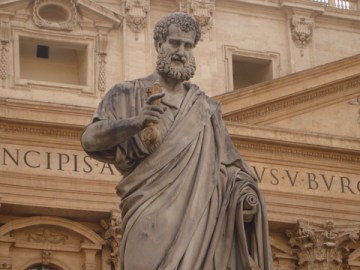
st peterThere is an existential question at the heart of today’s Gospel.

Who do you say that I am?

It is a very personal question, a risky question, a question that cuts to the heart of the matter. It is a question that gets down to the level of identity.

Who do you say that I am?

Simon tells Jesus who he is, and then Jesus, in turn, tells Simon who he is.
And who is he?
He is a fisherman.
He is the one who walked on the water.
He is one who saw Jesus in his glory on the mountain.
He is a sinner.

Who is he?
Blessed is he.
He is Simon, son of Jonah.
He is Peter, the rock, “Rocky”, the keeper of the keys, the Master of the House, the one on whom the Church will be built. 

Who do you say that I am?

You are Peter, and upon this rock I will build my Church, and the gates of the netherworld shall not prevail against it. I will give you the keys to the kingdom of heaven.

Simon acknowledges who Jesus is, and then Jesus tells Simon who he is. Simon discovers who he is when he discovers who Jesus is.

Peter finds his identity when he acknowledges Christ’s identity.

Brothers and sisters, the same is true for us. We find our identity when we find Christ’s identity. We discover who we are when we discover who He is. We find our very selves when we find him, the one through whom all things, including us, were made.

There is so much uncertainty in the world today. People are lost. They are like sheep without a shepherd, with no one to look to, with no one to lead them. So many people do not know who they are, or they have forgotten who they are. They do not know who they are because they do not know who Christ is. And they are searching, desperately searching, for someone to show them who they are. And in their searching, they look to people who seem confident in who they are, who seem to know who they are. Often they look to the wrong people, and what do we see? Panic. Unrest. Anxiety. Anarchy.

But, what if?
What if they were able to look to people who have been able to answer the question posed by Jesus in the Gospel today?
What if they were able to look to people who know who Jesus Christ is?
What if they were able to look to people who know what they are looking for because they have found it for themselves?

What if?
What if they were able to look to you or to me, and to hear us say:
You were made for more.
You were made for greatness.
You were made to be a saint.
You are a beloved son or daughter of the Father.
You are loved beyond measure.
You are the one for whom Christ gave everything to redeem.

What if?
What if they heard us say:
You are looking for love but you are bound by sin. The Church has the key to set you free. I know because I was there too. Here’s how I found freedom…

All of us look to someone else to find out who we are.  We see this especially with children.  Children look to their parents to find out who they are, and if they don’t find a strong example in their parents, they look to their peers.

All of us look to someone else to find out who we are.  Brothers and sisters, if you aren’t following Christ, I guarantee you that you are following someone or something.  And so my question for you this morning is this:

Who are you following?
Who do you look to?

Who do people say that you are?

There is nothing so compelling as when a disciple of Jesus speaks out of that place where Christ has been revealed to him, when he naturally shares his experience of a time when he encountered Christ in his life and how it changed him. Like Peter, we discover who we are when we discover who Christ is. And it changes everything. It changed Simon’s name to Peter and made him a firm foundation upon which the Church could be built. It changes us and gives us a firm conviction of who we are, a solid foundation on which we can build our lives.

Back to Saint Peter…

At the end of his life, Saint Peter’s gaze was so tightly fixed on the One he acclaimed as Lord that his identity was unshakeable – it was so unshakeable that he was able to bear being crucified upside down on a cross in the middle of a square in Rome.

He was crucified like his Lord. The great Rock of the Church seemed to crumble and fall. He was buried, and years passed. 2000 years passed.

This past January, my classmates and I went on pilgrimage to Rome. While in Rome, we had the privilege of going on the Scavi tour – a tour of the excavations under St. Peter’s Basilica in Rome.

The Emperor Constantine built the original Saint Peter’s Basilica in the 4th century. Tradition holds that he built it over the grave of Saint Peter. It was a massive undertaking. Much of Vatican Hill was leveled in order to build the basilica exactly where Constantine wanted it built.

He could have built it in another spot nearby where the ground was already level, but he wanted it directly over the grave of Saint Peter. A chapel in the basilica was built over Peter’s grave, and the main altar in the basilica was erected one story above the chapel, directly over Peter’s grave.

In the 1500’s, Constantine’s basilica was taken down and the current Saint Peter’s Basilica was built. The main altar was kept in the same place because of the tradition that it was directly over the location of Saint Peter’s grave.

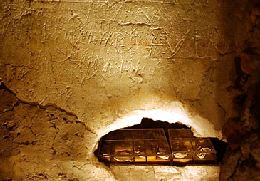
In the mid 1900’s, excavations under Saint Peter’s basilica began. Many tombs and graves were discovered, dating back to the 2nd and 3rd centuries. As our guide led us deeper and deeper underground, we eventually reached the spot where the bones of a man in his sixties were discovered – several stories directly under the main altar.

grafitti-wall-detail-wall-G-saint-peter-tomb-glass

We stared in wonder at a small piece of jawbone.

The jawbone that had partaken of the First Eucharist at the Last Supper…
The jawbone that had denied Christ, and then repented when the cock crowed…
The jawbone that confessed Christ as the Son of the living God…
The jaw of the one whom Christ declared as the Rock on whom He would build his Church…

Saint Peter’s Basilica – the Mother of all the Churches – is built on the Rock, and not only on the Rock of Saint Peter, but on his confession of faith and the jaw that proclaimed the answer to Christ’s question.

That same question comes down to you and to me today.

Who do you say that He is?

God Surpasses Every Human Desire

Homily for 20th Sunday in Ordinary Time (Year A)
August 19-20, 2017
Sacred Heart, EGF – 5:30 PM
St. Francis of Assisi, Fisher – 8:00 AM; Holy Trinity, Tabor – 10:00 AM

Focus:             God surpasses every human desire.
Function:        Increase your desire for God.


Steak on GrillIt had been a long day at work, and he was starving. But he was about to be filled. My uncle had bought a choice cut of meat, and the steak had been marinating for 24 hours. The charcoal was lit and the temperature was finally right. He threw the steak on the grill. As the steak sizzled and the aroma of the cooking meat filled the air, his mouth watered. He watched it closely. Not yet…not yet…ok, now.  He flipped it over at the perfect time. It sizzled some more. Finally, it was time to take the steak off of the grill. He ran inside to get a plate and some silverware. This was going to taste so good!
He came back outside, picked up the spatula, and…

The steak was gone.

GONE.

He looked around in disbelief, and then it hit him.

There sat Winzer, his year-old rambunctious Doberman Pincher, and he was licking his chops.

And the words of the Lord never seemed clearer:
It is not right to take the food of the children and throw it to the dogs. 

Our desires are meant to be fulfilled, and our desires move us, they push us forward, to pursue the end that we desire. For every natural desire that we possess, there exists something to fulfill that desire.

We experience hunger – the desire for food, and it is satisfied by eating a meal.
We experience thirst – the desire for a drink, and it is satisfied by water.
We experience loneliness – the desire for communion with another – and it is satisfied by a meaningful relationship.

Most importantly, we experience a desire for the infinite. We recoil at the idea of death. We experience a desire for eternity. We experience a desire to live forever.

And there is something to fulfill that desire.

CS Lewis put it this way:
If I find in myself a desire which no experience in this world can satisfy, the most probably explanation is that I was made for another world (Mere Christianity).

And yet, we know that not all of our desires are good. Some of desires are disordered. They propel us toward something that ultimately will not satisfy. These desires need to be reordered. They need to be redirected. They need to be purified.

This is what the pursuit of holiness is all about. Holiness is about the purification of our desires. It is about becoming pure of heart. Our hearts are where our desires lie, and our hearts have been wounded by original sin as well as our personal sins. Our hearts need to be purified so that they can receive what God desires to give us. Jesus said, “Blessed are the pure of heart, for they shall see God.”

Yet too often, rather than purifying our hearts, we spend our time giving into misdirected desires thinking that they will satisfy us, and they do satisfy us for a short time, but then, at some point, we experience the ache of our hearts again. We experience a desire for something more. What temporarily fulfilled that desire no longer works, so we move onto something else. We try to fill the infinite hole in our heart with finite things, and we’re always left feeling empty. We’re always left wanting more.

Saint Augustine knew this experience well. He spent years pursing empty relationships, giving into lust, and taking pride in his intellectual achievements. It left him empty. When he experienced his conversion and finally began to pursue holiness – to purify his heart – he put his realization this way:
You have made us for yourself, O Lord, and our hearts are restless until they rest in you.

God is the one who promises to fulfill our deepest desires, and God is the only one who can fulfill our deepest desires. Our opening prayer for Mass stated it so beautifully:

O God, who have prepared for those who love you
good things which no eye can see,
fill our hearts, we pray, with the warmth of your love,
so that, loving you in all things and above all things,
we may attain your promises,
which surpass every human desire.
 

During my deacon summer, I had the privilege to work with many couples who were seeking to come into the Church or to come back to the Church after some time away. They had a longing, a real desire, to receive Holy Communion. But they were living in an irregular marriage situation, and it took some time to go through the annulment process and then to go through their marriage preparation in the Church.

Yet, in all of this, they went about it in the right way. They knew they couldn’t receive communion until they were in right relationship with God and each other, and so they waited. And while they waited, they prayed.

And their desire grew stronger.

This is what prayer does. It stretches our hearts. Prayer enlarges the desires of our hearts so that they are able to contain what God desires to give us.

When the annulments came through and we celebrated their marriage in the Church, and the time came for them to receive Holy Communion, they were in a daze. You could see the ultimate fulfillment that they were experiencing on their faces. It was so good! It made all of the waiting worth it, because the time of waiting increased their hunger for the Eucharist and now they have a greater appreciation for it than many of us probably do.

Our desires are meant to lead us to God.

Brothers and sisters, where are your desires leading you?

Are you seeking to purify your desires? Are you pursuing what will ultimately satisfy? Or are you pursuing things that only leave you empty and hungering for more?

Do you desire the Eucharist? Do truly desire the Eucharist? Or have you become complacent and lukewarm?

Do you examine yourself before you receive the Eucharist and go to confession when your examination pricks your conscience?

Or do you numb your desire by making excuses, by filling up your mind with other thoughts so that you do not have to face your conscience?

Careless and ignorant reception of Communion without examining ourselves will blind us to the greatness of the gift and make us lukewarm. It will decrease our desires and shrink our hearts.

But careful and reverent reception of Communion after examining ourselves will help us recognize our unworthiness and thus will magnify the greatness of the gift. It will increase our desires and stretch our hearts.

Let us not be like Winzer the Doberman Pincher who felt that he was entitled to the steak and took it for himself. No, let us instead be like the Canaanite woman who knew she was unworthy of such a great gift.

She knew she was unworthy, but she asked for it with faith, with perseverance, and with humility. Her prayer showed both her great faith and her great desire, and the Lord fulfilled her desire because of her great faith.

She didn’t take it for herself, she received it as a gift, and how great is the gift that she received.

God surpasses every human desire. And God has a desire too.

God desires your heart.

Purify your heart so as to awaken your desire for Him, the only One who can truly satisfy every longing of your heart.

Live a Transfigured Life

Homily for the Feast of the Transfiguration (Year A)
August 6, 2017
Sacred Heart, East Grand Forks – 8:00 AM; 10:00 AM

Focus:             A converted life is a transfigured life.
Function:       Live a transfigured life.


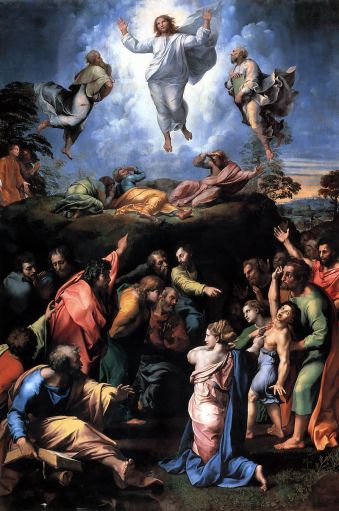
Transfiguration - Raphael

The Transfiguration – Raphael

Today we celebrate the Feast of the Transfiguration. There are many things that I could say about this feast.

I could talk about how this feast was celebrated as early as the 5th century by East Syrians.

I could speak of how it began to be celebrated by the entire Church when it was inserted into the general calendar in 1457 by Pope Callistus III.

I could reflect on how this this feast occurs 40 days before the Feast of the Exultation of the Holy Cross. I could point out that the gospel we hear proclaimed today is also proclaimed during the second Sunday of Lent, perhaps hearkening back to an ancient tradition which held that the Transfiguration took place 40 days before Good Friday.

I could preach about how Moses represents the law and Elijah represents the prophets, and so today’s conversation on the mountaintop shows us how Jesus fulfills both the law and the prophets and ushers in the new Covenant.

I could…
I could talk about any of those things.

But I think that today’s feast invites us to consider something deeper.

Today’s feast invites us to remember who Jesus is.
It invites us to remember the destiny to which we are called.
It reminds us to remember who we are, even now.

Peter, James, and John have been with Jesus for quite awhile by the time they go up the mountain with him today. They have been with him for 16 chapters in Matthew’s Gospel.

They have heard his famous sermon on the Mount.  They have heard him teach the crowds about the Beatitudes, about anger, retaliation and love for one’s enemies.  They have heard his teachings on prayer, fasting, and almsgiving; on storing up treasures in Heaven, and on God’s knowledge of how many hairs are on our heads.  They have heard his invitation to ask, to seek, and to knock.  They have heard his warnings on striving to enter through the narrow gate.

They’ve heard a lot.

They’ve also seen a lot.

They’ve seen him cleanse a leper.
They’ve seen him heal a centurion’s servant and even Peter’s own mother-in-law.
They watched him calm a storm at sea.
They’ve seen him cast out demons with the command of his word.
They’ve seen him heal a paralytic, two blind men, and a man with a withered hand.
They’ve even seen him raise a girl from the dead.

Peter, James, and John have every reason to believe that Jesus is the Son of God. But today, Jesus goes even further to strengthen their faith that he is who he says he is.

Today, he reveals his glory in a new way.
Today, he is transfigured before them.

His face shone like the sun and his clothes became white as light…and while he was still speaking, behold, a bright cloud cast a shadow over them, then from the cloud came a voice that said, “This is my beloved Son, with whom I am well pleased; listen to him.”

In all of his teachings and in all of his healings, Jesus looked like an ordinary man. Today, we see him for who he is. We see him in his divinity. We see him as God. And, with the three apostles, we stand in wonder and awe of what we see.

And we stand in wonder and awe of the destiny to which we are called, because he invites us to share in his glory. He invites us to share in his divinity.

The Church Fathers had a saying: God became man so that man might become God.

This is our great calling, and today’s feast draws this out.

Christianity is not primarily about becoming good and kind people. It is not primarily about a moral way of living, although all of that flows from Christianity. Christianity is primarily about God becoming man so that man might become God.

Through Jesus Christ, God invites us into a deep and personal relationship with him, so that we might share in his divinity.

This is the great mystery we contemplate today.
This is what today’s feast is about.

Jesus Christ is transfigured before us to remind us that we ourselves are destined to be transfigured.

When Christ comes again, our bodies will be raised with his and glorified with his if we remain united with him.

Brothers and sisters, stand in awe of the Transfiguration today and see the great destiny to which you are called.  You are sons and daughters of God, invited to share in his divinity.  You are children of light in the midst of a crooked and perverse generation, who shine like the stars of the sky.

Like those first disciples, experience for yourselves the transfiguration of Christ and let your minds and hearts be converted. See the Lord transfigured in his glory, and your life will be transfigured too. How could it not be?  A converted life is a transfigured life – your life will be transfigured because you have seen his glory for yourself.

What does a transfigured life look like?

It looks like the college student at the party who doesn’t play the drinking games, not because she is a prude or because it’s against the rules, but because she sees beyond the glory of the night into the glory of eternity. She lives a transfigured life and that life shines as a bright light to all of those around her.

It looks like husbands and wives, mothers and fathers, families who pray together, who sacrifice time in their busy schedules to be together because they know they are made not for the fleeting glory of sports, wealth, or a career but for the glory of eternity.

It looks like the person who prays, who seeks God’s mercy in the confessional on a regular basis, who worships and receives the Transfigured Lord in the Eucharist each Sunday, and all of this with joy because they know that God is giving them the grace to live more and more like his son or daughter.

It looks like parents who bring their children to the waters of baptism, not because it is a rite of passage or a nice ceremony but because they desire their children to be transfigured into sons and daughters of light who will share in the joy of eternity.

Brothers and sisters, behold the glory to which you are called. See the glory of Christ and live a transfigured life even now. You are made for eternity.  You are made for greatness.  You are made to be saints.  You are called to live not an ordinary life but an extraordinary life, a transfigured life.

Contemplate the glory of the Transfiguration and see the glory to which you are called, even now.

What is Sown as Seed Grows

Homily for 16th Sunday in Ordinary Time (Year A)
July 23, 2017
St. Francis of Assisi, Fisher – 8:00 AM; Holy Trinity, Tabor – 10:00 AM

Focus:               What is sown as seed grows.
Function:         Sow good seed.


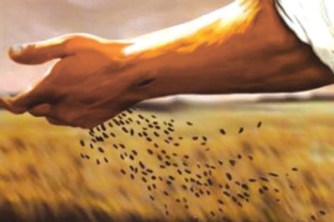
sowing seedSow an act, and you reap a habit.
Sow a habit, and you reap a character.
Sow a character, and you reap a destiny.
-Charles Reade

We reap what we sow.
What is sown as a seed grows.

Last week we heard about the sower who went out to sow. The sower is God, and the seeds are his Word. Our hearts are the fields to receive his Word. We were asked to reflect on the state of our hearts. We were challenged to cultivate our hearts so that they become the rich soil where the seed of God’s word can flourish.

Today, we are reminded that, while it is true that God sows his seed, it is equally true that he is not the only sower. The Evil One also sows his seed.

What is sown as seed grows.

Acts of sin grow into habits of sin.
Habits of sin grow into vices.
Vices, if unchecked and without conversion, can transform the fields of our hearts into fields of weeds which will not yield a bountiful harvest, but can only be bundled up and burned. Vices enslave us in our sins. They prevent us from loving well.

But acts of goodness grow into habits of goodness.
Habits of goodness grow into virtues.
Virtues, if planted and watered and tended, can transform the fields of our hearts into fields of wheat which yield a bountiful harvest, and are gathered into the Lord’s barn at the time of the harvest. Virtues give us the freedom to become saints. They give us the freedom to give fully of ourselves, to love freely.

What is sown as seed grows.
God will reap what we allow to be sown in our hearts.

I think we can look at this parable of the weeds and the wheat in two ways. The Gospel presents the weeds as the children of the Evil One and the wheat as the children of the Kingdom. The field is the world. Each person is a weed or a stalk of wheat. God lets them grow together until the Harvest.

I think we can also look at this parable in another way. We can see each person’s heart as a field that contains both weeds and wheat. The wheat is to be tended and nurtured and we are to stunt the growth of the weeds where we can. The seeds continue to be sown throughout our lives. We want to open ourselves to the seeds that come from God and close ourselves to the seeds that come from the Evil One. The field is each person’s heart. Each person’s heart is a field of wheat and weeds. God allows the person to grow and to cultivate his field until harvest time.

St. Thomas Aquinas once said,
Take away all evil, and much good would go with it.
God’s care is to bring good out of the evils that happen, not to abolish them.

God wants a bountiful harvest. He is willing to tolerate a few weeds for now in order to allow the wheat to grow. But, brothers and sisters, the weeds will be separated later. And that should motivate us to use the time we have now to tend the fields of our hearts.

We must do our part. We must cultivate our fields.

The Book of Sirach urges us:
Delay not your conversion to the Lord, put it not off from day to day. (Sirach 5:8)

What is sown as seed grows.
The Harvest is coming.
God will reap what we allow to be sown and grown in our hearts.

Last week and the week before, I attended the JPII Camp for the middle schoolers of the diocese. I spent hours hearing confessions. I was inspired to see the campers make life changing confessions. They recognized where they had allowed the Evil One to sow the seeds of sin in the fields of their hearts, they saw the weeds springing up, and they experienced conversion. They tended their gardens. They took a huge first step in making a resolution to rid themselves of the actions that sow the seeds of weeds in their hearts and resolved instead to sow the seeds of virtue.

Their hearts are young. It is early in their growing season.

Some of us are not so young. It is later in our growing season.

Yet one thing is certain. The first reading, in speaking of God, tells us that “You gave your children good ground for hope that you would permit repentance for their sins.”

God is patient. God will wait. He does not rush into the field of the world and uproot those of us who are weedy. He waits. He allows us to tend the fields of our own hearts – to change – to open ourselves to receive the seeds of His Word.

During this growing season of your life, do not stand idly by. Tend your field. Open your heart to the seeds of God and close yourselves to the seeds of the Evil One.

What are you allowing to be sown in your heart?

What are you allowing to be sown in your children’s hearts?

Are you planting so as to reap a harvest worthy of Heaven?

Our Hearts are the Fields to Receive God’s Word

Homily for 15th Sunday in Ordinary Time (Year A)
July 15-16, 2017
Sacred Heart, EGF – 5:30 PM
St. Francis of Assisi, Fisher – 8:00 AM; Holy Trinity, Tabor – 10:00 AM

Focus:              Our hearts are the fields to receive God’s Word.
Function:        Cultivate the field of your heart.


gardening

(Click Here to Follow Me)

I have to admit that I’ve never been much of a gardener. Don’t get me wrong, growing up on a farm, I’ve always enjoyed fieldwork. I enjoyed the hours spent driving the tractor as I cultivated the field. I loved the feel of the sun on my back and the wind in my face as I picked up the hay bales with the stackwagon. I reveled in the smell of freshly chopped silage as I rushed out to the field and back to pick up the next load.

But gardening…gardening is much different. Gardening is work. Several weeks back I helped my mom and dad plant their garden. I measured the distance between the rows. Then I hoed the dry and crusty ground, digging the rows by hand as my niece and nephew dropped in the seeds. It was easier for them to keep up with me than it was for me to keep up with them. Finally, I covered the seeds with the dry dirt and used my foot to pack the dirt over the seed.

In the days that followed, we watered and weeded, and we watched and waited. The next time that I was home, I was able to see the growth springing up. The dry, cracked earth had begun to be transformed by the seeds that were planted there. The barren landscape of that garden was transformed by some water and some work. It was made ready to receive the seed that would be planted. Soon, I expect that we will be enjoying the fruits of our labor – tomatoes, corn, onions, and potatoes. 

Our scriptures today remind us that “The seed that falls on good ground will yield a fruitful harvest” (Ps. 65). God’s Word is the seed that is sent forth like the rain from heaven, and it shall not return to him void, but shall do his will, achieving the end for which He sent it.

The seed of God’s Word is sown in the field of our hearts. Our hearts are the fields to receive the seed of his Word.

And like any field, our hearts need to be prepared to receive this seed if the seed is to spring up and bear fruit.

The soil of our hearts must be cultivated with silence so that we can hear the Word of God when it falls during the busyness of our days.

Our hearts must be weeded by the Master Gardener in the confessional; they must be watered with the tears of repentance for our sins so that the seed can grow without being choked off. The roots of vice must be plucked out to make room for the seeds of virtue.

Our hearts must be watered by the rains of prayer which soften them to receive the Word of God so that the seed can break open and bring forth conversion, transformation, new life.

Our hearts must be fertilized with gratitude for the many blessings with which the Lord enriches our lives.

The seed of God’s Word is sown in the field of our hearts. Our hearts are the fields to receive the seed of his Word.

A dry, weary land without water will not bring forth a fruitful harvest, and neither will a hardened heart, closed off to the Word of God, bear the fruit of the Gospel.

Brothers and sisters, you can come to Mass every Sunday and hear the Word of God proclaimed in the Scriptures but
if your heart is not open to receive it,
if you do not meditate on it and reflect on it,
if you do not think about it, pray about it, or put it into practice,
if you do not allow the Word to take root in your heart,
it will not bear fruit.
You will have eyes but you will not see. You will have ears but you will not hear.

But a softened heart,
a heart that has been prepared,
a heart that has been cultivated, watered, and fertilized,
a heart that is receptive to the Word of God proclaimed here every Sunday,
will bear abundant fruit.

The heart that is prepared, ready and waiting to receive the living Word of God, will receive it when it comes.

The seed of God’s Word will take root in that heart,
where it will be cracked open and the life it contains will burst forth,
transforming the landscape of that heart from a dry land into a fruitful field,
bearing 30, or 60, or 100 fold.

What is the state of your heart?

What work needs to be done in your heart so that it can better receive the seed of God’s Word?

One thing is certain. God’s word is poured out. The seed of God’s word will be sown.

Just as from the heavens the rain and snow come down
and do not return there
till they have watered the earth,
making it fertile and fruitful…
so shall my word be that goes forth from my mouth;
my word shall not return to me void,
but shall do my will,
achieving the end for which I sent it.

God’s Word will not return to him empty. It will bear fruit. The question is, will it bear fruit in your heart? Will your heart be the rich soil on which it falls, or will it be dirt of the path, the rocky ground, or the thorny ground?

This is not an easy task. Gardening is hard work. It requires humility. It takes patience, it takes persistence, and it takes perseverance.

It is easy to be open to the Word that we agree with. It is much more difficult to be open to the Word that challenges us. But the fruit is worth the effort. The sufferings of the present are as nothing compared to the glory to be revealed in us (Romans 8:18). If we prepare our hearts to be worthy fields of the seed of God’s Word that is entrusted to us, then we will glory in the harvest of our lives when we stand before God on judgement day.

Soon, the seed of the living Word of God Himself will appear on this altar.

The sower is about to cast his seed from this altar.
This is the seed that gives life to all who believe.
The Eucharist is the seed that has the power to transform your heart because it is none other than the living Word of God, Jesus Christ himself, the Word made Flesh who dwells among us in the gift of his Body and Blood.

Our hearts are the fields upon which this Seed is sown.

May they be hearts of rich soil so as to yield a harvest worthy of Heaven.


Meekness is not Weakness; It is Gentle Strength

Homily for 14th Sunday in Ordinary Time (Year A)
July 8-9, 2017
Sacred Heart, EGF – 5:30 PM
St. Francis of Assisi, Fisher – 8:00 AM; Holy Trinity, Tabor – 10:00 AM

Focus:                Meekness is not weakness; it is gentle strength.
Function:         Place yourself under the yoke of Christ.


IMG_1781

There is a beautiful image near the entrance of one of the chapels at Saint Meinrad, where I attended seminary. You have to go out of your way to find it; it’s not in a conspicuous place. It’s in the basement, near the door to the oratory – a chapel that rarely gets used.

The image depicts the Holy Family on a journey. The Holy Family had fled to Egypt when Joseph learned in a dream that King Herod was searching for the child to kill him. They remained there until Herod’s death, and then came to Nazareth. The image depicts the holy family returning from Egypt to Nazareth.

Mary is seated on a donkey, holding the child Jesus who is two or three years old. Joseph is leading the donkey. In one hand, he holds his walking staff. In the other, he holds the hand of Jesus. Or, rather, Jesus is holding onto Saint Joseph’s finger as he stares at him in admiration.

The title of the painting reads: “The Hand of the Humble Joseph Guides That of the Almighty.”

Another one of my favorite images at Saint Meinrad is located in the seminary chapel. You don’t have to go so far out of your way to find this one. But it’s still not in a conspicuous place. You must look for it. It’s in the back of the chapel, in a corner, near the confessional.

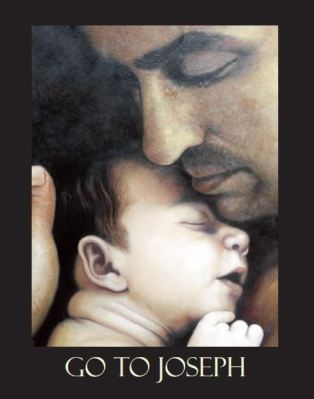
GoToJoseph

This image depicts a close-up of a young father in his early twenties. He has black eyebrows and a five o’clock shadow. His eyes are closed as he cradles his infant son against his bare chest. His son is sleeping, resting his face and bare chest against that of his father. The image contrasts the strength of the father with the weakness of the child. The child is completely dependent on his father, and the father is committed to protecting his son.

The caption under this image reads: “Go to Joseph”

Framed on the wall next to this image of Saint Joseph holding baby Jesus is a Seminarian’s Prayer to Saint Joseph. It reads:

We honor you, Saint Joseph,
for the tender care and fatherly wisdom
that marked your holy life
as you taught your son Jesus
how to be a man. 

Look on us now, we pray,
as we seek to become men
in the very image of your son.
As you guided him to become fully one like us,
so guide us to become more and more like him,
who is our brother and our Lord,
now and forever. Amen.

These images of Saint Joseph are important because they present an image of true meekness. And we need an image of true meekness because we are often presented with an image of false meekness. Too often, we think of meekness as weakness. We think of cowardice, wimpiness, an unwillingness to rock the boat or take a stand for what matters.

But true meekness is not weakness. It is gentle strength. It is self-possession in the face of trial and adversity. It is knowing who you are and having the ability to stay true to who you are when your patience is tried. It is possessing great strength but it is also possessing the ability to harness, to control, that great strength.

Saint Joseph is a model of true meekness. He never speaks a word in the Scriptures. He doesn’t have to. He is a man of great strength. He is a carpenter. He works with his hands. He provides for the needs of his family. He protects his family. Under his watch, no harm will come to them.

But like the location of his images in the seminary, Saint Joseph is not conspicuous. He doesn’t flaunt his strength for all to see. He doesn’t need to. Anyone who looks at him can see that he is a man of strength. Anyone who looks at him can see a man who knows what his mission is and a man who has the strength to carry it out. St. Joseph’s masculine strength shines ever brighter in the light of his humility and meekness. He is a man in possession of his strength, a man who is not ruled by his strength but rather a man who has mastery over his strength.

Meekness is not weakness; it is gentle strength.

Come to me, all you who labor and are burdened, and I will give you rest. Take my yoke upon you and learn from me, for I am meek and humble of heart.

Brothers and sisters, let us take up the yoke of true meekness by following in the footsteps of our Lord who learned meekness in his humanity from the example of his foster father Saint Joseph.

Place yourself under the yoke of Christ who is meek and humble of heart.

Submission to Christ the Lord does not mean being a wimp, a coward, or a pushover. It means knowing what, or rather who, your life is about. It is knowing who you are, or perhaps who you are not, in relation to Christ who is God. It means knowing that God is God and I am not. Placing yourself under the yoke of Christ means believing that his vision for how to live our lives is what will bring us ultimate happiness, freedom, rest, and joy.

Brothers and sisters, if you are not under the yoke of Christ, whose yoke are you under?

I invite you today to cast off the yoke that has you enslaved and take up the yoke of Christ.

Cast off the yoke of vice and take up the yoke of virtue.

Cast off the yoke of slavery and take up the yoke of true freedom.

Cast off the yoke of self-doubt, of self-loathing, of self-deprecation and take up the yoke of your true identity as a son or daughter who is infinitely loved by the Father.

Cast off the yoke of individualism and caring solely for your own needs and take up the yoke of your true identity as a brother or sister to those around you.

Cast off the yoke of arrogance and pride and take up the yoke of humility and meekness.

Cast off the yoke of the world and take up the yoke of Christ:
Christ, the one who came not to be served but to serve;
Christ, the one who set us free from the yoke of sin and death;
Christ, not the harsh taskmaster but the one who is meek and humble of heart.

Take his yoke upon you and learn from him, and he will give you rest. He will give you peace. He will give you joy.

For his yoke is easy, and his burden light.


We Show Hospitality to God When We Show Hospitality to Others

Homily – 13th Sunday in Ordinary Time (Year A)
July 1-2, 2017
Sacred Heart, EGF – 5:30 PM, 8:00 AM, 10:00 AM

First Weekend Homily as a Priest.
First Homily at Sacred Heart in East Grand Forks.

Focus:              We show hospitality to God when we show hospitality to others.
Function:        See God in others and show them hospitality.


Whoever receives you receives me, and whoever receives me receives the one who sent me.

Last weekend I was in Oklahoma City for the ordination of a classmate. After the ordination, I had the opportunity to meet up with a friend that I had not seen in a long time. My friend wanted to take his mom, his brother, and me on a boat ride through the canal that cuts through Oklahoma City. We stood in line to buy our tickets. I was wearing my collar, and I was chatting with my friend’s mother when I noticed a man in front of us ask my friend if there were four in our group. My friend said, “Yes,” and the man turned back to the ticket window. My friend’s mom hadn’t noticed the interaction, so I said to her, “I think the man in front of us is going to buy our tickets.” Sure enough, I then overheard him tell the man working in the ticket booth, “I’ll buy four additional tickets for the group behind me.” The man tried to slip away without being noticed, but I was able to step up and thank him for his generosity, for his great hospitality.

The word “hospitality” comes from the Greek word philoxenia, which means “love of strangers.” To extend hospitality to someone means to welcome guests or strangers. To extend hospitality is to receive someone who is an outsider and to change them from a stranger into a guest. The man who bought our tickets did not know I was a visitor to the city, but I was certainly a stranger, and he showed great hospitality by his generosity.

All four of us were strangers to him, and yet he saw something. I know that he saw me wearing my collar, and so when he looked at me he saw Christ, and he saw an opportunity to show hospitality to God by showing hospitality to me and to my friends.

Whoever receives you receives me, and whoever receives me receives the one who sent me.

In his rule of life for his monks, Saint Benedict challenges his brothers to welcome all guests as if they were Christ. He does so because he knows that we show hospitality to God when we show hospitality to others. I was a stranger and you welcomed me…Whatever you did for the least of my brothers, you did for me. (MT 25). Christ is hidden in the brother or sister standing right in front of us. We are all made in the image and likeness of God, and when we are reborn in the waters of baptism, we become sons and daughters of our Father in Heaven, and we become brothers and sisters to each other.

The Letter to the Hebrews urges us with these words: Do not neglect hospitality, for through it some have unknowingly entertained angels (Hebrews 13:2). Indeed, the Old Testament contains several stories of angels appearing to people as guests on a journey. In receiving the strangers in their midst, these characters in the Old Testament received God.

In the first reading, we hear the story of a woman showing hospitality to Elisha the prophet because she knows he is a holy man of God. She does not show hospitality just because it is a nice thing to do. No, she shows hospitality because she recognizes who Elisha is – she recognizes his identity as a prophet. So, she gives of herself to make him feel welcome. In Biblical times, most people slept on the floor. They did not sit in chairs. Yet, this woman not only gives Elisha a room in her home, but she furnishes the room with a bed, table, chair, and lamp. She gives of herself at great cost to make Elisha feel comfortable in her home. She shows him great respect. She makes him feel welcome in her home. She receives someone who is a stranger and turns him into a guest.

She shows hospitality to God by showing hospitality to another. And I say to you that she surely did not lose her reward.

Brothers and sisters, the Lord is inviting us today through the Scriptures to remember who we are: sons and daughters of a Father who loves us, children of light who are on the way to our true home in Heaven. And in the light of that great truth, he reminds us to develop a heart that sees this truth.

He reminds us to develop a heart of hospitality.

Hospitality is what makes the difference between a house and a home. And so, I ask you: Is your heart a house or is it a home?

Is your heart a home where others find welcome or is it a haunted house that scares them away?

Is your heart a home where others feel like family or a house where they feel like unwanted intruders merely to be tolerated for a time until they leave and I can finally get back to my life?

Do you see others as your brothers and sisters in Christ, made in the image and likeness of a God who loves them dearly, so dearly that he gave his only Son as the price of their redemption – a God who waits for the day when his children will complete their pilgrimage of life and finally come to his home in Heaven?

Is your heart a heart of repentance? Have you experienced his hospitality in the confessional where he waits to welcome you back so that you can extend him true hospitality when you welcome him into your heart in the Eucharist?

Is your heart furnished with the lamp of love and the bed of silence and prayer so that the Lord can come and rest within you?

Brothers and sisters, behold the truth of who we are. We are adopted children of the Father thru our baptism – children of light journeying to our true home in heaven. Our Lord Jesus Christ has gone before us to prepare a place for us in His Father’s house – a house with many dwelling places.

Can we not prepare a place for him here in our hearts?

The man who bought our tickets saw God in us. That was the reason why he bought the tickets. He showed hospitality to God by showing hospitality to us, and we experienced the hospitality of God through his kindness.

We are made in the image and likeness of God, and that means that we show hospitality to God when we show hospitality to each other. Whoever receives you receives me, and whoever receives me receives the one who sent me. We show hospitality to God who dwells in us when we show hospitality to each other.

Let us help each other along the way.  Let us furnish not only our homes with desks, beds, and lamps but also our hearts with love, compassion and generosity.  Let us open the homes of our hearts to each other.  Let us receive one another, and in receiving one another, let us receive Christ. Let us receive him in one another with the same reverence with which we receive him in this Eucharist.

I say to you, if we do this, we will surely not lose our reward.

Christ Came to Set the World on Fire

Homily for 20th Sunday in Ordinary Time (Year C) (75th anniv of death of Maximilian Kolbe)
August 14, 2016
St. Joseph’s, RLF – 10:00 AM

Focus:              Christ came to set the world on fire.
Function:        Go, set the world on fire!


kolbeI have come to set the earth on fire, and how I wish it were already blazing!

75 years ago, in late July of 1941, a prisoner escaped from a bunker in the concentration camp at Auschwitz. He had nothing to lose.  The conditions were horrendous.  He knew he was going to die.

The guards had a rule. If anyone escaped, 10 men would be killed in his place.  So, the guards lined up all 600 prisoners.  The prisoners stood in the hot sun all day while the guards searched for the escapee.

They didn’t find him.

The commander walked up and down the line of prisoners and slowly began to select 10…10 men who would be sent to a starvation bunker with no food, no water, where they would die a horrible death.

 “You.”  “You.”  “You…”

The heart of Franciszek Gajowniczek (Francis Guy oh KNEE check) pounded as the commander approached.

“You.”  “You.”  “You.”

As the commander drew nearer, he looked at Francis, pointed, and said it: “You.”

Francis wasn’t able to control himself. “Please!  My wife!  My children!  Who will care for them?!”

Then another prisoner stepped out of line. He walked up to the commander.

“What do you want?!”

“I want to take that man’s place.”

“Who are you?”

“I am a Catholic priest from Poland, and I want to take his place, because he has a wife and children.”

The commander paused for a moment and stared the prisoner down. “Fine, switch ‘em out!”

The guards sent Fr. Maximilian Kolbe and the prisoners to the underground starvation bunker, where they remained for two weeks. Fr. Kolbe kept his eyes fixed on Christ and gave the men in the bunker hope and encouragement, helping them to meditate on the Passion of Christ, the very passion in which they were now sharing.  At the end of two weeks, four men were still alive.  The guards needed the starvation bunker for more men, so they injected the men with carbolic acid.

Fr. Maximilian Kolbe died on August 14, 1941 – 75 years ago on this date.

Franciszek Gajowniczek remained in Auschwitz for 3 years before he was transferred to another concentration camp. He was then freed by the Allied forces and, 6 months after the War ended, he was reunited with his wife, although his two sons had been killed in the war.

He died in 1995, at the age of 93. Thirteen years before his death, he was present at the canonization Mass where Saint John Paul II proclaimed Fr. Kolbe as Saint Maximilian Kolbe, a martyr of charity.

In speaking of St. Maximilian Kolbe, Francis said: “I could only thank him with my eyes. I was stunned and could hardly grasp what was going on.  The immensity of it: I, the condemned, am to live and someone else willingly and voluntarily offers his life for me – a stranger…

“He didn’t just die for me but for all of us – to give us a witness of heroic charity.”

Jesus said to his disciples, I have come to set the earth on fire, and how I wish it were already blazing!

Christ had set the fire ablaze in the heart of Maximilian Kolbe, and Kolbe in turn set that fire ablaze in those he came into contact with. Saint Maximilian Kolbe was on fire with the love of God.  The fire of Divine Love consumed him – it blazed within him, and God used that heavenly fire to draw Francis out of the pit of destruction and to draw the other men in the bunker out of the pit of hopelessness and despair.  Even though their time in the starvation bunker would end in death, Kolbe kept them focused on the joy they would soon attain – the joy of eternal life.

And when Kolbe died, his flame did not go out. No, it exploded through Auschwitz as other prisoners learned of his heroic deed.  In a cold place of horror, hate, and despair, where the fire of God’s love seemed to have been extinguished, Kolbe lit the torch of hope.  And beyond Auschwitz, the fire that consumed him comes to us today and lights a fire within us.

A fire that cannot be controlled
A fire that cannot be contained
A fire that captivates the hearts of those who see it

A fire that burns deep within our hearts, consuming them and providing the fuel for a life poured out in service…

A fire that burns through our fears and keeps our eyes fixed on the One who came to set the earth on fire with the love of God.

I have come to set the earth on fire, and how I wish it were already blazing!

Brothers and sisters, the fire has been lit. It has been passed down through the centuries.  Sometimes it blazes and sometimes it seems to lay dormant, smoldering in the coals of indifference and lukewarmness.  But Christ desires it to be blazing.  Is your heart ablaze?  Is your heart raging with the uncontrollable fire of divine love?

Fan the flame, don’t let it go out!

Pokemon Go will not set the fire ablaze…
Facebook will not set the fire ablaze…
Soundbites will not set the fire ablaze…
Donald Trump and Hilary Clinton will not set the fire ablaze…

But…Virtuous friendships and real relationships will set the fire ablaze
Pursuing a life of virtue will set the fire ablaze
Prayer – real, fervent prayer will set the fire ablaze

A life transformed by the living Word of God will set the fire ablaze because “The Lord’s voice flashes flames of fire”

Reading the Lives of the Saints, Saints like Maximilian Kolbe, will set the fire ablaze as we encounter the love of God in the example that they set for us.

A life poured out in service, a life spent using the gifts of the Holy Spirit that we have been given, will set the fire ablaze.

A life of charity, devotion, fervor, and zeal will set the world on fire. Saint Catherine of Siena once said, “Become who you were meant to be, and you will set the world on fire.”

Brothers and sisters, we were made for greatness. We were made to be saints.  We were made to be disciples of the Lord Jesus Christ who came to cast a fire on the earth.

Remember who you are.
Go, set the world on fire!