Christ Exchanged His Life for Our Death

Good Friday Homily
April 19, 2019
Sacred Heart, EGF – 3 PM

Focus:              Christ exchanged his life for death so that we might exchange our death for life.
Function:        Receive the gift.


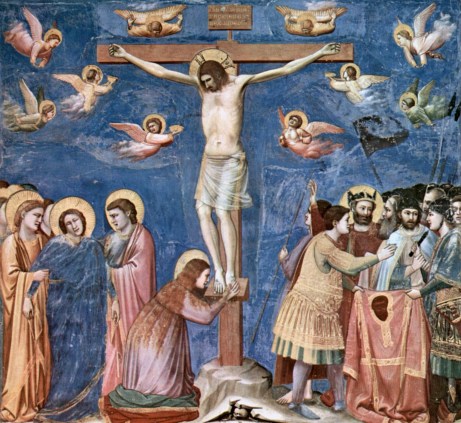
Giotto_Crucifixion

Christ Crucified
Artist: Giotto
ca. 1310

O wondrous exchange!

The One deserves salvation while the many deserve condemnation,
and yet
The One is condemned so that the many might be saved.

Christ exchanges his life for our death
so that we might exchange our death for his life.

For:
It was our infirmities he bore,
Our sufferings he endured,
Our sins for which he was crushed,
Our death that he died.

O glorious exchange!

What is an exchange?
An act of reciprocal giving and receiving.
Not merely giving, but giving and receiving.

It has been said that “a gift is not a gift until it has been given.” That is true.
But it also true that “a gift is not a gift until it has been received.”

If we give a gift to someone and they decline the gift, where does that leave us?

We have just been given an immense gift.
Will we receive it?

Christ just emptied himself and gave his life for us.
Let us receive that gift into our hearts.

And, with hearts overflowing with love and gratitude,
let us give him our love and gratitude.

Brothers and sisters, come to the cross.

Come to the place, to the intersection, where the exchange takes place.
Come to the place from which the sacraments receive their power.
Come and receive the gift.

Come to the cross.
Come to venerate the cross.
Come to behold the wood of the cross on which hung the salvation of the world.

When we come with our love and gratitude,
He receives our love and gratitude,
and gives his body once again in the Eucharist.

Christ exchanges his life for your death
so that you might exchange your death for his life.

Exchange your death for his life.

O marvelous exchange!

And it happens at the Cross.

Come Home

Homily for 4th Sunday of Lent (Laetare Sunday), Year C
March 30-31, 2019
Sacred Heart, EGF – Saturday, 5:30 PM
Holy Trinity, Tabor – Sunday, 10:00 AM

Focus:       You don’t have to earn the right to come home.
Function: Come home.


Robert Frost death of the hired man

Home…

Home is the place of our origin, our growing up.
It is our place of residence.
It is a place of comfort and familiarity.
It is the place where we feel attached.
Home is where we belong.

Recently I read Robert Frost’s poem entitled “The Death of the Hired Man”. The poem is about the homecoming of a hired farmhand named Silas who has been less than reliable and has left the farmer high and dry in the past.

I’d like to share part of the poem with you:

Mary sat musing on the lamp-flame at the table
Waiting for Warren. When she heard his step,
She ran on tip-toe down the darkened passage
To meet him in the doorway with the news
And put him on his guard.  

“Silas is back.”        

She pushed [Warren] outward with her through the door
And shut it after her.

“Be kind,” she said.

She took the market things from Warren’s arms
And set them on the porch, then drew him down
To sit beside her on the wooden steps.

“When was I ever anything but kind to him?
But I’ll not have the fellow back,” he said.
“I told him so last haying, didn’t I?
‘If he left then,’ I said, ‘that ended it.’
What good is he? Who else will harbour him
At his age for the little he can do?
What help he is there’s no depending on.
Off he goes always when I need him most…
…In haying time, when any help is scarce.
In winter he comes back to us. I’m done.”

“Sh! not so loud: he’ll hear you,” Mary said.

“I want him to: he’ll have to soon or late.”

“He’s worn out. He’s asleep beside the stove.
When [I got home] I found him here,
Huddled against the barn-door fast asleep,
A miserable sight, and frightening, too—
You needn’t smile—I didn’t recognise him—
I wasn’t looking for him—and he’s changed.
Wait till you see.”

“Warren,” she said, “he has come home to die:
You needn’t be afraid he’ll leave you this time.”

  “Home,” he mocked gently.

Yes, what else but home?
It all depends on what you mean by home. …,” [Mary said.]

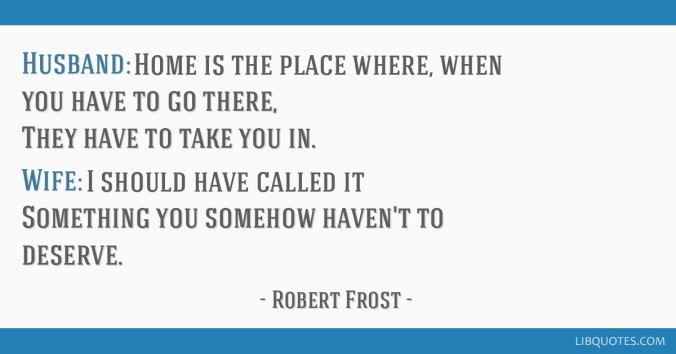
“Home is the place where, when you have to go there,
They have to take you in.”

“I should have called it
Something you somehow haven’t to deserve.”[I]


Brothers and sisters, during this Lenten season, I have had several conversations with people that have revolved around repentance, conversion, and one’s relationship with God.

In more than a few of these conversations, the dialogue has gone something like this:

“I know I need to go to confession, but I’m not ready.”
“What’s holding you back?”
“I need to fix myself before confess my sins otherwise I’ll lying and it won’t be sincere.”

In other words, I’m not yet ready to come home.

I’m not yet ready to come home, because I believe that

Home is the place where, when you have to go there,
they have to take you in.

And I don’t want that.  I don’t want pity.  I want to have my act together.  I want to earn the Father’s love.  I want to be worthy of the Father’s love.

The parable of the prodigal son overturns this logic. We may view home as the place where, when you have to go there, they have to take you in. But that is not how the Father views it.

The Father views it like Mary:
I should have called it
Something you somehow haven’t to deserve.

The Father stands on his doorstep,
watching,
waiting,
longing for his lost child to return home;
to return to where he belongs, near the Father’s heart,
to return, not with everything fixed and put nicely together,
but to return as we are,
reeking like the dung from the pigpen of our sins,
and it is there, it is then,
when we stink to high heaven,
that the Father throws his arms around us and weeps with joy that his son, his daughter, has returned.

And it is there, it is then,
when we experience the mercy and tenderness of the Father’s love for us,
that we are able to work on growing in those areas where we struggle with sin.

We work on them after we have been washed clean in the shower of his tears for us.
We work on them with his grace when we are in his grace.
We work on them together with him, not apart from him.

My brothers and sisters, we don’t fix ourselves before we come home.
No, first we come home, we are embraced,
and it is there,
it is then,
in the Father’s house,
where we work on getting our house in order,
on making things right.

Until the day we stop trying to earn the Father’s love for us,
until we are able to experience his love for us in the muck of our sins,
we will not truly appreciate what it means to be home.

Home is not the place where, when we have to go there, He has to take us in.
No, home is rather something we somehow haven’t to deserve.

Some of you may find yourselves resisting the Sacrament of Reconciliation. It has been years since you’ve been reconciled.  The Lord is calling you there, but you don’t think you’re ready.  You want to fix yourself before you return. You feel the weight of your sins.  They are crushing you.  They are killing you.

I offer to you tonight the words of St. Paul:
Be reconciled to God!

Come home!

The Father is waiting, watching and waiting with longing in his heart and with open arms to welcome home his son or daughter who is lost.

Come home.

Make the Father’s heart rejoice.

He doesn’t care what you’ve done. He just wants you home.
He doesn’t want you to earn your way home. He just wants you home.

You are enough as you are.
Come as you are.

Come home.


[i] Robert Frost, “The Death of the Hired Man”

Chaplain’s Conference – Into the Desert (Lent)

Chaplain’s Conference
Sacred Heart School – High School
Thursday, February 28, 2019
Pre-Lenten Conference


lent

Let us pray.

Clothe us, Lord God,
with the virtues of the heart of your Son,
and set us aflame with his love,
that, conformed to his image,
we may merit a share in his eternal redemption.
Through our Lord Jesus Christ, your Son,
who lives and reigns with you in the unity of the Holy Spirit,
one God, for ever and ever.  
Amen.[I]

Lent begins next week with Ash Wednesday.

In the Old Testament, we read the story of the Israelite people in slavery in Egypt.  God raised up Moses who led them out of slavery in Egypt and into the freedom of the Promised Land. But in order to get from slavery to freedom, they had to go through the desert.  They were in the desert for 40 years…hence the 40 days of Lent.

Lent is the time of the desert. But the desert is not an end in itself.  We don’t go through the desert for the sake of going through the desert.  We don’t do penance for the sake of doing penance.  No, we go through the desert in order to reach the freedom of the Promised Land.  We direct our penances toward the purpose of growing in the area where God wants us to grow.

Lent is about the conversion of our hearts. It is about becoming the saint that God calls us to be.  One of the Benedictine Values is conversion of life – we always try to become more like Christ.  It never ends.  It’s lifelong.  Sometimes we strive forward and at other times we fall back.  Lent is a time to take stock of where we are and to strive forward.

And so, I ask you:

From what do you need to be set free this Lent?

Where have you grown lazy?

Where have you allowed habits of sin to creep in?

Where have you allowed bad habits to take hold – habits that keep you from becoming the saint that God calls you to be?

Think of the 7 deadly sins.  Generally, we have one that we struggle with more than the others.

  • Pride is a puffed up view of yourself.  “I’m the ultimate authority on everything and no one is going to tell me what to do.”
  • Anger.  Do I find myself losing my temper easily or do I struggle to be patient with others?
  • Greed.  Do I always need to have the next best thing?  Am I content with what I have?
  • Envy.  Do I find myself jealous of others?
  • Sloth.  Have I grown lazy in an area of my life or in general?
  • Lust.  Have I fallen into pornography or other sexual sins?
  • Gluttony.  Am I consuming more food or drink than is healthy for me?

In the beginning, in the Garden of Eden, Adam and Eve were tempted by the serpent. They gave into the temptation.  They sinned.  Before the Fall, Adam and Eve walked in harmony with God, with each other, and they experienced harmony within themselves.

After the Fall, those 3 relationships experienced a rupture.

Sin causes a rupture in these three relationships: in our relationship with God, with others, and within ourselves. Lent provides three remedies to heal the rupture in these three relationships.  The remedies are: Prayer, Fasting, and Almsgiving.

Prayer strengthens our relationship with God. Draw near to God and he will draw near to you.

How is your prayer life?  Are you determined to keep your prayer time each day?  Or have you grown slack?  Have you stopped praying altogether?

Lent provides you the time to be renewed in your prayer life. Seize it.  How could you take a small step each day to grow?  Pick something and be consistent.  Practice it every day.

Here are some suggestions:

  • Learn a new prayer – lots of them in your planner
  • Rosary or decade of the Rosary each day
  • Pick a day of the week to spend some time sitting before the Tabernacle. Before/after school, during study hall.
  • Pray Evening Prayer or Night prayer from the Liturgy of the Hours
  • Commit to going to confession once/week during Lent
  • Set up a prayer corner in your room and use it every day

Whatever you do, focus your prayer.  Ask God to strengthen you in the area in which you are trying to grow.

Fasting heals the rupture that we experience within ourselves. The human person has an intellect, a will, and desires (head, heart, appetites).  Before the Fall, these three were in harmony.  I desired what I knew was good for me.  With the Fall, these were ruptured.  Now I want to do what I know I should not do.

Fasting is when we deny ourselves something that we want. Fasting strengthens our will.  As human beings, we have one will.  If we strengthen our will in one area, it carries over to other areas.

As an example: Do you struggle with lust or anger or laziness? Fasting from desserts will strengthen your will, which will in turn make it easier to resist temptations of lust, anger, and laziness.  By controlling your desire for food, you increase the control that you have over your desires of lust, anger, and laziness.  You strengthen your will.

What could you give up in order to grow in the area where you struggle?

  • Social media?
  • Eating between meals?
  • Desserts?
  • The snooze button?
  • A limit to your time in the shower?

This is hard.  You’ll want to give up.  Stay consistent.  Choose something small that you will be able to do but then stick to it every day.  Focus your fast.  Direct it to a purpose. “Jesus, I offer this to you. Help me to grow in…”

Almsgiving is giving something for others, especially for others in need. Almsgiving heals the rupture that sin causes in our relationship with others.  It draws us out of ourselves and helps us to focus on others.  It changes our hearts from being selfish to being generous.

How can you make a gift of yourself to others during this Lent?

  • What if you wrote a classmate’s name on every day of your calendar for Lent, and did an act of kindness for that person on their day?  Or offered a word of encouragement to that person on their day?
  • What if you wrote a kind note to someone every Wednesday and Friday during Lent, affirming a gift that they have or expressing gratitude for something that goes unnoticed?
  • Could you volunteer at the food bank, at the Northland Rescue Mission, the Women’s Pregnancy Center, or another organization sometime during Lent?
  • Could you give some money to a charity each week?
  • How could you show generosity this Lent?

Lent is a time of repentance. The word “repentance” means “to turn around” – to change our ways.

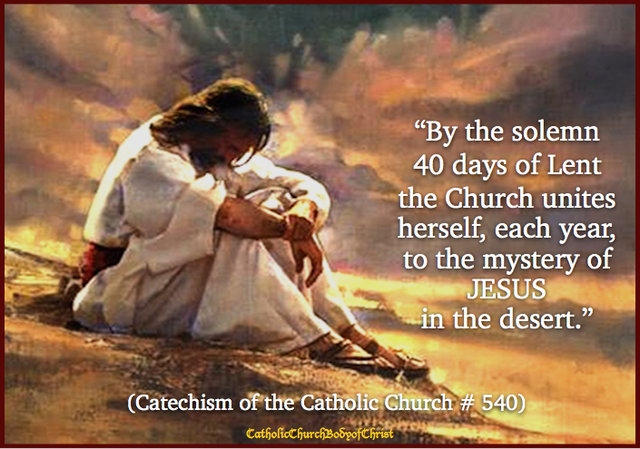
Repentance is at the heart of the Gospel. Jesus goes into the desert himself for 40 days and 40 nights, just like we are about to go into the desert of Lent.  He is tempted by Satan but he overcomes his temptations, undoing the sin of Adam and Eve.  He then comes out of the desert and begins the preaching of the Gospel with these words: Repent and believe in the Gospel. Repent – turn around, turn away from sin, change your ways, and believe in the good news.

You hold in your hands a purple form entitled “The Good Works of Lent”.  Take this home tonight and pray over it.  Ask the Lord where he desires to lead you out of slavery and into freedom.  Then commit to acts of prayer, fasting, and almsgiving with the purpose of attaining the freedom that He desires for you.  Keep this form as a reminder of what you’ve committed to.  Keep it where you can see it.

During tomorrow’s prayer period, you’ll be given another copy of this form, and you’ll be given the time to fill it out again in class.  Fill it out again and hang it up in your locker where you will see it often throughout the day.

The good news is that Jesus has redeemed us, he does not leave us in our sins, he will lead us out of them. But we have to cooperate.  He does not leave us in our sins so let’s not stay there ourselves.  Let’s repent and believe that Jesus can lead us out of the slavery of our sins, through the desert of Lent, and into a newfound freedom on Easter Sunday.

Let us pray.

Father,
As we go through this life, we often wander.  We sin.
Enflame our hearts with the desire to repent, to turn around, and to draw closer to you.
Enlighten our hearts to show us where You desire for us to grow in freedom this Lent.
Fill us with courage and firm resolve in our Lenten practices this year.
You suffered greatly out of love for us, help us to endure our Lenten penances gladly out of love for you.
Help us to become the saints that you call us to be.
We ask this through Christ, our Lord.  Amen.

The Lord be with you…


[i] Collect for the Votive Mass for the Sacred Heart of Jesus

See the Star. Follow the Star. Encounter the Lord. Give a Gift.

Homily for Epiphany (Year C)
January 6, 2019
Sacred Heart, EGF: Sat 5:30 PM; Sun 8:00 AM

Focus:              He saw the star.  He followed the star.  He encountered the Lord.
He gave a gift.

Function:        See the star.  Follow the star.  Encounter the Lord.  Give a gift.


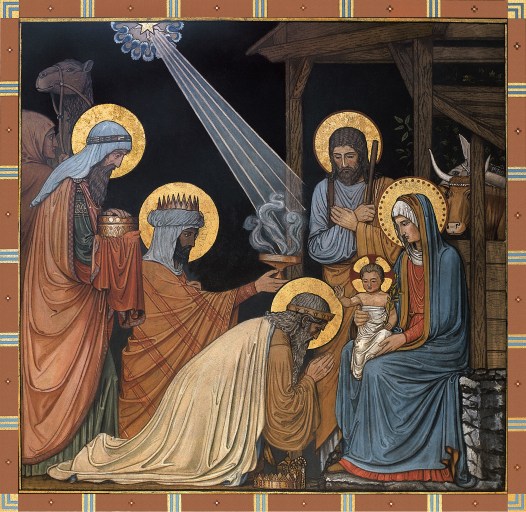
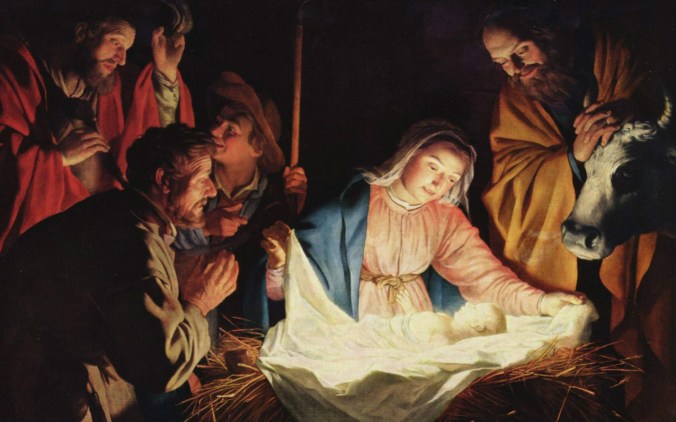
'ADORATION OF THE MAGI'

They saw the star.
They followed the star.
They encountered the Lord.
They gave gifts.

Today we celebrate the Feast of Epiphany.  Epiphany – an “Aha!” moment.  The light bulb comes on.  A revelation.  A manifestation.  I see something that I did not see before.  I see something that was hidden.  The God who is hidden is revealed.  The infant lying in a manger is revealed as the newborn King.

Tonight we remember the story of the magi following the star to the Christ child lying in the manger.

They saw the star.
They followed the star.
They encountered God.
They gave him gifts.

About 5 years ago, Sean a 26 year old husband and father of a two-year old son, a wrestling coach, was coaching a wrestling tournament in Fargo in January. A blizzard was brewing.  It was 20 degrees below zero.  The tournament ends.  He wants to get home to his family.  As he is leaving Fargo, the storm is getting bad.  Visibility is poor; he can hardly see.  He drives past a man walking along the road in the frigid temperatures.

He saw the star.

At least, he thought he saw the star. He wasn’t entirely sure that it was a man walking, but it looked like a man.  It looked like he had no hat or gloves.  “Maybe the next car will stop…but I didn’t see him until I had already driven past…it’s -20 degrees…but I really want to get home before I get stranded here…but if I don’t stop, he could die…”

Sean turned the car around.

He followed the star.

He approached the man and invited him into his vehicle. The man climbed in.  The first words out of his mouth were, “There is a God!  I have been praying that someone would stop!”

He, too, saw the star.
He, too, followed the star.

It turned out that the man was about Sean’s age. He was homeless.  He had been working at the Fargo Dome and was on his way to a soup kitchen for a meal that evening, but he was so disoriented from the cold that he was walking in the wrong direction.  In fact, he was walking out of town.  Sean turned up the heater, and they talked as the man warmed his hands.  It turned out the man had a wife and a two-year-old son – about the same age as Sean’s son.

When they reached the soup kitchen, Sean gave the man his pair of gloves.

He saw the star.
He followed the star.
He encountered the Lord.
He gave a gift.

They said their goodbyes and Sean continued on his way. The blizzard got worse.  Sean stopped at a gas station in a small town along the interstate and asked if there was a motel nearby.

There was no room at the inn.

In fact, there wasn’t even an inn.  But there was a Church – a small country church.  The gas station worker called someone in town to open it up.  Sean spent the night in the church basement by himself.

It was his stable. It was his manger.

He saw the star.
He followed the star.
He encountered the Lord.
He gave a gift.

While he waited in the basement of that Church, he was haunted by the question. “What if I had kept going?  What if I hadn’t stopped?  What would have happened to him if I had passed by?”

Brothers and sisters, the Holy Spirit invites us to encounter the Lord so many times throughout the ordinary events of everyday life. So often we get a sense that we should do something.  We see the star.  But we come up with excuses for why we shouldn’t follow the star.

“It’s cold out there.”
“I’m not sure that I really saw a man there anyway – visibility is so poor.”
“I need to get home to my family.”
“The next car will stop.”

And yet, it’s in following the star that we encounter the Lord, and in encountering the Lord, we are moved to give a gift. And when we give the gift, we find that so much more has been given to us.  We have an incredible encounter that leaves its mark on us, that changes us, that reminds us of God’s mysterious workings in the world through us and through those around us.

Sean saw the star.
Sean followed the star.
Sean gave a gift.

And he received a gift in return –
an epiphany,
an encounter with Jesus in disguise,
Jesus disguised as a brother in Christ – someone like himself in need of a savior.

He received another gift in that night that he spent alone in the church basement:
that night at the stable,
a gift that forced him to reflect on the encounter he had just experienced in order to cement it into his memory,
a great story to be shared with his family,
a story of encounter that would be made all the more memorable by his silent night at the manger.

What about the homeless man?

He, too, saw the star – he prayed to God, perhaps for the first time in years. He looked up into the stars he could not see and made known his need for a savior.

He followed the star – he climbed inside the vehicle that pulled over.

He encountered the Lord. He encountered the Lord present within Sean, the Lord whose Spirit it was that urged Sean to pull over and to help someone in need.

He received a gift – the gift of the gloves.

And I’m sure he gave a gift:
the gift of his presence to his family,
the sharing of a story of a prayer answered,
the sharing of his faith, perhaps his newfound faith, in God who hears and answers prayers.

He gave the gift of his encounter.

Brothers and sisters,
God led the magi to Jesus. He leads us too, through so many ordinary events within our lives, if we just pay attention.  See the star.  Have faith and follow the star, and then see what happens.  Go on a great adventure.  You may just encounter the Lord in an unexpected place, an unexpected place like a manger on a cold winter night that was so deep.

Let There Be Light

Homily for Christmas Eve (Year C)
December 24, 2018
4:30 PM – Holy Trinity, Tabor
10:00 PM – Sacred Heart, EGF

Readings from “Mass During the Night”


manger

In the beginning, God said “Let there be light”
The light shone
We walked in the light – in friendship with God.

We had the fire of love in our hearts – love for God and for each other.

And then something happened…The original sin – we were plunged into the darkness – we had to leave the Garden of Eden, that place of light and life…

And darkness enveloped us…
the darkness of sin that separated us from God.

The weight of sin – the yoke of sin – we took upon our shoulders – a weight so heavy that it was sure to crush us.

And, already at that time,
God had a plan…

A plan to set things right
A plan to undo what had been done
A plan to restore what had been lost
A plan which the prophets spoke of throughout the ages

God had a plan to save us.

Tonight, in a stable in Bethlehem, this plan is fulfilled.
The fullness of time has come.

Tonight, God sends forth his Son, born of a woman, born under the law, to ransom us from the law.

Tonight, the grace of God appears, saving all and training us to reject godless ways and worldly desires. The angel of the Lord appears to shepherds who are keeping watch over their flocks as the darkness of night surrounds them.

Tonight, the prophecy is fulfilled:
The people who walked in darkness have seen a great light! Upon those who dwelt in the land of gloom, a light has shown!

Brothers and sisters, behold the significance of this night.

Tonight, God speaks his word again, he speaks again that same word that he spoke in the beginning: “Let there be light!”

God recreates his wounded creation. Time is reset to the year 0 because we have a new beginning.

“Let there be light!”

Let there be light to scatter the darkness of sin!
Let there be light to lead them along the path to salvation!

Tonight is indeed a momentous occasion.

Tonight, the yoke that burdened us has been smashed!
The weight of our sin has been removed!
The rod of our taskmaster has been smashed!

Our chains have been broken, and we have escaped. The shackles of sin can hold us no longer because tonight,
A child is born for us!
A son is given us!
Upon his shoulder dominion rests!

God, in his love for each of us, gives us not only a Son but HIS OWN SON.

My brothers and sisters, if you ever doubt that God could love you, look to the manger. Look to the manger and see what He gave for you.  He gave the best gift he could give – he gave the gift of His Son.

And, in 33 years, he will exchange the wood of the crib for the wood of the cross. So great, so immense, is God’s love for you.

God, in his love for us, chooses to share in our humanity so that we can share in his divinity.

“He who clothes the whole world with its varied beauty, is wrapped up in common linen, that we might be able to receive the best robe.”[1]

“He is confined to the narrow space of a manger – He whose seat is in the Heavens, so that He might give us ample room in the Heavenly Kingdom. He who is the Bread of Angels is laid in a manger, that He might feast us with the Bread of his flesh.”[2]

How appropriate that this manger, this feeding trough, lies in Bethlehem – the town whose very name means “the House of Bread”.

Tonight, we like those shepherds, see the glory of God. We see the light shining in the darkness, and we follow the light.

We come to Bethlehem.
We come to the manger.

We come and bend the knee in adoration at a mystery so great – that God would take on our flesh to save us.

Every Sunday, we say the Creed. We make a profound bow at the words that speak of the mystery held out for us to adore tonight.  We bow at the words “and by the Holy Spirit, was incarnate of the Virgin Mary, and became man.”

Tonight, because this mystery is made present to us, we pause and genuflect at these words. As we do so tonight, I invite you to genuflect with not only your knees, but with your heart as well.  Bring your heart to its knees and point it toward the manger as you join the shepherds in bending your knee in love and in worship of the newborn King.

“No one, whether shepherd or wise man, can approach God here below except by kneeling before the manger at Bethlehem and adoring him hidden in the weakness of a newborn child.”[3]

“In the very act of reverencing the birth of our Savior, we are also celebrating our own new birth.”[4]

How can it be otherwise? How can I kneel before a mystery of love so great and remain unchanged?

May I arise tonight as a new man or new woman. May my life, like His, be a total gift of self from this night onward.


[1] St. Bede
[2] St. Bede
[3] CCC 563
[4] St. Leo the Great

The Immaculate Conception Finds Its Fulfillment in the Annunciation

Homily for Solemnity of the Immaculate Conception
Friday, December 7, 2018 (Vigil Mass)
5:30 PM – Sacred Heart, EGF

Focus:               The Immaculate Conception finds its fulfillment in the Annunciation.
Function:         Stay close to Mary so you too can say “yes!”


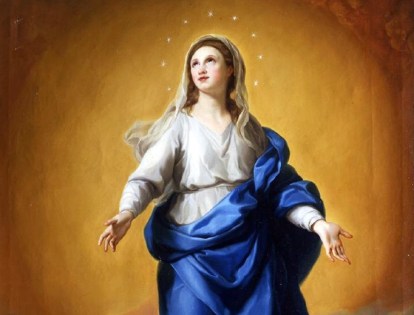
immaculate conception

Concupiscence: a disordered tendency which comes from sin and inclines us to sin. “I do what I do not want to do and I do not do what I want to do”

“Return with me to the Garden of Eden…”

Imagine! Harmony of Intellect, Will, and Desires.

A Fallen Angel appears – Satan – the serpent in the garden, whose deception led to the conception of a lie in Eve’s heart, a lie that would be passed on to all of her children, and their children, and their children, down through the centuries. A lie that the Creator could not be trusted.

Eve ate from the tree of which God had forbidden them to eat. And we fell.  We fell hard, and far.

All of creation fell. Humanity fell.

The intellect was darkened. The will was weakened.  Desires became disordered.

Human beings were enslaved to sin. Created free, they were no longer truly free as they were in the beginning.  True freedom is perfect virtue – the ability to desire and to choose the good: easily, without struggle, and promptly.

Yet, already at the very beginning, when all seems lost, God has a plan. The “proto-evangelion” – the first Gospel…

“I will put enmity between you and the woman, between your offspring and hers…

You: Satan, a Fallen Angel
Woman: an illusion to Mary
His Offspring – the fallen angels and the principalities and powers of sin, death, and Hell
Her Offspring – Jesus, the Son of God and Son of Mary, and those joined to him. Christ the Head and also we who are members of His Body.

All of this brings us to tonight’s Feast: The Solemnity of the Immaculate Conception. A New Beginning.

A New Eve who would truly become the Mother of all the Living, the Mother of those alive in Christ.

Believed through the centuries and formally declared by the Church when in danger of being challenged, the Doctrine of the Immaculate Conception was formally declared by Pope Pius IX in 1854 as an infallible dogma to be held definitively by the faithful:

The doctrine “that the Blessed Virgin Mary, from the first moment of her conception, by a singular grace and privilege of Almighty God, and in view of the merits of Jesus Christ, Savior of the human race, was preserved free from every stain of original sin.”

She was immaculate. She was immaculately conceived.

Humanity had a second chance.

Eve was free from the stain of original sin in the beginning. A fallen angel appeared to her, she allowed the trust in her Creator to die in her heart, and she sinned.  Creation fell.

Mary was free from the stain of original sin from the beginning of her existence. Like Eve, she was fully free to give her “yes” to God.  And angel appeared by her, she allowed the trust in her Creator to flourish in her heart, and she conceived Life itself in her womb…Jesus Christ, who is the Way, the Truth, and the Life…Jesus Christ, the one who would rescue us from sin and death and restore us to Eternal Life!

Tonight’s Gospel is the fulfillment of tonight’s feast!

The Immaculate Conception finds its fulfillment in the Annunciation!

Mary was conceived without sin so that she would be free to give her “yes” at the Annunciation.

St. Anselm: “He who could create all things from nothing would not remake his ruined creation without Mary.”

Mary is the new Eve.

In Mary, God is solving the problem of sin that entered the world through Eve. Mary’s “yes”, her “fiat”, gives us Christ who came to set us free!

St. Irenaeus: “The knot of Eve’s disobedience was untied by Mary’s obedience. What the Virgin Eve had bound through her disbelief, the Virgin Mary loosed by her faith.”

And so, she is truly “Full of Grace” as the Angel Gabriel declares. Grace abounds in the one who was given the grace of original innocence – an Immaculate Conception.

A spotless, clean vessel was prepared in order to be filled with the best of wine – the Blood of Christ himself.

Let us indeed “sing to the Lord a new song, for he has done marvelous deeds!”

One last thought for we who consider ourselves disciples of the Lord:

On the day of salvation, when Christ hung on the Cross, of those who were the closest disciples of Jesus, of his Twelve Apostles:
One had betrayed him.
One had denied him.
Nine had fled.

Only one remained.

John, the Beloved Disciple remained. He remained near the side of Mary at the foot of the cross.

Was it accidental that the disciple closest to Mary was the One who had the courage to stand under the cross?  I think not…

John shows us that the disciple who takes Mary by the hand is able to follow our Lord all the way to Calvary.

Let us beseech Mary that she will inflame our hearts with the same love and courage that John had on Good Friday,[1] so that, in the face of our own trials and temptations, when we like John who have not been conceived without sin feel the weight of concupiscence crushing us…we may, like John, and like Mary, give our “yes”.


[1] Tim Gray.  “Mary as the New Eve” in Chapter IV of Catholic for a Reason II: Scripture and the Mystery of the Mother of God, page 55.

Chaplain’s Conference: Keep Your Heart with All Vigilance, for from It Flow the Springs of Life (Prov 4:23)

Chaplain’s Conference
Sacred Heart High School
November 26, 2018


This past weekend I had the great privilege of baptizing my niece, Catherine Marie. It was a great day.  As I prepared for the celebration I could not help but think of her future.  “What will this child be?”  “What trials will she face in her life?”  “What joys will she experience?”

I found myself looking at her and praying that she would always know the Father’s love for her…
A love so strong that it created her out of nothing…
A love so strong that He was willing to send His only Son to die to pay the debt for the sin that she inherited from our first parents…
A love that, on Saturday, on the day of her baptism, would adopt her into his own family and fill her soul with his own divine life, a love that would truly make Catherine his daughter…

Those were my hopes for Catherine as I looked upon her on the day of her baptism. “What will this child be?”

I thought of my own coming of age and of the coming of age of my siblings and cousins…I thought of how, as we grow up, our hearts can become hardened and we can lose sight of the glory to which we are called.

I thought of all of you.

What dreams did your parents have for you on the day of your baptism?

What dreams did the Heavenly Father have for you on the day of your baptism?

The Book of Proverbs urges us with these words:

“Keep your heart with all vigilance, for from it flow the springs of life.” (Prov 4:23)

The heart is the core of a person…it is the center of who we are. If we lose our heart, we lose everything.

Jesus says, “Blessed are the pure of heart, for they shall see God.”

Ultimately, this was my wish for Catherine and it is my wish for you – that you would “Keep your heart with all vigilance, for from it flow the springs of life…”  …the Springs of Life – the Holy Spirit, God’s Holy Spirit, who calls you to become who you were created to be…a Beloved Son, a Beloved Daughter, destined to live with him for all eternity in the Heavenly Kingdom.

The past few weeks, in the readings at Mass, we have been hearing a lot about the end times. “Stay awake!  Watch!  Be vigilant!  You do not know the day or the hour when the Son of Man will come!”

The words sound as a warning. They are meant to wake us up from our complacency and they urge us to look at the way we are living our lives.  They ask us the question:

Are we keeping our hearts with all vigilance? Or have we fallen asleep?

You’ve heard me say it before and I say it again today:
the choices that you make today form the person you will be tomorrow.

Are you keeping your heart with all vigilance? Or have you fallen asleep?

What are the ways that we sleep?

We sleep when we fail to be vigilant – to be intentional – about pursing virtue and overcoming sin. When we brush it aside and say “It’s no big deal…everyone is doing it.  I don’t need to go to confession.”

We sleep when we fail to be intentional in our dating relationships…when we fail to set healthy boundaries to keep our hearts with vigilance, when we live for the moment instead of living for the future, our future in this life and also our future in the next.

We sleep when we use the Prayer Period as a time to sleep or rest instead of as an opportunity to practice the tools that we will need in the future to be men and women of prayer, men and women on fire with the love of God. We say “I’m too tired…this is boring…” and we grow slack in zeal – we grow lukewarm – we fall asleep – and we fail to keep our hearts with all vigilance.

How many of us know that we don’t pray as much as we should, and yet we fail to make the most of 15 minutes that we are given during the school day to do this?

I want to give you a challenge. It is this:  Make the most of the gift you are given here.  Invest your heart in prayer and in your relationship with God.

Invest in your relationship with God and in your relationship with your faith family. Say “yes” when your FFL asks you to read a passage for Lectio Divina.  Listen for the word or phrase that sticks out to you – share that with your small group in your faith family.  Quiet your hearts and listen for where the reading touches your life – take a step and share that with your small group instead of zoning out and saying nothing.  Keep your heart with all vigilance, don’t fall asleep.

When we pray the Examen prayer, looking over the past week to see where God was present, where we look at where we responded well or failed to respond to the opportunities that God gave us, do we actually reflect on our week? Do you keep your heart with all vigilance, or do you zone out?

When we come to Mass, do we open a book and sing? Or do we let our lips sleep?  We keep our heart with all vigilance when we allow our hearts to sing praise to God. A grateful heart is the only thing that we can give to God that he does not already have. Keep your heart with all vigilance, for from it flow the springs of life.  Keep your heart with all vigilance, and then give it to God.

On December 14th, we will celebrate our Advent Penance Service for the High School.  Confessions will be available.  The opportunity will be given to you.  Will you seize it?  Will you prepare yourself well to make a good confession, to keep your heart, once again, with all vigilance?

After I had baptized Catherine, we gathered downstairs for lunch and to open presents. My mom and dad had bought Catherine her first Rosary.  My mom asked me to bless it, which I did, asking God that when Catherine prayed this rosary that it would inspire faith and devotion in her heart.

Later, I overheard my sister say that my mom and dad had prayed the Rosary for Catherine, using those Rosary beads, as they had driven to the church that morning. They had an intention for each decade.

The first decade was for Catherine to be a happy, healthy, and holy child of God.

The second decade was for her to always know the love of her mom and dad, and that they would have a happy and holy marriage.

The third decade was for her future spouse, that he may be a virtuous, courageous and loving man who is willing to lay down his life for her.

The fourth decade was for her children, whether natural born or adopted, to bring her much joy in her life.

The fifth decade was for just enough trials in life to make her courageous and strong but not overwhelm her and that she will one day be united with God in Heaven.

I heard of this beautiful act of love of a grandma and grandpa for their granddaughter, and I thought: “What will this child be?

I heard of this beautiful act of love, and I thought of you.

What dreams did your parents have for you on the day of your baptism?

What dreams did the Heavenly Father have for you on the day of your baptism?

What dreams does he have for you, even today?

Keep your heart with all vigilance, for from it flow the springs of life.

He Will Come Again. Are you ready?

Homily for 33rd Sunday in Ordinary Time (Year B)
November 18, 2018
Holy Trinity, Tabor: 10:00 AM

Focus:               He will come again.
Function:         Wake up and be ready.


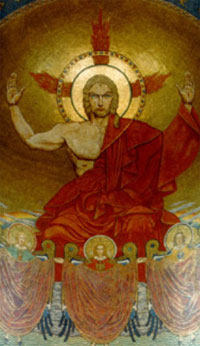
Christ the Judge

Christ in Majesty
Basilica of the National Shrine of the Immaculate Conception
Washington DC

If today was the day, would you be ready?

Everyday life can wear us down. We lose sight of the glory we are made for.

We are made in the image and likeness of God. We are made for love.

We are made for the glory of Heaven.

We are made to live forever, but we have to choose.

We choose to see the glory to which we are called and to live in a manner worthy of the call we have received, or we choose to give in to our own selfishness and stubbornness.

We choose to live for Heaven or to live for Hell.

We live for Heaven when we embrace the trials and tribulations of life, when we struggle against sin and vice, against our own hard-heartedness, when we humble our sinful pride and forsake the pleasures of today for the glory of tomorrow.

We live for Hell when we give into the temptations of sin: pride, anger, greed, lust, envy, sloth, gluttony, when we live beneath our dignity, when we live for the pleasures of this world and lose sight of the eternal.

When it is all said and done, each of us will give an account for the choices we’ve made.

That day is coming.

If today was the day, would you be ready?

Today’s readings at the end of this liturgical year call out to us like the blaring of a smoke detector in the middle of the night, a warning to wake up and see the danger in which we stand if we just stay put where we are as the fire rages around us…

We’ve seen the destruction caused by the fires in California. People were warned to evacuate.  Most heeded the warning – they saw the signs of the times.  Others ignored the warnings – they nearly lost their lives.  Some did.

If today was the day, would you be ready?

In World War II, in the concentration camp at Auschwitz, where darkness spread over the land in a time of great tribulation, ten men were chosen to be sent to a starvation bunker, among them a man named Francis Gajowniczek. He pleaded for his life.  Another man stepped out of line and offered to take his place.  His name was Maximilian Kolbe.  St. Maximilian Kolbe embraced the sufferings of today because he knew the glory to which he would be called tomorrow.  He spent his life conforming his heart to the Heart of His God, so that when Christ came riding on the clouds for him, he was ready to follow.

What about us?

Today’s readings are the alarm. Wake up.  Be prepared.  Raise your gaze from the gutter of your sins to the glory of heaven!  See the eternal glory to which you are called, and begin anew to live for it today.

Repent and believe in the Gospel.

We live in the age of mercy. God has given us this time to repent and to believe in the gospel, to live in a manner worthy of the call we have received, the call to be his Sons and Daughters in Christ.  We live in the age of mercy.  We have Christ’s Blood available to us to wash away our sins.  We have only to accept it.  We live in the age of mercy, but brothers and sisters, make no mistake, this age will come to an end, whether by our own death or by Christ’s second coming.

Repent and believe in the Gospel. Hear the alarm sounding and change your ways while there is still time.  Live today so as to be ready for tomorrow.  Accept his mercy in this hour and be reconciled to him so that when he comes in power and glory, he may take you to himself.

He wants to take you to himself. But you must be willing to go there.  More than any pleasure this life can offer, you must want to go there.

The end is coming.

Perhaps today.

Are you ready?

Are you living for that day?

Reflection: The Eucharistic Miracle of Lanciano, Italy

Sacred Heart School
Reflection for High School Students during Adoration of the Blessed Sacrament
October 8, 2018


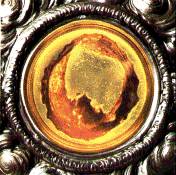
Lanciano

The Eucharistic Miracle of Lanciano, Italy

In the 700s, in the town of Lanciano, located southeast of Rome, some monks of had established a monastery under the patronage of St. Longinus, traditionally believed to be the centurion at the crucifixion who proclaimed, “Truly, this was the Son of God” (Mt 27:54) and pierced the side of our Lord with his lance (Jn 19:34).

One day, a certain monk was offering the Holy Sacrifice of the Mass. He was versed in the sciences of the world and had had been plagued by doubts about the real presence of Jesus in the Eucharist: he agonized over whether the bread and wine actually changed into the Body and Blood of our Lord at the words of consecration, and whether our Lord was truly present in the Holy Eucharist.

This time, when the monk pronounced the words of consecration, the host was miraculously changed into flesh and the wine into blood. The monk was awestruck. Weeping joyously, he regained his composure. He called the congregation around the altar and said, “O fortunate witnesses, to whom the Blessed God, to confound my unbelief, has wished to reveal Himself visible to our eyes! Come, brethren, and marvel at our God, so close to us. Behold the Flesh and Blood of our Most Beloved Christ.” Those who witnessed the miracle soon spread the news throughout the surrounding area.

Shortly after the occurrence, the Blood coagulated into five globs of different sizes, but the Flesh remained the same. The archbishop ordered an investigation. The testimony of witnesses was recorded. The Flesh and Blood appeared to be human flesh and blood. The archbishop sent a scale for the weighing of the globs: each individual glob weighed the same as the other individual ones (although different in size) or as all five together or as any other combination. Eventually, the Flesh and the globs of Blood were placed in a special reliquary, but were not sealed. Church authorities certified the miracle.

Since the first basic investigation, the Church has permitted other studies on the relics. In 1574, Msgr. Rodrigues once again weighed the five globs of Blood in the presence of witnesses and arrived at the same conclusion. Eight eight centuries had passed and no visible sign of deterioration had taken place.

The most thorough study occurred in 1970-71, less than 50 years ago. Pope Paul VI permitted a series of scientific studies on the precious relics to verify their nature. Dr. Odoardo Linoli, professor of anatomy and pathological histology, chemistry and clinical microscopy, and head physician of the hospital of Arezzo, conducted the study. He was assisted by Dr. Ruggero Bertelli, professor emeritus of human anatomy at the University of Siena. The analyses were performed in accord with scientific standards and documented, and Dr. Bertelli independently corroborated Dr. Linolis findings. In 1981, using more advanced medical technology, Dr. Linoli conducted a second histological study; he not only confirmed the findings but also gathered new information.

The major findings from this research include the following:

  • The Flesh is real Flesh. The Blood is real Blood.
  • The Flesh and the Blood belong to the human species.
  • The Flesh consists of the muscular tissue of the heart.
  • In the Flesh we see present in section: the myocardium (heart wall), the endocardium (membrane of tissue lining the cavities of the heart), the vagus nerve and also the left ventricle of the heart for the large thickness of the myocardium.
  • The Flesh is a “HEART” complete in its essential structure.
  • The Flesh and the Blood have the same blood-type: AB (Blood-type identical to that which Prof. Baima Bollone uncovered in the Holy Shroud of Turin).
  • In the Blood there were found proteins in the same normal proportions (percentage-wise) as are found in the sero-proteic make-up of the fresh normal blood.
  • In the Blood there were also found these minerals: chlorides, phosphorus, magnesium, potassium, sodium and calcium.
  • The preservation of the Flesh and of the Blood, which were left in their natural state for twelve centuries and exposed to the action of atmospheric and biological agents, remains an extraordinary phenomenon.

Professor Linoli asserted that the blood, if taken from a cadaver, would have deteriorated rapidly. Given that these samples were centuries old, free of preservatives, and never hermetically sealed in the reliquaries, they should have deteriorated. However, he underscored that the samples had the same properties as fresh human blood and flesh.

The beauty of the miracle of Lanciano reflects the words our Lord spoke, “I am the Bread of Life. He who feeds on my Flesh and drinks my Blood has life eternal and I will raise him up on the last day. For my Flesh is real food and my Blood real drink. The man who feeds on my Flesh and drinks my Blood remains in Me, and I in him” (Jn 6:35, 54-56). We must, therefore, never forget that when we participate at Mass, we witness a miracle, and through the reception of Holy Communion we share in the divine life of our Savior.

The Eucharist is the Body, Blood, Soul, and Divinity of Jesus Christ. The name of our school and parish is “Sacred Heart”.  We have placed ourselves under the patronage of the Sacred Heart of Jesus.  The Eucharist is the living, beating, Sacred Heart of Jesus…and he waits for you to come to him with the desires of your heart.


Slightly edited for brevity and reworded in order to put the text into the language of high school students, but taken almost verbatim from these sources:

https://www.catholiceducation.org/en/culture/catholic-contributions/the-miracle-of-lanciano.html

http://www.therealpresence.org/eucharst/mir/lanciano.html


Chaplain’s Conference: On Detachment, Integrity, and Identity

Chaplain’s Conference
Sacred Heart Catholic High School
October 3, 2018

integrity

Let us pray.

Clothe us, Lord God,
w
ith the virtues of the Heart of your Son
and set us aflame with his love,
t
hat, conformed to his image,
w
e may merit a share in eternal redemption.
We ask this through Christ our Lord.

Sacred Heart of Jesus, have mercy on us.
St. Benedict, pray for us.

I would like to reflect this morning on a few key principles in the spiritual life: detachment, integrity, and identity.

First, some definitions.

Detachment: to let go, to not be attached to something.

In order to follow Jesus, to live as he calls us to live, to become the men and women he calls us to be, we must become detached from those things that keep us from following him and from becoming who he calls us to be.

When I was in junior high, I hated going to the sacrament of Reconciliation. My priest at the time was Fr. Joe Richards. He was, and still is, a holy man…a good priest…someone I look up to. As we grow and mature, we start to have a greater awareness of sin than we had as younger kids. When we were younger, we confessed disobeying our parents and fighting with our brothers and sisters. As we get older, we become aware of bigger things – things that we’re too ashamed or too afraid to admit to ourselves or to say to a priest: anger, gluttony (overindulgence), lust, gossip, envy & jealousy, cheating, stealing, greed, laziness, cowardice, pride.

I had my own struggles with these things. And I was too ashamed to admit them. So, I avoided the sacrament. My parents would bring me to the Sacrament of Reconciliation periodically. I couldn’t bring myself to say them in the confessional, especially to a priest who knew me. So, I confessed the same things that I confessed as a younger child, and I purposefully left out the very thing that I knew I needed to confess.

I was too attached to my need to look like a good kid.
I was too attached to my fear of being judged or of disappointing someone.

And, in clinging to my sin instead of clinging to God’s mercy, I started to lose my integrity.

Integrity is one of the Benedictine values we’ve been highlighting this year. Integrity and integration come from the same word. Those who are new to the Sacred Heart community this year are hopefully, by now, integrating into the community. Soon, if not already, it will seem as if you’ve always been here.

The opposite of integration is disintegration: dissolving, falling apart. Integration is wholeness.

A person of integrity is a person who is integrated. They don’t act one way with one group and another way with another group. They are who they are. What you see is what you get.

Becoming a man or woman of integrity, of integration, takes a lot of work. And part of that work is to detach ourselves from whatever it is that has us acting one way in some situations and another way in other situations.

For me, I acted one way in the world, and then lied to the priest in the confessional. I was two-faced. I was not acting with integrity. Or, I would act one way in the world, and then avoid the priest in the confessional. I would show myself as a “good boy” – a boy of integrity, but I would not act that way around others.

This lack of integrity, this disintegration, finally got to me one year at a high school youth rally. There were 10 priests hearing confessions. Trembling with fear, I went to a priest that I didn’t know and finally confessed everything, and I also confessed that I had purposefully hidden things from my parish priest in previous confessions. It was a huge step forward in my spiritual life – a huge moment of growth. The priest was merciful – he made God’s mercy present to me. And I walked out truly knowing God’s love and forgiveness of me.

The Lord accepted me for who I was and not for what I had done.
I finally knew his love when I was able to detach myself from my fears and from my sin.

Grace abounded.

Brothers and sisters, we don’t practice detachment just for the sake of detachment. We don’t give up things that are sinful in order to be in pain and misery. No, we detach ourselves from things in order to attach ourselves to God and to find our true identity.

You are sons and daughters of the Heavenly Father.
You are made to be saints.
That is your identity.

Yet, how often do we attach ourselves to other things that don’t jive with this identity?

What are you attached to?

Are you attached to popularity or a need to be liked?

Are you attached to the need to have a boyfriend or girlfriend?

Are you attached to being funny, to being accepted by older students, to being smart and having perfect grades?

Are you attached to being a star on the court or on the field?

Those can be good things in themselves, but…
if you find yourself getting your self-worth from any of those things…
if you find yourself changing who you are depending on who you are with…
if you find yourself willing to compromise your true identity as a son or daughter of God in order to get those things…

then you have an unhealthy attachment, and if you cling to that unhealthy attachment, you will not be able to become the man or woman of integrity…of integration…of wholeness…that God calls you to be.

Unhealthy attachments lead to anxiety, fear, and misery. Ultimately, they make one two-faced.

Detachment leads to peace of soul, courage, and happiness. Ultimately, it makes one a person of integrity.

How do you find the strength to detach from things that keep you from your true identity?

Prayer. The primacy of prayer. Make time for silence in your day – every day. Doesn’t have to be a lot. Start with 10-15 minutes. Same time every day. Speak to God for a bit, then listen. Spend more time listening than speaking. Prayer is what God uses to help us become integrated.

Regular Confession. Don’t make my mistake. If you find yourself avoiding the Sacrament of Reconciliation because of fear or shame, I want to tell you again that you cannot say anything in the confessional that will shock me or any other priest that hears confessions here. I have heard it all. I can honestly say that I have never found myself disappointed in a person for what they have said in the confessional. Quite the opposite – I greatly admire the courage that it took for them to admit that and I feel the joy of the Lord who has seen a son or daughter return. (And, to be honest, I don’t remember what was said…)

Last month, I challenged you to consider who you want to be when you leave Sacred Heart.

Do you want to be a man or woman who failed to make use of the means present to them here to become the saint that God calls them to be?

Or do you want to become a man or woman of integrity, who had the courage to face your struggles and to overcome them, with the Lord’s help.

The choice is yours, and you make it by your willingness or unwillingness to take action in your time here.