They didn’t just cry out once. We hear: As Jesus passed by, two blind men followed him, crying out…
Then, we hear: When he entered the house, the blind men approached him…
It implies that some time passed.
So, how long did the blind men follow after him?
30 minutes? An hour? A day? Longer?
We don’t know.
But we know that they waited. They experienced a mini-Advent in the darkness of their blindness.
How long had they been waiting in that darkness?
Years.
But in those years, in that Advent, they waited.
They watched interiorly, looking with their ears and hearts for the Savior.
They lived in the darkness of that deep violet shade for years. Dark violet like that one candle lit on our Advent wreath. The light began to pierce it when they heard he was passing by. The violet turned to rose with their joy and hope that it could change. It turned back to violet when it seemed he might not answer, but they kept pleading.
And then, in an instant, their waiting was over. Their Advent ended.
Light pierced the darkness, the white light of Christmas broke in.
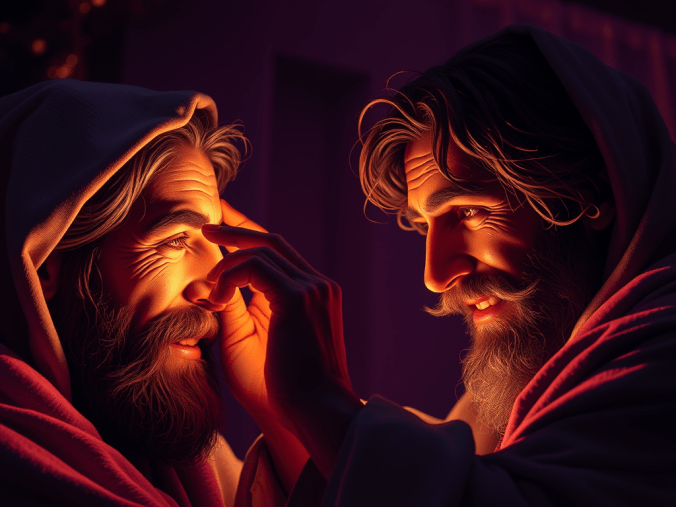
Jesus, the Light of the world, lit up their world with light, with color, the dawn of day, and they experienced a new kind of blindness. They were blinded by the glory of God.
As their sight was restored, the light of faith gave way to the glory of God.
…
Brothers and Sisters, Your Advent waiting and watching is worth it.
What do you want him to do for you?
He asks you the same question he asked those two blind men: Do you believe that I can do this?
Holy Thursday Mass of the Lord’s Supper April 17, 2025 Sacred Heart, EGF – 7:00 PM
Tonight is one of the rare days where Holy Mother Church tells the priest what he is say in his homily.
After the proclamation of the Gospel, the Priest gives a homily in which light is shed on the principal mysteries that are commemorated in this Mass, namely, the institution of the Holy Eucharist and of the priestly Order, and the commandment of the Lord concerning fraternal charity.
I have to say, I’m glad to be told what to say.
I love being a priest. It’s a beautiful vocation. I love to talk about it at vocation camps, in discernment groups, in conversations.
But I struggle to preach about it at parish Masses.
I am a priest, after-all, and so it somehow seems self-referential or self-serving, as if I am looking for a pat on the back, and that’s not the case at all.
Tonight, on the night before he will offer his life for us, Jesus gives us the gift of the Priesthood and the Eucharist, along with the command and example of fraternal charity.
These are beautiful gifts. And they are all connected.
You cannot have one without the other.
Without the priesthood, there is no Eucharist. But without the Eucharist, there is no Priesthood.
The two are ordered to each other.
And charity – love – is the reason for both of them.
Did you know that a priestly ordination must take place within the context of a Mass for it to be a valid ordination? That is the only sacrament where that is the case. I can confirm someone who is dying in a nursing home, and I can do it outside of a Mass.
But a priest must be ordained within a celebration of the Eucharist.
The priest is ordained, and then he immediately concelebrates the Eucharist with his Bishop and the other priests who are present.
This is because the priest is ordained precisely to celebrate the Eucharist. It’s the most important thing that he does.
A few years back, one of our seminarians asked me this question: “Fr. Matt, what is your vision of the priesthood.”
I thought for a second, and then said: “The priesthood exists to extend the Incarnation.”
The Incarnation: the Son of God took on human flesh in the person of Jesus. He walked among us. Divine power flowed through him.
And tonight, as his time on earth among us ends as his disciples have known it, he leaves but he also has a way to stay with us until the end of time.
He gives us his Body in the Eucharist.
And he gives us the way for the Eucharist to be with us throughout all ages, present in our own day here and in our own lives.
He gives us his apostles as the first priests to continue to make him present. But they also make him present in their person.
They act in the person of Christ when they celebrate the sacraments. Christ acts in and through them. The Holy Spirit directs the course of a priest’s ministry. Just this past week:
Leaving the hospital, almost to my vehicle. Meeting a person whose friend was dying. Going back into the hospital. Praying with her friend, who had been unresponsive, but who opened her eyes, showing that she could hear us. It brought comfort and peace for the family.
At an outing, greeting some people, medical emergency happens within one minute of my arrival. I prayed for the person with my hand on her should as she is stabilized. She later sent me a message: “Thank you for being there, your presence brought me comfort and let me know it was going to be ok.”
On Monday, after the Chrism Mass, I waited to take a phone with a group of our youth from Sacred Heart. After the picture, I went to the gathering space. One of the Pastoral Center staff came up to me and handed me the Holy Oils for St. Francis of Assisi (one of my parishes). I moved into the social hall and was visiting. Within 5 minutes a parishioner approached and said, “I need to come see you sometime this week to be anointed.” I held up the box of oils and said, “How about now?” She sent me a message: how much peace it brought her and her anxiety was removed.
Jesus’s heart burns with love for us. Jesus shows his love for us through the priesthood and the Eucharist.
“He loved his own who were in the world, and he loved them to the end.”
Love goes outside of itself and seeks to lay itself down. He will lay his life down on the cross tomorrow. But tonight, he desires to show his love for his apostles. So, he washes their feet.
He serves them.
He serves them because his heart beats with love for them. His heart beats with love for us.
The priesthood is the love of the heart of Jesus. The Eucharist is the heart of Jesus, beating with love for us.
And so he gives his very self: “This is my Body which will be given up for you.”
He asks calls some men to follow him as priests. In calling them, he asks us to make these words of institution our own: “This is my Body, which will be given up for you.”
And in giving up our bodies, in giving up our lives, we find ourselves.
That is true for all of us, but it especially true for the man who is called to the priesthood.
I cannot help but think of the Apostles tonight. Peter. Andrew. John. Thomas. Simon. Thaddeus.
Real men with real lives. They had families. James was Zebedee’s son. Andrew was Peter’s brother. Thomas was probably someone’s uncle. Thaddeaus was someone’s friend.
Philip had a life. Nathaniel had dreams.
Jesus called them. He called them.
They all, in their own say, had to say, “This is My Body, given up for you.”
…
I feel compelled to say something tonight.
The time has come for the vocations drought in this parish to end.
The Eucharist and the Priesthood are deeply connected. They cannot be separated.
A parish community centered on the Eucharist produces priests.
The Eucharist is important to all of us here, or we wouldn’t be here tonight.
But are we willing to sacrifice to spend time before the Eucharist? To partake of the Eucharist? To go above and beyond, to give that time to God, and to do so while asking him to call men from this parish to serve him as priests?
A former vocation director in our diocese once said: “How can we expect a man to sacrifice his whole life for us if we are not willing to sacrifice an hour a week praying before the Eucharist for his vocation?”
We just finished a National Eucharistic Revival. It has affected many of you sitting in this church tonight.
I believe, I really do, that we are on the cusp of a revival of the Priesthood – in the Diocese of Crookston, yes, but here at Sacred Heart in particular.
God has always been calling. The seeds of those vocations have been nourished here in recent years. They need the watering of your prayers and support.
All that’s needed is for you to step out and to offer a word of encouragement, and to offer your time in prayer praying for someone in whom you sense the Lord’s call.
You actually need to think about someone that you think would be a good priest, you need to pray for him, and then you need to look for the opportunity to personally tell him what you see in him.
They need to hear it.
God wants to call them through you. God wants to call him through you.
You are going to want someone to baptize your great grandchildren. I want someone to absolve my sins. I want someone to sanctify my suffering with the Anointing of the Sick when the Cross comes. And I want someone to commend my soul to God when the time comes for me, like Jesus, to journey from this world to the Father.
Our future priests are among us.
Some of them are behind me (altar servers). Some of them are in front of me (in the congregation). Some of them are not here.
To the young men of our parish, I say: If the Lord is calling you, do not be afraid! We would be incredibly proud to have God call you from our parish family to serve us as a priest. Our community would stand with you. Our community would support you. Wouldn’t we?
In the next 5 years, I’d like to see 5 men from our parish enter the seminary.
That is a very real possibility, if we center ourselves around the Eucharist in Charity on their behalf.
This is my Body, given up for you. Do this in remembrance of me.
Homily for 25th Sunday in Ordinary Time (Year C) September 18, 2022 Sacred Heart, EGF – Sunday 8:00 AM, 10:00 AM, 5:00 PM
Focus: There’s always a way. Function: Use your ingenuity for the Kingdom
Charlotte, North Carolina:
A lawyer purchased a box of very rare and expensive cigars, then insured them, among many other things, against fire.
Within a month, he had smoked all 24 of these great cigars, and without yet having made even his first premium payment on the policy, the lawyer filed a claim against the insurance company.
In his claim, the lawyer stated the cigars were lost… in a series of small fires.
The insurance company refused to pay, citing the obvious reason that the man had consumed the cigars in the normal fashion.
The lawyer sued… and won.
Delivering the ruling, the judge agreed with the insurance company that the claim was frivolous. The judge stated, nevertheless, that the lawyer had a policy from the company in which it had warranted that the cigars were insurable and also guaranteed that it would insure them against fire – without defining what was considered to be acceptable fire – and was obligated to pay the claim.
Rather than endure a lengthy and costly appeal process, the insurance company accepted the ruling and paid $15,000 to the lawyer for the loss of his 24 cigars lost in the fires.[1]
…
It’s disgusting, but you’ve got to admit, it’s pretty good.
He’s a rascal, but he’s a clever rascal… (The lawyer and also the steward.)
The master praises the steward not for his dishonesty, but for his prudence. If a dishonest person could have that much foresight and planning when it comes to worldly business, how much more foresight should the disciple have when it comes to heavenly business?
…
What if the lawyer used his ingenuity for the Kingdom?
Brothers and sisters, what about us?
What if we put that much effort into getting into Heaven?
What if we used our ingenuity for the Kingdom?
What if we used our money, our time, our skills to lead others to Christ to serve Christ in those in need?
What if acted shrewdly by appearing foolish in the eyes of the world because we do not ultimately care about what this world will think of us – because in the end the only thing that matters is what God thinks of us?
The gospel flips the values of the world upside down. We know this. What is given away here is stored up as treasure in Heaven.
Be prudent! Be creative! Be generous!
If a dishonest steward can find a way to use his dishonesty to get what he wants, certainly you and I can apply the Gospel to our lives and use what we’ve been entrusted with in such a way so as to receive what we will ultimately want when we are asked to give an account of the stewardship of our lives.
That dishonest lawyer used his abilities to find a way.
Brothers and sisters, So should we.
There’s much more at stake for us than a $15,000 payout. We should not be outdone so easily…
Back to the story…
As I stated, rather than endure a lengthy and costly appeal process, the insurance company accepted the ruling and paid $15,000 to the lawyer for the loss of his 24 cigars lost in the fires.
Now, for the best part…
After the lawyer cashed the check, the insurance company had him arrested … on 24 counts of arson.
Good Friday Homily April 2, 2021 Sacred Heart, EGF – 7 PM
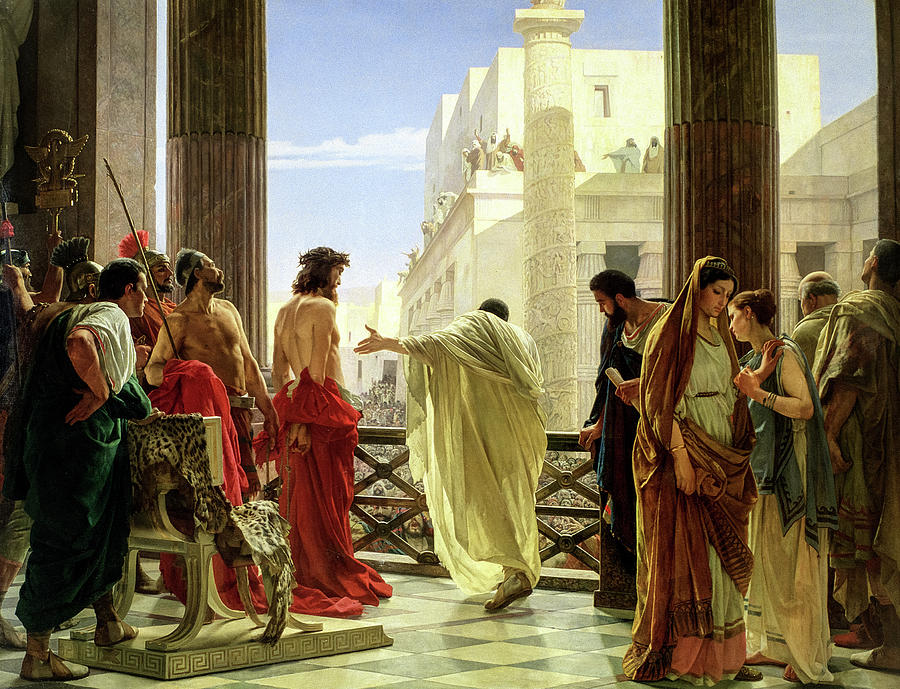
Ecce Homo “Behold the Man” by Antonio Ciseri, 1871
Do you know what day it is today? I thought I knew…until one of the altar servers asked me that question at our rehearsal this morning. He enlightened me.
It’s “Free Barabbas Day.”
His favorite part of the Passion, apparently, is when the whole congregation exuberantly exclaims: “Not this one, but Barabbas!” And so, to him, today is “Free Barabbas Day.”
Indeed. Wisdom from a high schooler. Because, for all of us, today is “Free Barabbas Day.”
After all, who is Barabbas?
You are.
I am.
Barabbas was a revolutionary…a rebel. Is not rebellion the sin of Adam and Eve? Is that not the sin that each one of us has inherited? Has committed at some point in our lives?
Barabbas was the one enslaved in a prison of his own making, of his own choices. Barabbas was one who deserved to die for what he had done. Along comes Jesus on that first Good Friday, and that Good Friday became “Free Barabbas Day.”
He was pierced for our offenses, crushed for our sins, upon him was the chastisement that makes us whole.
The guilty man goes free and the innocent man takes his place.
I wonder what Barabbas did with the rest of his life?
Homily for 22nd Sunday in Ordinary Time (Year A) August 30, 2020 Sacred Heart, EGF – 8:00 AM St. Francis, Fisher – 10:00 AM
Focus: You duped me, O Lord, and I let myself be duped. Function: Embrace the Cross
You duped me, O Lord, and I let myself be duped.
Jeremiah the prophet – a story that started out so hopeful and with so much promise.
His calling:
God speaks to him:
Before I formed you in the womb, I knew you. Before you were born, I dedicated you. A prophet to the nations, I appointed you.
Beautiful words.
Jeremiah responds:
Ah, Lord God! I do not know how to speak; I am too young!
God says:
Say not, “I am too young.” To whomever I send you, you shall go; whatever I command you, you shall speak. Do not be afraid of them, for I am with you to deliver you.
Then the LORD extended his hand and touched my mouth, saying to me, See, I place my words in your mouth!
Today I appoint you over nations and over kingdoms, to uproot and to tear down, to destroy and to demolish, to build and to plant.[1]
Beautiful.
Jeremiah is then sent to preach the coming captivity of Jerusalem. He is a prophet of doom. No one wanted to hear his message. He was rejected and branded as a traitor. He started out with so much promise, now he finds himself suffering greatly.
And so, in his anguish, he cries out to God:
You duped me, O Lord, and I let myself be duped.
Here is the couple, young and in love, infatuated with each other, as their wedding day approaches. The image of family life begins at the altar with the beautiful white dress, hair perfectly in place (the groom’s and hers…), corsages bursting with color, everyone is all smiles as they exchange their “I do’s”.
Five years later, here is that same couple. The honeymoon is over. Dirty clothes are on the bedroom floor instead of in the hamper, kids are crying, bills are unpaid. This one wet the bed, that one threw his orange juice on the floor, and the third one just gave his sister a haircut.
I just want a nap and some peace and quiet.
You duped me, O Lord, and I let myself be duped.
Here is the young man approaching his ordination day. Six years of seminary have prepared him for this moment. Soon he will be celebrating Mass, hearing confessions, anointing the sick, acting in the person of Christ to bring the sacraments to the people of God to aid them on their journey toward heaven. He’s ordained, it’s glorious, everyone wants to hug him and receive a priestly blessing.
Here is that same man 3 years later. Priesthood in the time of corona. Unable to visit the hospital to anoint the sick. Preaching the Mass of the Lord’s supper without the people of God present. An early Sunday morning is in order as it was a busy week and the homily is not ready for the 8 AM Mass. No more handshakes, it might spread the virus. He visits his nieces and nephews and family life starts to look pretty good in the time of corona.
You duped me, O Lord, and I let myself be duped.
Here is the teacher preparing her lesson plans during the first year. She is not much older than her students. They think she’s cool. They look up to her. She is making a difference in their lives.
Here is that same teacher 7 years later. Teaching to a computer screen in March, wearing a mask in front of her classroom in September. She’s no longer that cool.
You duped me, O Lord, and I let myself be duped.
Here is the parishioner praying to be open to God’s will…drawn to a neighbor they don’t get along with or don’t know all that well. There’s a whisper in the heart:
“Do an act of kindness. Stop and visit with them.”
“Really, Lord, are you sure?”
They are convicted. Fire in the chest, a nagging thought that won’t go away.
They do it.
The neighbor goes on and on, complaining about the world in which we live. On the other side of the political divide. The parishioner can’t get away.
Or the neighbor gives them a quizzical look when they stop to visit because the parishioner has never done this before. The conversation is awkward and the parishioner leaves wondering why they even bothered.
You duped me, O Lord, and I let myself be duped.
…
A heresy of our time: “the prosperity Gospel.”
“Become a disciple and you’ll be happy.” It’s a half-truth. You’ll be happy, yes, but that happiness comes at a cost. The cost, the price, is the cross.
Christianity has the cross at its center. A crossless Christianity is no Christianity at all.
The Gospel – the Good news – is that Christ suffered for us so that we could be redeemed and forgiven of our sins.
The Gospel – the Good news – is NOT that there will be no suffering. It is that Christ suffers WITH US and FOR US.
The Gospel – the Good news – is that the Suffering of the Cross leads to the Glory of the Resurrection.
The suffering is not the end. It is part of the path.
Jesus says, “Take up your cross and follow me.” St. Paul says, “Offer your bodies as a living sacrifice.”
Lose yourselves to gain eternity. Lose yourselves for the sake of love.
It is through the Cross that grace rushes in.
The blood of Christ that bought our redemption flows from wounded, suffering hands and feet and a pierced heart.
Throw out the cross and we throw out the means of our salvation.
Peter – denies the cross today. Denies it 3 times during the Passion. He will be filled with the Holy Spirit on Pentecost, and will be given the grace and strength needed for him to embrace his cross in Nero’s Circus in Rome, when he is crucified upside down for his witness to Christ.
Brothers and sisters, you too have the Holy Spirit. You also have your cross. Pray for the strength to carry it.
Maybe it’s not not what you expected. It’s probably not what you’d have chosen.
But it is your call. And there’s grace in it. There’s goodness in it. There’s beauty and life in it. There’s pain and suffering in it, yes, but there is also surrender and sanctification.
You duped me, O Lord, and praise God, I let myself be duped.
Homily for the Solemnity of the Most Sacred Heart of Jesus June 19, 2020 Sacred Heart, EGF – 8:00 AM
Focus: The Sacred Heart of Jesus bleeds, binds, burns, blazes, and beats. Function: So must ours.
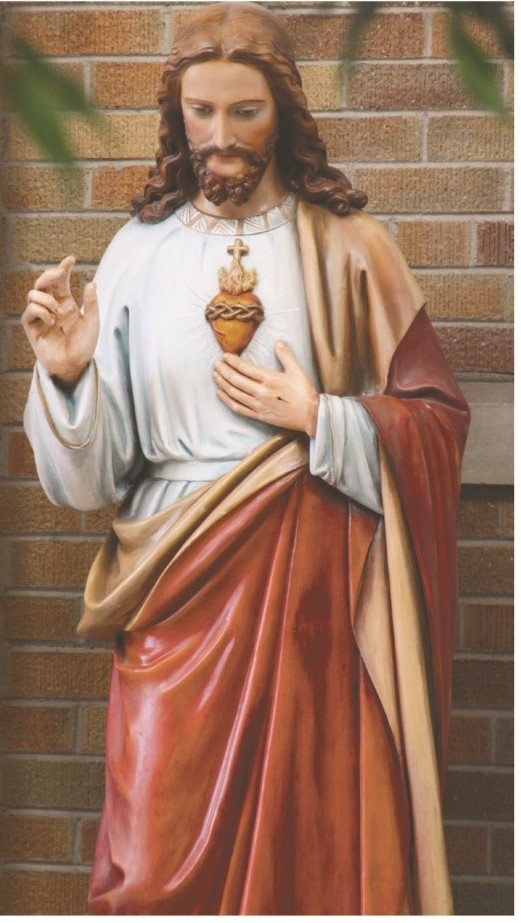
Statue of the Sacred Heart of Jesus Sacred Heart Catholic Church East Grand Forks, MN
The Lord has set his heart on you, on us.
He has set his heart.
We hear way back in the book of Deuteronomy, Moses telling the people: “The Lord has set his heart on you.”
We celebrate today the feast of that heart, the Feast of the Sacred Heart of Jesus.
The image of the Sacred Heart, of course, we know well. And I think the image itself tells us a lot about God’s love for us.
I think, in particular, there are five things that we see in that image.
The heart bleeds, because it was pierced.
The heart binds, and it is bound, by the crown of thorns.
The heart burns: the cross and fire that are on top of the heart.
The heart blazes: the rays of light that shine forth from it.
And it beats: it is alive. It beats with a living heartbeat because Christ is alive.
So, each those in their turn:
First, it is a heart that bleeds,
a heart that bleeds because it offered itself in sacrifice,
a heart that was willing to be pierced for us,
that desired to be pierced for us,
in order to save us.
It is a heart that suffers, and suffers gladly, for love of us. It is the heart of the Good Shepherd who laid down his life for his sheep.
Pierced and bleeding,
a blood of bleach flows forth which washes away every stain of sin.
The heart bleeds because it is open,
open for you and open for me,
a fountain of life from which we drink,
the wellspring of the Church’s sacraments,
the very stream, the blood that flows from that Sacred Heart is what gives power to the sacraments.
It is a heart that bleeds.
Secondly, it is a heart that binds.
The crown of thorns around the heart is like a wedding band around the finger of Christ’s Heart, uniting his heart to our heart, Bridegroom united to his Bride.
It is a heart that binds in a Holy Communion by offering his Body, Blood, Soul, and Divinity to us. And in receiving that Communion, we are, in turn, bound to him. And in being bound to him, we are set free: set free from our sins, set free to truly live and to love as he calls us to love. Every morning, when we pray morning prayer, we are reminded that “God has come to his people and set them free.”
A love that binds with a bond of love so tight that it can never be broken.
Thirdly, it is a heart that burns.
The flame on top of that heart, with the cross above that flame, providing the wood for the sacrifice. A heart that is consumed with love for us. A heart that burns within him, that pines, that yearns, that longs and aches for us. A stirring, a burning in the Heart of Christ. He says: “I have come to cast a fire upon the earth, and how I long to see the flames leap up!”
It’s a love that burns,
that purifies,
that burns away the selfishness of every sin.
And for hearts that cannot or will not open themselves to receive that love,
the burning of that love can be experienced as the fires of Hell,
a rejection of Christ’s love.
But his love is meant to be a love that moves us to repentance and stirs us to love of God and neighbor, a love that draws us to himself.
It is a heart that burns.
Fourthly, it is a love that blazes.
The rays of light that blaze forth from the heart light the way for us.
This love is attractive. Just like the light of a bonfire draws everyone in toward the fire and toward one another, so the love of Christ draws everyone to his Sacred Heart. The brightness of his mercy shines forth. He leads us to himself with the love of his heart, the love of the Good Shepherd. And in his light, we see light.
And, brothers and sisters, when we can be filled with the love of the Sacred Heart of Jesus, they see it within us, and we glow, we radiate, we shine, and we help others to see.
It is a love that radiates.
It is a love that blazes.
Finally, it is a heart that beats.
It is a love that is alive. With you is the source of life. Dead in sin, we were brought to life by the love of his Sacred Heart.
So, the love of the Sacred Heart:
It bleeds to justify us.
It binds to unify us.
It burns to purify us.
It blazes to glorify us.
It beats to enliven us.
Can these qualities be said of our hearts?
Can these qualities be said of the love in our hearts?
Do they bleed?
Do they bind?
Do they burn?
Do they blaze?
Do they beat?
Jesus, meek and humble of heart, make our hearts like unto yours.
Homily for Divine Mercy Sunday (Year A) April 19, 2020 Sacred Heart, EGF – Sunday, 9:30 AM (Livestream due to COVID-19)
Focus: Mercy came for Thomas; Mercy comes for you. Function: Come back to the upper room.
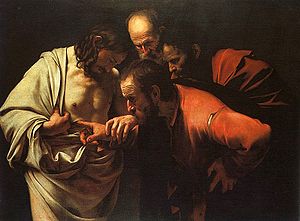
Caravaggio, The Incredulity of St. Thomas
Where did he go?
Perhaps he needed some air…
Perhaps he couldn’t continue to keep cooped up in that room for another minute…
Perhaps the disciples needed some groceries and he was the man…
Where did he go?
Perhaps he went to the tomb. The Master had said he was going to prepare a place for him. He had said that “where I am going, you know the way.”
Where did he go?
We don’t know. We don’t know where Thomas went.
What we do know is that he was suffering. He was in pain.
His heart had been wounded.
He had placed all his hope in Christ, and Christ had died. With Christ’s death, Thomas’s heart and hope died as well.
He felt an unrest.
He couldn’t take it anymore.
So he left.
Where was he?
We don’t know.
All we know is that He wasn’t there.
He wasn’t there on the first day.
He wasn’t there when the risen Jesus stood in their midst.
He wasn’t there when Jesus cast out their fear.
He wasn’t there when the peace of Christ, the peace that surpasses all understanding, descended upon the disciples, healing their broken hearts.
He wasn’t there when the Jesus breathed the Holy Spirit onto the disciples.
He wasn’t there. Then he came back.
The others had seen. He had not. He had missed out. And so his heart hardened.
“Until I see for myself, until I place my finger in the nail marks of his hands and feet, until I place my hand in his wounded side, I will not believe!”
…
Where had he gone?
Jesus.
He knew everything.
He knew that Thomas was suffering.
He knew Thomas wasn’t there.
He also knew that Thomas would be coming back.
Couldn’t he have waited?
Where had he gone?
Jesus.
We don’t know.
What we do know is that He came back.
Jesus came back.
He came back for Thomas.
And, brothers and sisters, he comes back for you.
…
Today we celebrate Divine Mercy Sunday.
What is mercy? It is love’s second name (St. John Paul II).
God is love.
Mercy is love in the presence of suffering.
The word “mercy” comes from the Latin word “misericordia”, which means “a pitied heart”.
Mercy is love coming to stand in the presence of someone who is suffering, and by that presence, alleviating the suffering, taking the suffering upon itself.
God is love.
God is rich in mercy.
God’s greatest mercy was to send his Son to undergo his suffering, death, and resurrection so that we who were dead in our sins could be raised to new life.
God’s mercy came for Thomas.
Mercy came today – on the Eighth Day.
Thomas had come back. So, Jesus came back.
Thomas had a second chance.
He was shown mercy.
He encountered the risen Jesus.
Thomas himself rose. He was resurrected.
He experienced a resurrection of his faith and his hope. He was stronger than ever. He, like the others, was now a witness.
My Lord and My God!
…
Brothers and sisters, perhaps you are like Thomas.
Perhaps your hope has been shattered.
Perhaps you are filled with fear and doubt.
Perhaps you can’t bring yourself to believe that the God who is Love is Alive.
Perhaps you are locked in the upper room of your sins,
quarantined in an isolated prison of your own making,
afraid to come out because of what it will mean…
Jesus came back for Thomas.
And Jesus comes back for you.
Today is the Eighth day.
Today was Thomas’s day.
Today is your day.
Thomas wasn’t beyond the reach of God’s mercy. He just needed to return to the upper room where the community was gathered so that he could experience it.
You are not beyond the reach of God’s mercy.
You just need to return to the place where mercy is found.
Receive the Holy Spirit. Whose sins you forgive are forgiven them. Whose sins you retain are retained.
I am speaking, of course, of “the upper room” of the confessional.
Today is Divine Mercy Sunday. Special graces flow out of the wounds of Christ. These graces allow him to enter the locked room of your heart and to bring with him the peace that you long for. Ask him for the grace to return. Ask him for the courage and grace to make a good confession if it’s been a long time.
Say, “Jesus I believe, help my unbelief!”
Say, “Jesus, I trust in you!”
Do that today, and very soon, you will be exclaiming with Thomas:
“My Lord and My God!”
Homily for Third Sunday of Advent (Year A) – Gaudete Sunday December 15, 2017 Sacred Heart, EGF – 10:00 AM
Focus: The darkest hour is just before the dawn. Function: Rejoice in hope.
A young man, weighted down by the guilt of his sin,
feels worthless, powerless, and hopeless.
He’s tried to rise and overcome his sins by his own power for so long.
He continues to fall and to fail.
He is losing hope.
The darkness is great.
It’s Easter night. He’s visiting with his family. A Christian movie plays in the background, one of those movies that always plays on Easter night. The acting is cheesy. He pretends not to watch.
One line stands out to him: “All you have to do is turn to Christ…”
He thinks, “Yeah, if only it were that easy…”
A voice in his heart speaks: “Why can’t it be that easy?”
The light begins to pierce the darkness.
He begins to pray for the grace and courage to make a good confession.
Two weeks later, he enters the confessional. “Bless me, Father, for I have sinned. It’s been four years since my last confession. These are my sins…”
The priest listens while the young man speaks. The young man finishes, quite embarrassed at what he’s done. He braces himself for what the priest will say…
The priest smiles, slaps his knee, and says, “Welcome back! Don’t wait so long next time!”
Absolution is granted. He feels the chains fall. He’s free. His heart is set ablaze. Life is breathed into his soul which had been dead in sin. He leaps for joy. God is real. His spirit rejoices in God his Savior.
…
An elderly woman sits alone at her kitchen table, wrapped in a blanket. She can’t sleep. It’s been six months since her husband died. Cancer. Her heart is heavy. It’s been heavy for a long time.
The pain of watching him suffer…
The helplessness of not being able to do anything to take away the pain.
She’s scared. She doesn’t know what to do. He was her heart. He did everything…paid the bills, fixed things around the house, plowed the driveway.
The driveway…
She sighs as she looks out the window. It’s early. The light from the moon glistens off the freshly fallen snow. The driveway is filled in. She needs groceries but it looks like she won’t be going to the store today…
She was helpless to do anything for him in his sickness and now she feels helpless to do anything for herself.
The darkness is great.
She prays, “O God, how can I go on?”
Then, a noise. The rumbling of a motor.
Snow bursts forth from the ground into the air.
Her neighbor,
a young man with his own family to care for,
with his own driveway to plow out,
with his own job to get to,
walks down her driveway pushing his snowblower as the first streaks of dawn break on the horizon…a glimmer of hope on a cold winter day.
…
Brothers and sisters, today we celebrate Gaudete Sunday – “rejoice Sunday”.
In the darkest and coldest part of the year,
when the days are nearing their shortest,
the Church bids us to rejoice.
We rejoice because the Lord is near.
Ten days until Christmas.
Ten days until the Lord comes with power to save his people.
John the Baptist languishes in the darkness of his prison cell and though he cannot see the works of Christ, he hears about them:
The blind see. The deaf hear. The lame leap. The dead rise. The poor have the good news preached to them.
Though we languish in the darkness of our hearts, we rejoice because of what Christ is doing…
A young man who has been blinded and paralyzed by his sin finally begins to see and is set free in the Sacrament of Reconciliation…
He had been deaf to the cries of those around him, cries like the widow next door, but now he hears. Now he hears, even in the early morning hours, and he moves, he rises, and sets to work setting her free.
And the good news is preached to her. God is near. God loves her. He has not forgotten about her. He comes to her in the form of a young man whose heart has been set free, free to love with the love of Christ.
Brothers and sisters,
when you are tired,
when the outlook is bleak and you are tempted to give up,
when all hope seems lost and when the darkness is too great…
when you feel like you can’t take another step…
Wait. Wait just a little longer.
Watch. Watch with your eyes peeled for the coming of the Lord.
Remember. Remember that Jesus comes in the darkness of night.
It was in the fourth watch of the night,
between the hours of three and six AM,
when the disciples were losing hope in the storm.
It was then that Jesus came to them walking on the water.
In the darkest hour of the night, the Light of the world appeared out of nowhere, climbed into their boat, and calmed the sea.
Jesus comes in the darkness of night.
When it is the darkest,
it is then that The dawn from on high shall break upon us to shine on those who dwell in darkness and the shadow of death, and to guide our feet into the way of peace.[i]
It is today, on Gaudete Sunday,
when the white light of Christmas
pierces the dark violet of Advent,
transforming it into the shade of rose,
the color of a flower which brings the promise of summer,
a reminder that it is in the darkness of night
when the first streaks of dawn appear and the Morning Star rises in our hearts.[ii]
It was in the dark of night when a star, a single star,
could be seen in the distance,
shining over a simple stable in the hill country of an obscure town called Bethlehem…
It was in the dark of night when Christ was born.
Gaudete.
Rejoice, for even now, Joseph and Mary are making their way to Bethlehem for the census.
It may be dark, but the darkest hour is just before the dawn.
Homily for 18th Sunday in Ordinary Time (Year C) August 3-4, 2019 St. Lawrence, Mentor – Sat 7:30 PM; Sun 10:30 AM St. Joseph, Fertile – Sun 8:30 AM Sacred Heart, EGF – Sun 5:30 PM
Focus: So many things don’t matter to God Function: Seek what matters to God
DL Moody (1800’s preacher): Our greatest fear should not be of failure, but of succeeding at things in life that don’t really matter.
So many things don’t matter to God
Your hair color
The car you drive
Sports results
The plot of the latest TV show
The latest drama on social media
Your job title
Vanity – having my ego stoked
Money, possessions
So many things don’t matter to God
Some things matter greatly to God:
Relationships
Quantity time
Virtue: the disposition to love and to live in right relationship with others. Humility, Patience, Generosity, Gratitude, Diligence, Discipline, Temperance, Chastity.
Learning to love – learning to make a gift of yourself to others
Loving God and Loving others: union with God and union with others. PURPOSE – THIS IS WHY YOU EXIST. God made us for him.
Prayer, which fosters and strengthens your relationship with God
Repentance: “turn away from sin and believe in the Gospel”
Eternity – our eternal salvation
So many things don’t matter to God.
Some things matter greatly to God.
Holiness: transforming our desires so that “what matters to me is what matters to God.”
To advance along the path of holiness is to stop chasing what matters to me and to start chasing what matters to God.
In your own life, how do you know what matters to God?
The gospel gives us a clue.
The gospel puts it into perspective.
The man in the gospel chased things that did not matter to God. He had been given all of these riches, all of these good things. Instead of emptying his barns and making a gift of what he had to others, he stored them up for himself so that he could rest on his laurels.
And that very night his life was demanded of him.
How do you know what matters to God?
Here’s the test:
If your life was demanded of you tonight, what will you wish you would have done?
…
Recently I listened to a talk where the speaker likened how old you are to the time of day.
If you are 15 years old, it’s 10:25 AM.
If you are 20 years old, it’s 11:34 AM.
If you are 25 years old, it’s 12:42 PM – just after lunch.
If you are 35 years old, it’s 3:00 PM.
If you are 45 years old, it’s 5:15 PM.
If you are 50 years old, it’s 6:25 PM.
If you are 70 years old, it’s 11:00 PM.
It puts it in perspective, doesn’t it? I thought I had more time…
Are you chasing what matters to God? Or are you chasing what matters to you? When you get to the end of your life, you will wish you had chased what mattered to God, because what matters to God is what will ultimately matter to us in the end.
Cardinal Francis George: The only things you take with you in the life to come are the things you’ve given away on earth.
Bishop Robert Barron: You’ll have in the heavenly realm nothing other than the love you’ve cultivated here below.
The man in the gospel would not give his life away, so his life was demanded of him.
John Paul II: Man will not fully find himself until he learns to make a sincere gift of himself.
Jesus: He who loses his life for my sake will find it.
We are meant to give our lives away.
My work in the Office of Vocations with the Diocese of Crookston: walking with guys discerning a vocation to the priesthood. It’s so often the same. “I think this is what God wants. It’s not what I want”
To the infinite call of God, man must add his finite yes.
God empties himself in the call to the man, man must empty himself so that he can receive that call.
The man being called to the priesthood must learn to want for himself what God wants for him.
The man must die to himself, must empty himself, in order to be filled with what God desires to give.
It’s a painful thing to give up what you want, but once you do, you find that really you wanted what God wanted for you all along.
State of things in the Diocese. It takes 6-8 years to journey through seminary. 15 of our 35 active priests eligible to retire in that time. We have 4 men in seminary. God will provide. This is not a cause for despair, but it is a cause to ask ourselves if we are doing our part, if we are doing all that we can.
God is still calling, but the men he is calling may not want what God wants. To get to that point – they need your help.
They need you to empty yourself of your riches so that they can discover what God wants for them, and ultimately, what we want for them – to realize their vocations as priests.
Will you give of the riches of your encouragement, speaking that word that you’d rather hold in because you don’t know how it will be received?
Will you pour out the gift of your prayers and the sacrifice of your time? In the words of your pastor: “How can we expect a man to give his whole life in service to God’s people when we will not give an hour a week before the Blessed Sacrament praying for his vocation?”
Brothers and sisters, The goal of life is not to fill your barn. The goal of life is to empty your barn, to empty it so that you have room to receive what God wishes to give you: life to the full on this earth and eternal life in the Kingdom of Heaven.
Let me say it again.
What matters to God is not that you fill your barn.
What matters to God is that you empty your barn so that he can fill it with what he wants to give you.
What ultimately matters to God? You. He emptied himself for you.
What does he want to give you?
His very self (Crucifix)
What does he want to give you?
His very self (Eucharist/altar)
He emptied himself for you.
Will you empty yourself for him?
Homily for Epiphany (Year C) January 6, 2019 Sacred Heart, EGF: Sat 5:30 PM; Sun 8:00 AM
Focus: He saw the star. He followed the star. He encountered the Lord.
He gave a gift. Function: See the star. Follow the star. Encounter the Lord. Give a gift.
They saw the star.
They followed the star.
They encountered the Lord.
They gave gifts.
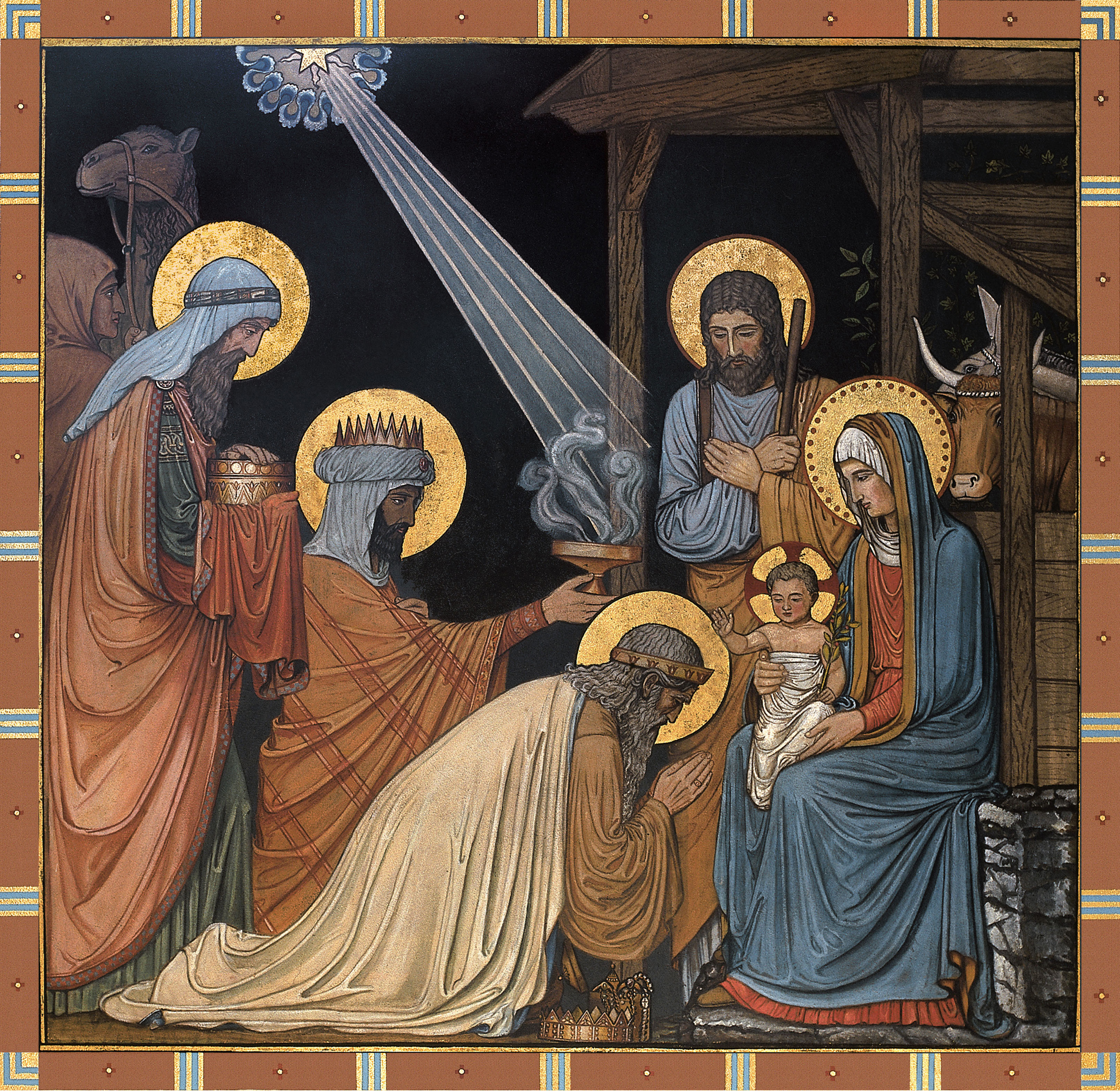
Today we celebrate the Feast of Epiphany. Epiphany – an “Aha!” moment. The light bulb comes on. A revelation. A manifestation. I see something that I did not see before. I see something that was hidden. The God who is hidden is revealed. The infant lying in a manger is revealed as the newborn King.
Tonight we remember the story of the magi following the star to the Christ child lying in the manger.
They saw the star.
They followed the star.
They encountered God.
They gave him gifts.
…
About 5 years ago, Sean a 26 year old husband and father of a two-year old son, a wrestling coach, was coaching a wrestling tournament in Fargo in January. A blizzard was brewing. It was 20 degrees below zero. The tournament ends. He wants to get home to his family. As he is leaving Fargo, the storm is getting bad. Visibility is poor; he can hardly see. He drives past a man walking along the road in the frigid temperatures.
He saw the star.
At least, he thought he saw the star. He wasn’t entirely sure that it was a man walking, but it looked like a man. It looked like he had no hat or gloves. “Maybe the next car will stop…but I didn’t see him until I had already driven past…it’s -20 degrees…but I really want to get home before I get stranded here…but if I don’t stop, he could die…”
Sean turned the car around.
He followed the star.
He approached the man and invited him into his vehicle. The man climbed in. The first words out of his mouth were, “There is a God! I have been praying that someone would stop!”
He, too, saw the star.
He, too, followed the star.
It turned out that the man was about Sean’s age. He was homeless. He had been working at the Fargo Dome and was on his way to a soup kitchen for a meal that evening, but he was so disoriented from the cold that he was walking in the wrong direction. In fact, he was walking out of town. Sean turned up the heater, and they talked as the man warmed his hands. It turned out the man had a wife and a two-year-old son – about the same age as Sean’s son.
When they reached the soup kitchen, Sean gave the man his pair of gloves.
He saw the star.
He followed the star.
He encountered the Lord.
He gave a gift.
They said their goodbyes and Sean continued on his way. The blizzard got worse. Sean stopped at a gas station in a small town along the interstate and asked if there was a motel nearby.
There was no room at the inn.
In fact, there wasn’t even an inn. But there was a Church – a small country church. The gas station worker called someone in town to open it up. Sean spent the night in the church basement by himself.
It was his stable. It was his manger.
He saw the star.
He followed the star.
He encountered the Lord.
He gave a gift.
While he waited in the basement of that Church, he was haunted by the question. “What if I had kept going? What if I hadn’t stopped? What would have happened to him if I had passed by?”
…
Brothers and sisters, the Holy Spirit invites us to encounter the Lord so many times throughout the ordinary events of everyday life. So often we get a sense that we should do something. We see the star. But we come up with excuses for why we shouldn’t follow the star.
“It’s cold out there.”
“I’m not sure that I really saw a man there anyway – visibility is so poor.”
“I need to get home to my family.”
“The next car will stop.”
And yet, it’s in following the star that we encounter the Lord, and in encountering the Lord, we are moved to give a gift. And when we give the gift, we find that so much more has been given to us. We have an incredible encounter that leaves its mark on us, that changes us, that reminds us of God’s mysterious workings in the world through us and through those around us.
Sean saw the star.
Sean followed the star.
Sean gave a gift.
And he received a gift in return –
an epiphany,
an encounter with Jesus in disguise,
Jesus disguised as a brother in Christ – someone like himself in need of a savior.
He received another gift in that night that he spent alone in the church basement:
that night at the stable,
a gift that forced him to reflect on the encounter he had just experienced in order to cement it into his memory,
a great story to be shared with his family,
a story of encounter that would be made all the more memorable by his silent night at the manger.
What about the homeless man?
He, too, saw the star – he prayed to God, perhaps for the first time in years. He looked up into the stars he could not see and made known his need for a savior.
He followed the star – he climbed inside the vehicle that pulled over.
He encountered the Lord. He encountered the Lord present within Sean, the Lord whose Spirit it was that urged Sean to pull over and to help someone in need.
He received a gift – the gift of the gloves.
And I’m sure he gave a gift:
the gift of his presence to his family,
the sharing of a story of a prayer answered,
the sharing of his faith, perhaps his newfound faith, in God who hears and answers prayers.
He gave the gift of his encounter.
Brothers and sisters,
God led the magi to Jesus. He leads us too, through so many ordinary events within our lives, if we just pay attention. See the star. Have faith and follow the star, and then see what happens. Go on a great adventure. You may just encounter the Lord in an unexpected place, an unexpected place like a manger on a cold winter night that was so deep.

 Piercing the Heart